
Day 1: I planned to visit Campbeltown, Islay and Tiree, before heading into Glenforsa for an over-night. I needed to call into Perth en-route, to fuel up, before heading to the west coast, but there was some low cloud there in the morning, not due to clear until around 10:00. I waited until 09:20 before I set off, knowing that the cloud base was improving all the time. Another resident pilot was heading off to East Fortune from Whiterashes that morning and the sight of JT and the Jodel lined up on a freshly cut grass strip helped set the mood for the day. The strip had even dried out nicely with the week of great weather that we’d had previously and was in good condition for a change!
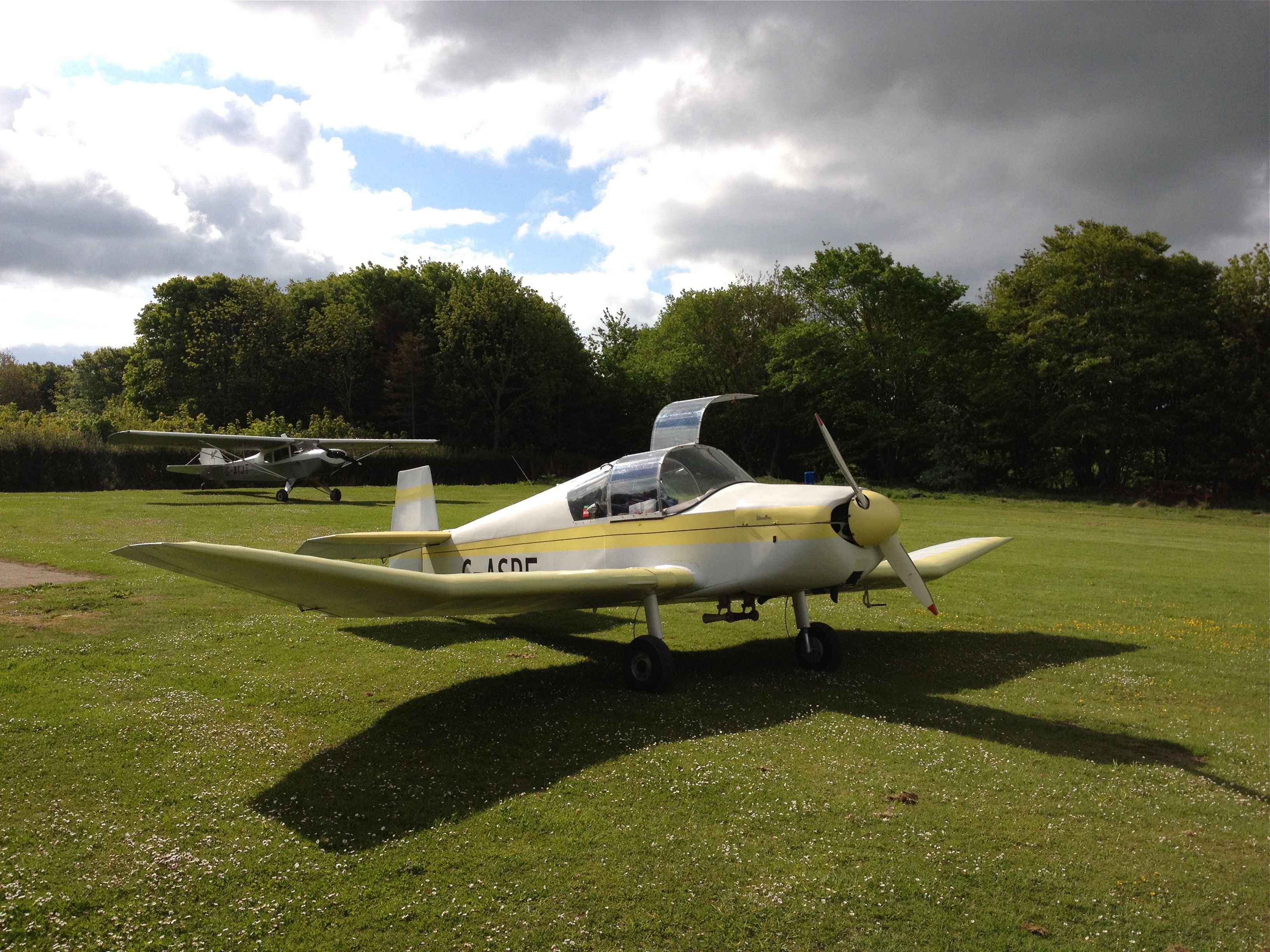
The flight down to Perth was un-eventful and the cloud base allowed me a comfortable 2,000ft cruise, with only some light drizzle and a little lower cloud to contend with at Forfar. The cloud base had lifted to well above 2,000 ft by the time I got to Perth and I landed there at 10:20 to take on fuel.
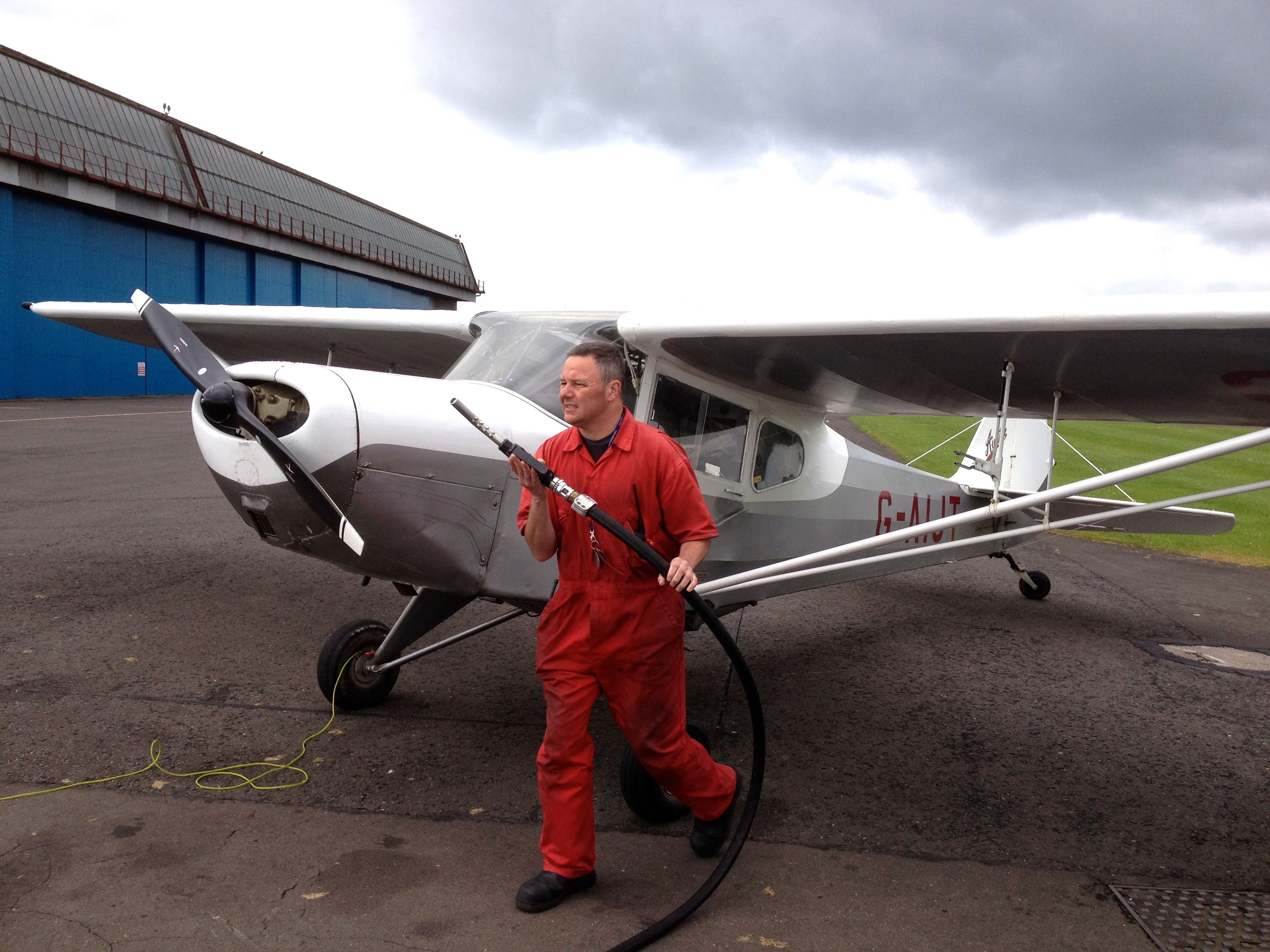
After a chat with one of the other members of the SAC , who I’m working with to set up an Aviation Charity ( more as that develops ), I grabbed a coffee and a soggy bacon butty, which I couldn’t stomach and got on the phone to Campbeltown. They told me they had runway works in progress until 15:00! ( No – I didn’t check the Notams for Campbeltown 🙂 ) and Tiree, I now noticed, was closing at 15:00, too! First amendment to the plan, then! I decided to just set off for Islay and take it from there – maybe I could squeeze Tiree in if the winds were good at Glenforsa; otherwise I’d need to get to Oban before that closed at 17:15.
I got away again by 12:15 and the flight down to Islay was gorgeous – the light winds made for lovely, smooth conditions and the route took me down past Loch Lomond with its many islands and Ben Lomond, itself, standing tall at the western end of the loch. The radio was busy here and after contacting Glasgow approach to inform them of my routing around the north of their zone, was transferred over to Scottish Information, who provided a great service all the way down to Islay. After routing round the Glasgow zone I flew across Bute to the northern tip of Jura, crossing Loch Fyne at the narrowest point, before routing south for Islay. The scenery just got better as I progressed westward, with Loch Fyne and Jura providing some wonderful vistas.
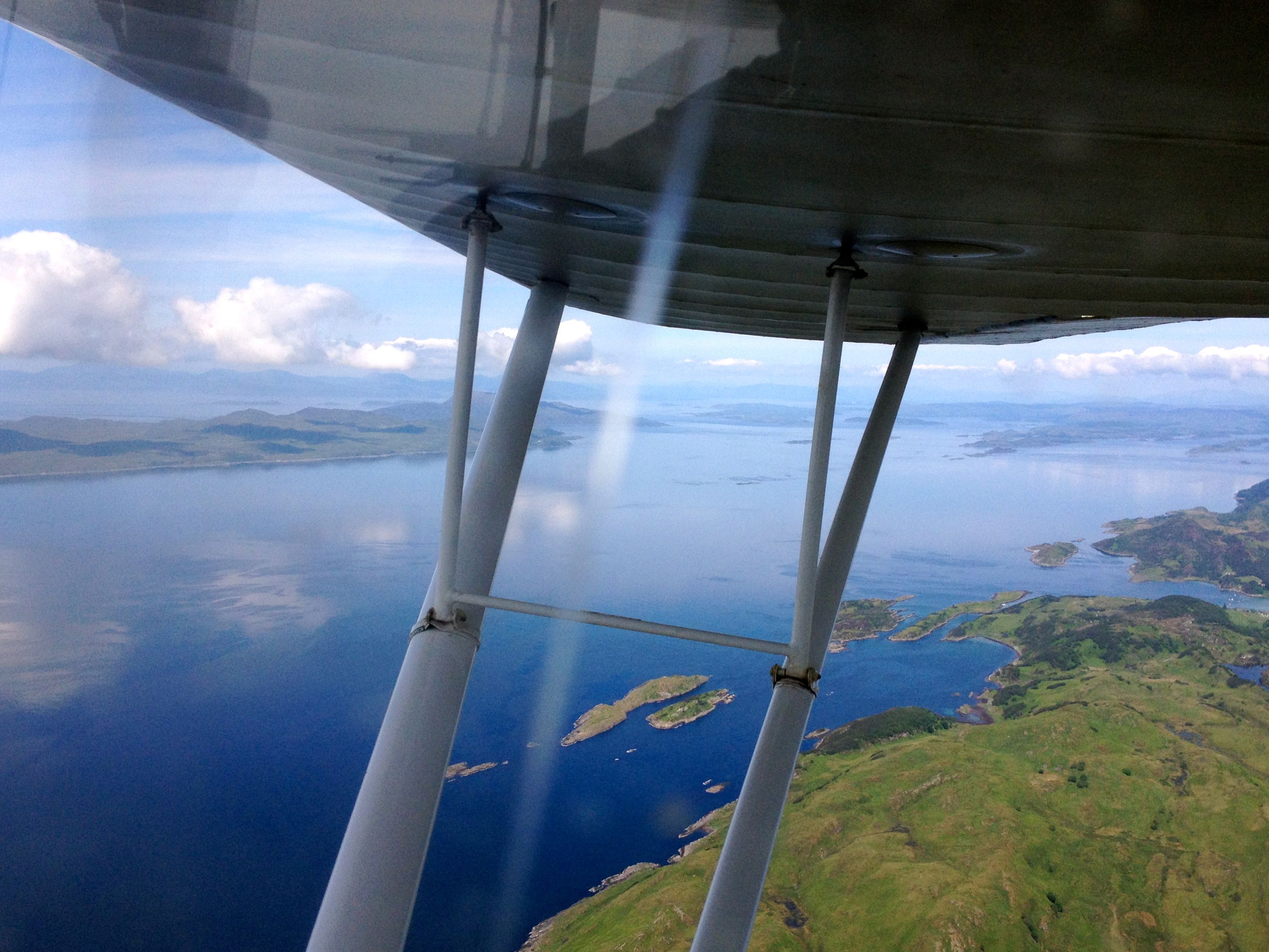 Loch Fyne
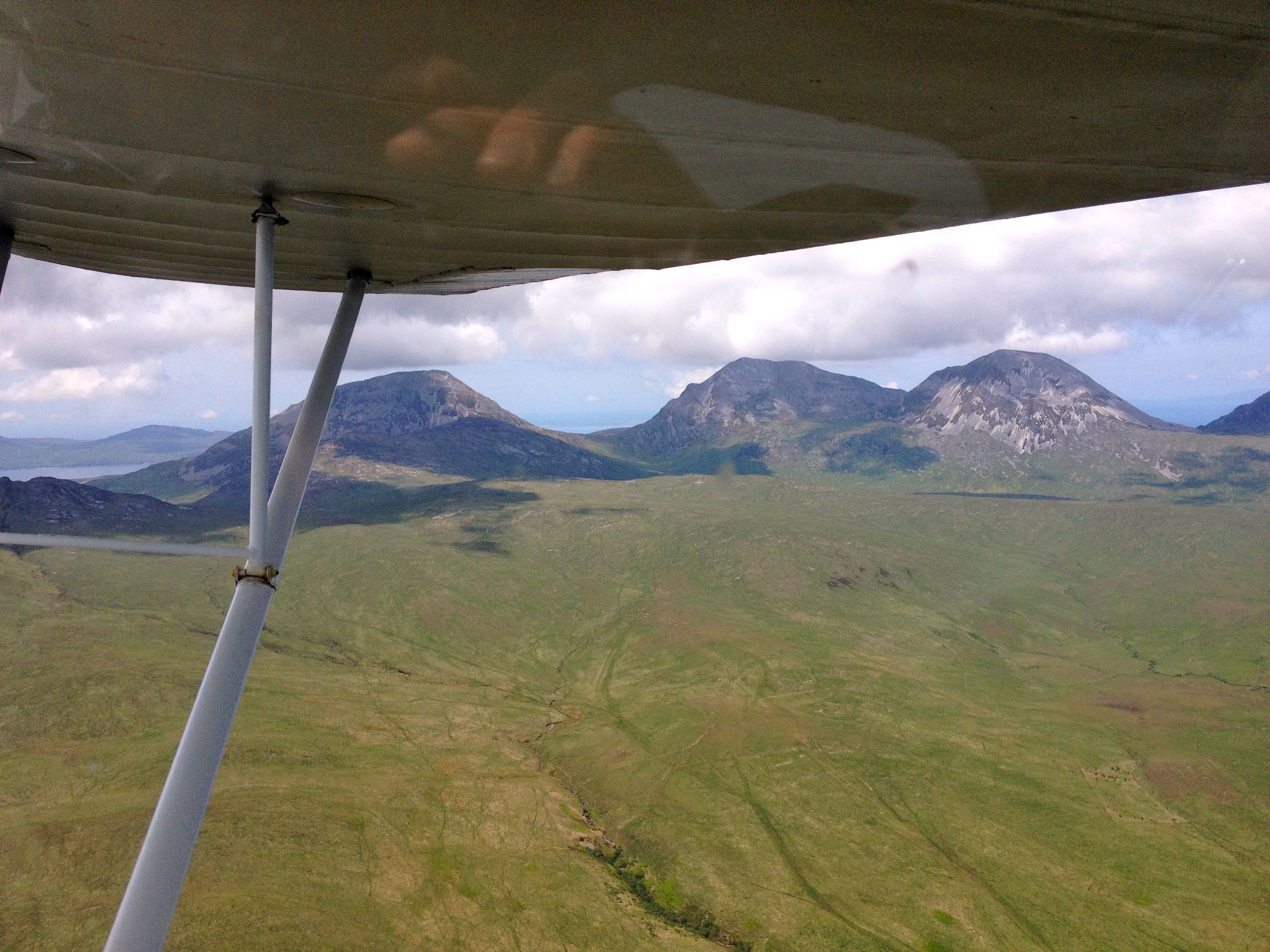
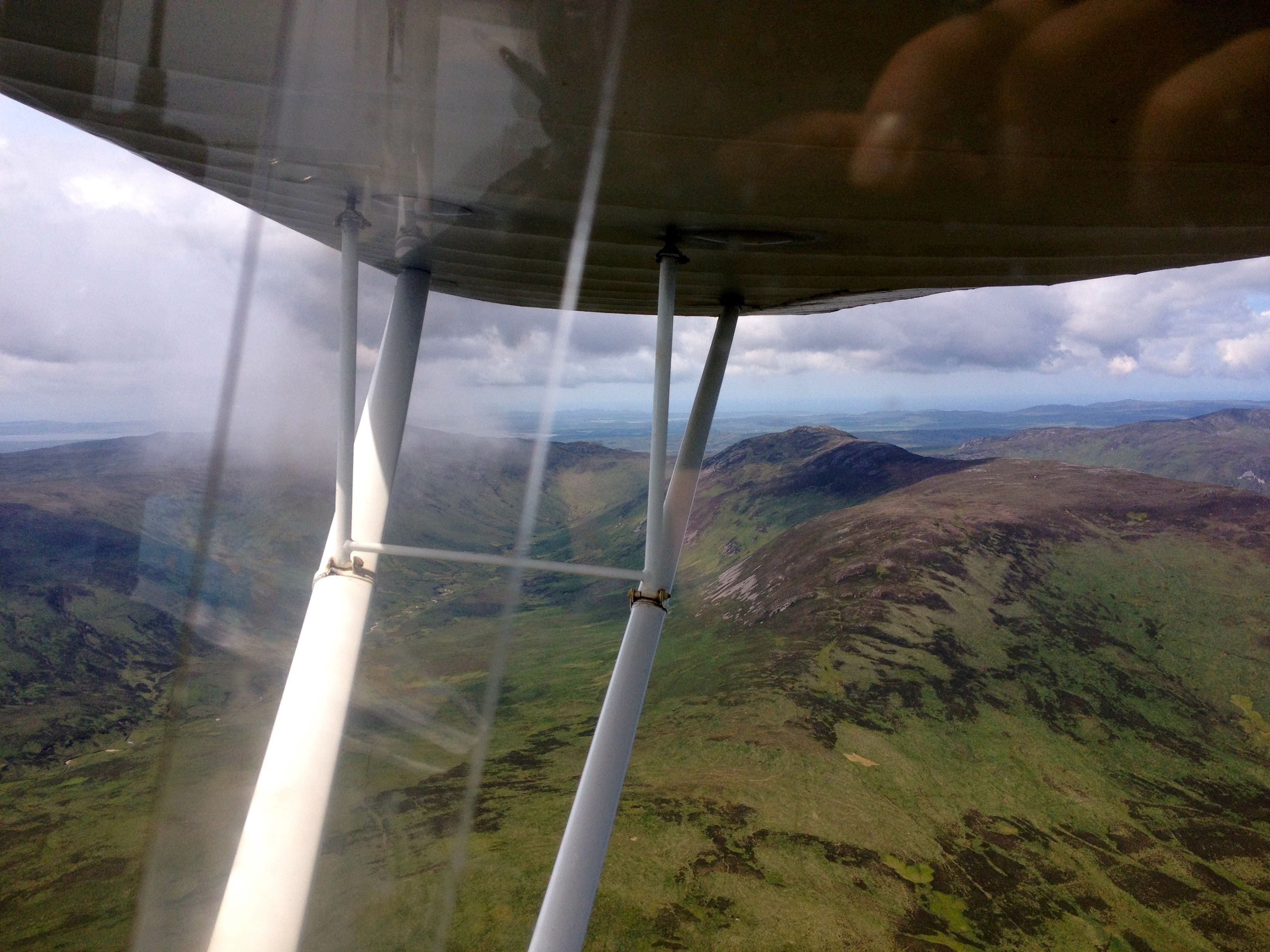 The hills of Jura
I landed with a ten knot cross-wind at Islay at 13:50 local – a very remote feeling little airport with only a handful of commercial flights a day in the summer, but very friendly and helpful staff and a nice cafe. See here for info. I was taken from the parking area by the airport handling truck and went to the tower to settle up – a fairly stiff landing charge of £19.00, but at least I had no need to take on fuel, which was priced at well over £2.00 per litre.
The whisky festival was on and I was sorely tempted to stay a night, but I still wanted to try to make Tiree and get to Glenforsa, ready for a flight to Sollas and Stornoway the next day.
After some lunch, a call to Glenforsa revealed a northerly wind of 18 knots, right across the strip – a cross-wind I didn’t want to risk in the Auster. Strangely, Oban also had a cross-wind! Oban and Glenforsa’s runways are exactly 90 degrees apart in orientation, with Glenforsa having an east / west strip and the main runway at Oban being north / south, which means you can normally go into either with wind aligned down at least one runway. Today, the prevailing westerly, which had picked up by now to around 15 knots at Islay, was funneling down the Sound Of Mull. accelerating and becoming northerly at Glenforsa, but turning westerly and reducing again by the time it reached Oban.
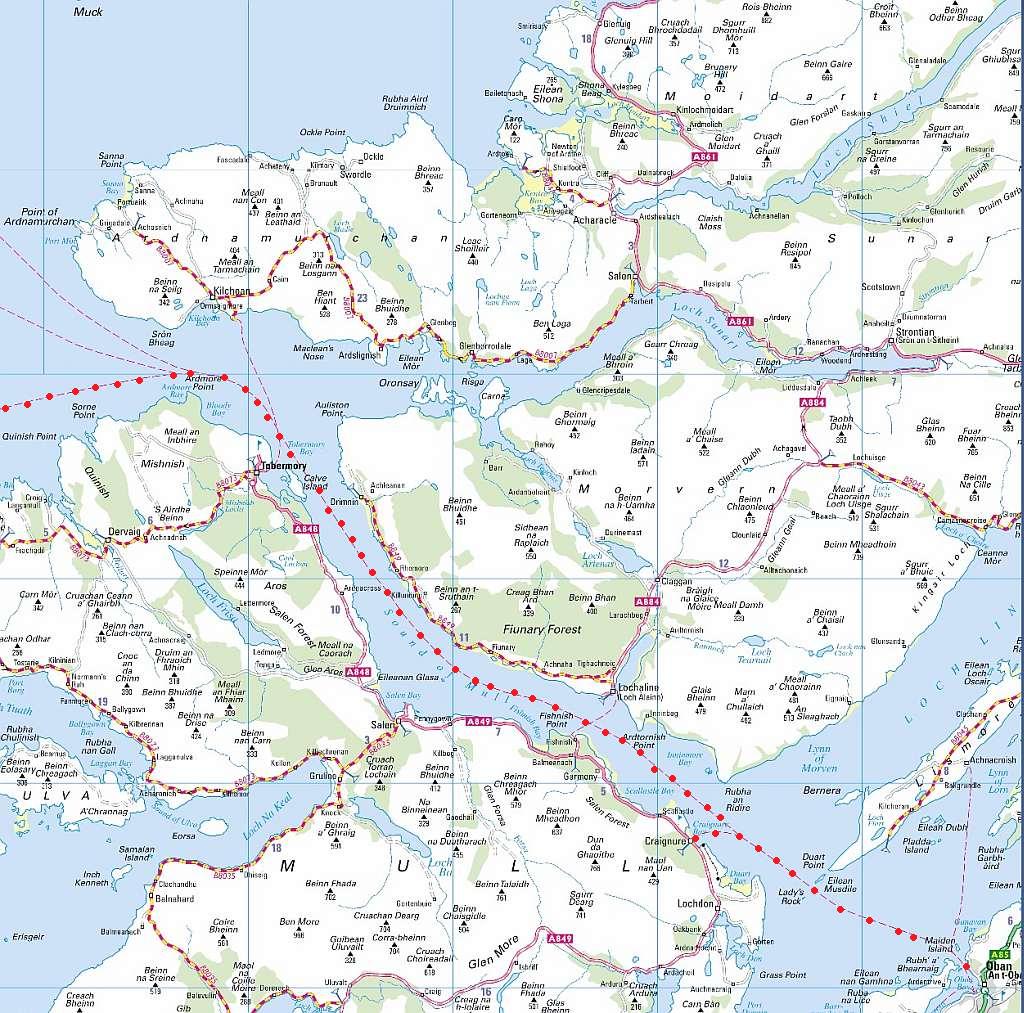
My working cross-wind limit for the Auster is 10 knots, so I’d need to go for Oban, though the tarmac runway would make this crosswind enough of a handful in itself. No time for Tiree, then, if I was to get to Oban by 17:15.
This closing time is just crazy at this time of year – it’s light until around 22:00 and with Oban being one of the few places you can get fuel on the west coast, I just don’t understand why they close so early. If they had stayed open later, I could have waited at Oban until the wind dropped at Glenforsa ( which is open as long as there’s light ) and then hopped across the Sound to get to my intended destination. No wonder Oban’s popularity is in decline with the GA community – tighter restrictions, increased charges and bureaucracy and crazy opening times since Argyll and Bute Council took over the running of the place, has really started to spoil an otherwise superb west coast destination airport.
I got away at 15:45 from runway 26, which was into wind, and had the best flight of the day, cruising up the western side of Jura and then on up the west coast, with all its many inlets, bays and beaches drifting slowly by below me. It was a wonderful feeling. No longer on a tight schedule apart from the need to get to Oban, I felt relaxed and happy, just watching the world and the wonderful scenery going by below me, fascinated by the intricate patterns of the landscape and the sand banks visible beneath crystal clear water. Arriving at Oban, the back-drop was truly breathtaking – the tangled mass of mountains that make up the Highlands framed the town and the airport at Connel, stretching on into the distance as far as I could see, while Oban’s Marina, sat sparkling in the early evening sunlight. To my left, Mull’s high peaks rose up out of the sea, which faded to a bright, misty horizon to the west. It was truly stunning.
I landed ( with a little cross-wind squeal from the tyres ) at North Connel at 16:35 and once parked up, quickly telephoned Glenforsa for an update on the wind, hoping I could get away again before the airport shut. No such luck – they had twenty knots now, still out of the north. It was hard to believe this, as just 16 nm away at Oban, there was just a 9- knot westerly! Still – funny Geography in this part of the world, so I made arrangements to tie down for the night and sort out some accommodation.
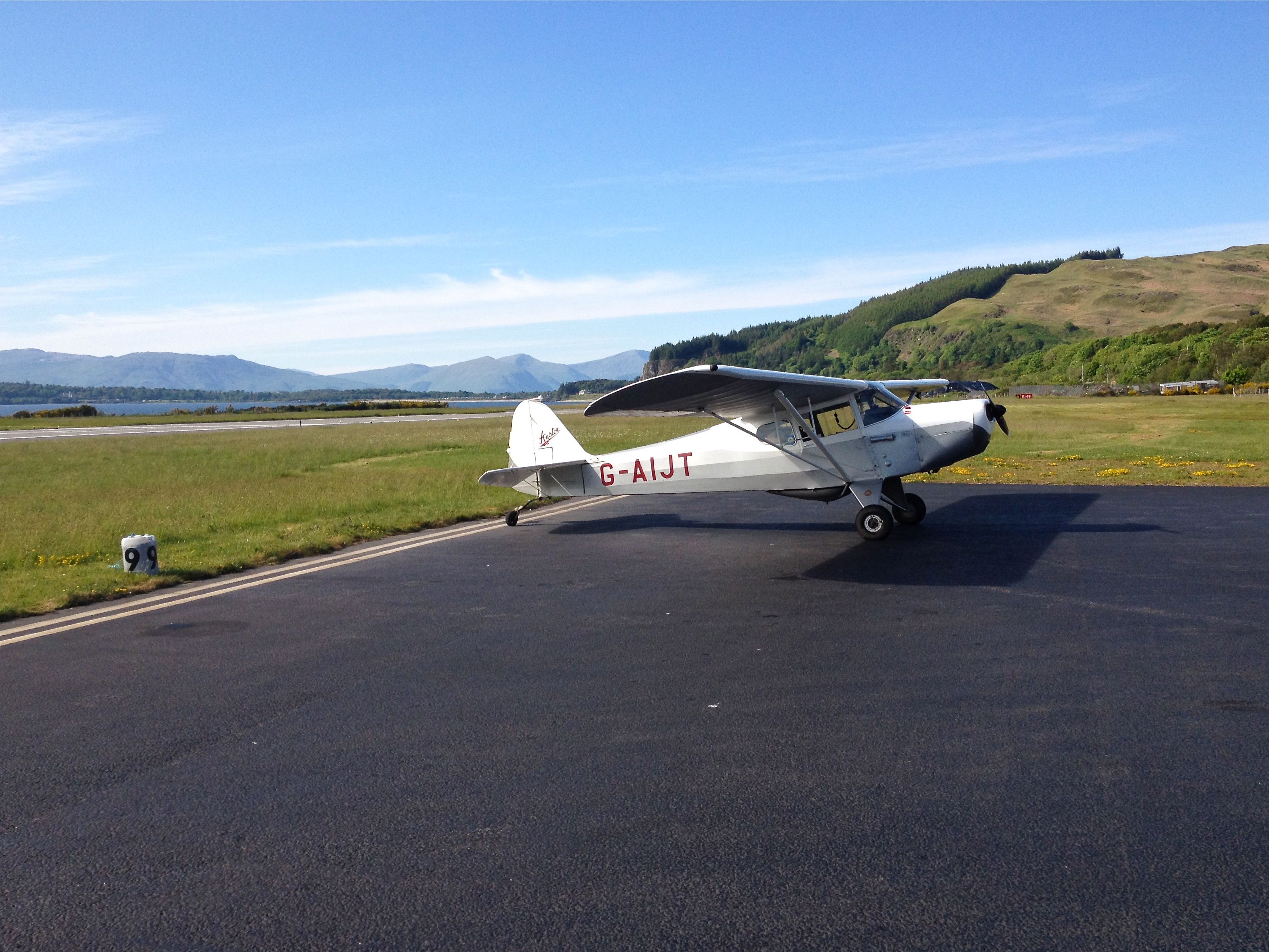
Parked up at Oban
I managed to get a room at the not so modern Falls of Lorna hotel in south Connel, about a twenty-minute walk across the bridge. It had lovely views from the hotel window and the staff were very nice, but there was no shower in the en-suite and the place was pretty old-fashioned. I wandered down to the shore opposite the hotel once cleaned up and fed, to watch a lovely sun-set.
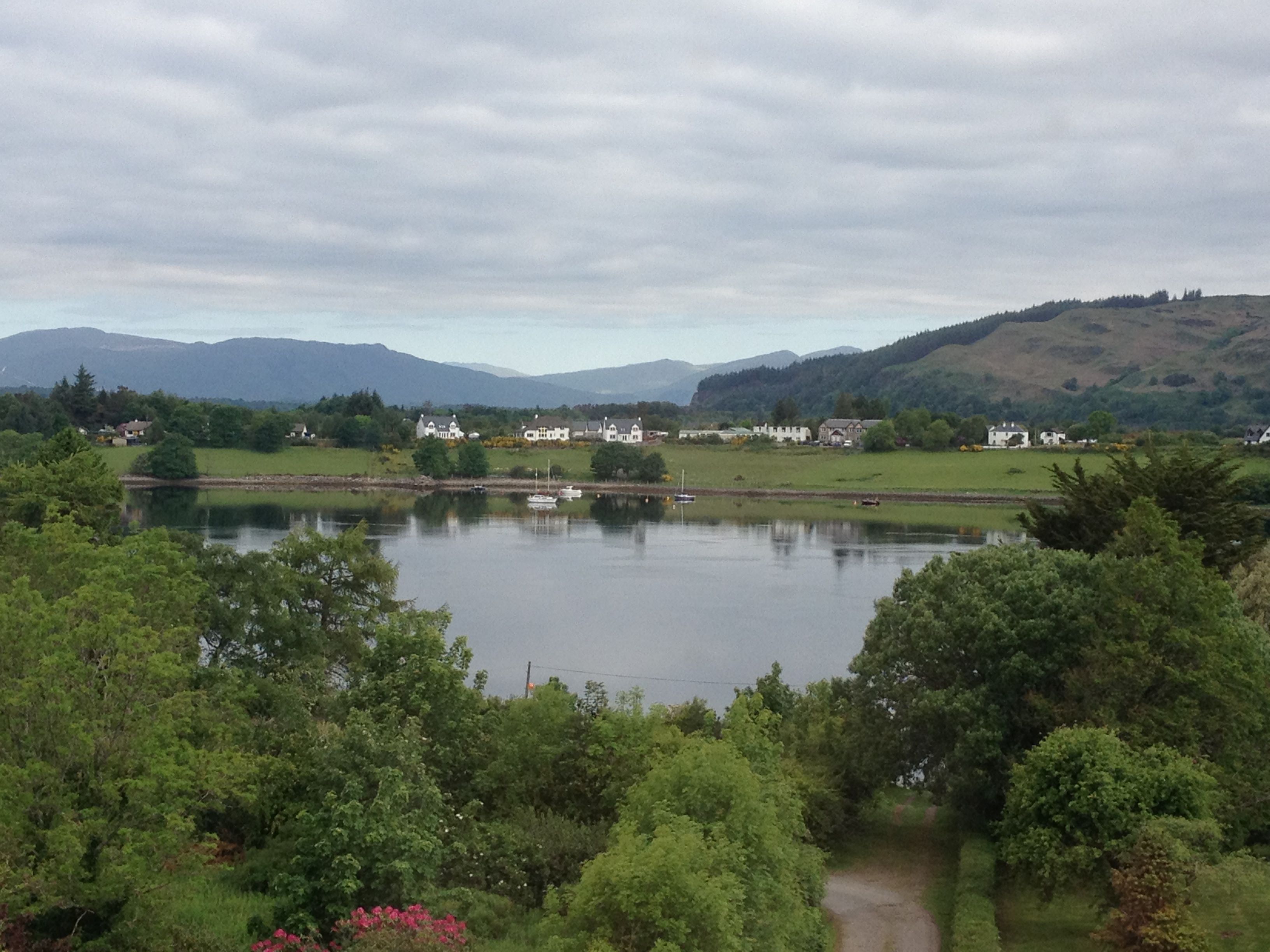
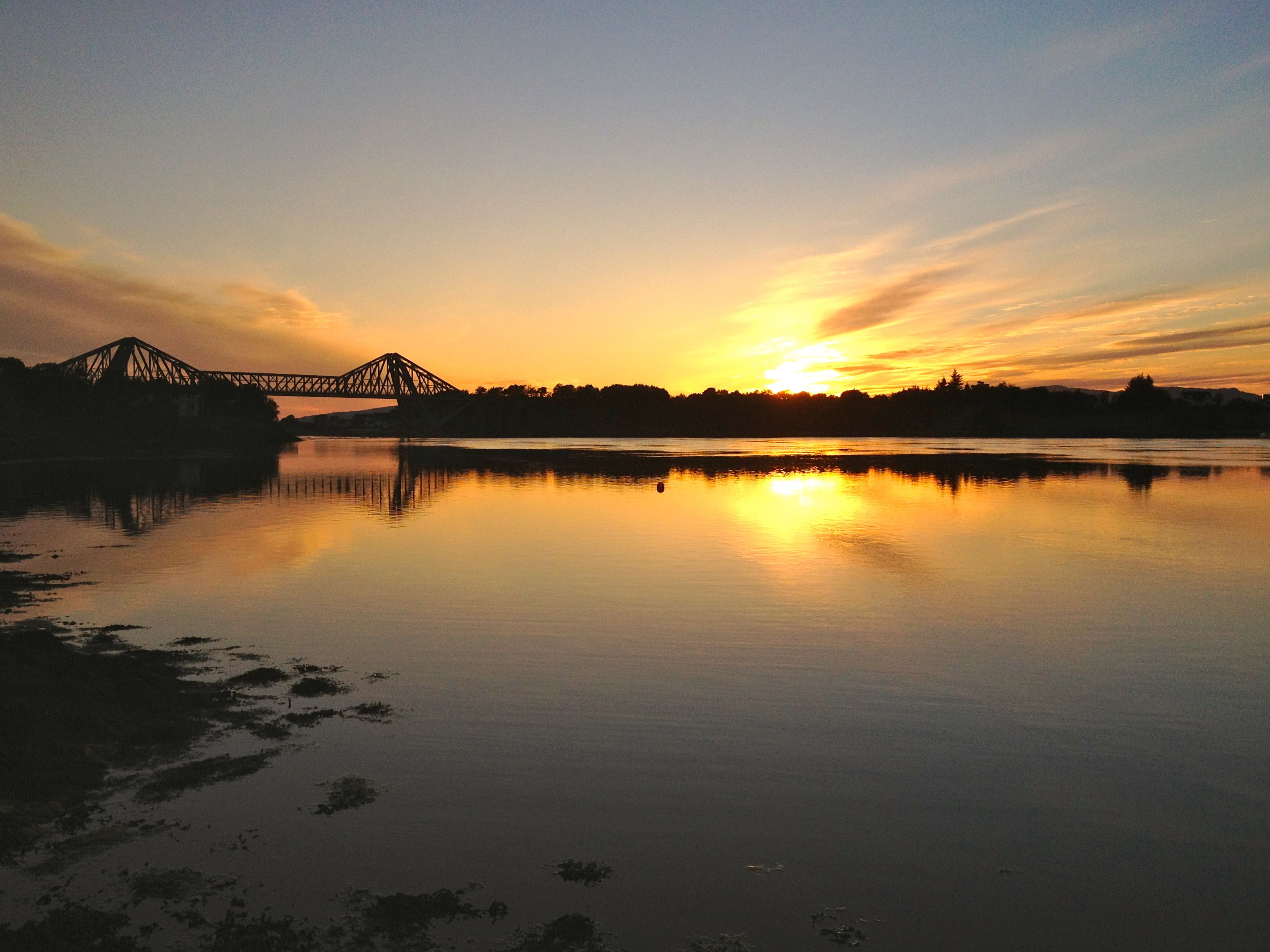
View from the hotel bedroom window Sunset over Connel Bridge
Day 2: The second day’s flying was always going to be the best and a real mission! I wanted to fly up to north Uist and land on the beach at Sollas, then call into Stornoway. I had originally planned to stay over-night at Stornoway and then head for Inverness, but one of the main reasons for my west coast trip, was the chance to stay over-night at Glenforsa. I’d been through Glenforsa a few years previous and had been promising myself an over-night there since and this draw, together with a late airport opening time of 13:00 at Stornoway the next day, made my mind up to head back into Mull after visiting Lewis. It was going to be a long day’s flying and quite an adventure.
I got to the airfield at 09:30 to prep the Auster for a departure at 10:30, so that I would reach Sollas for low-tide at mid-day. The ever helpful and enthusiastic Paul Keegan of Total Logistics Concepts was on hand to offer advice about flying in the area and top up the tanks. I was all set and got airborne at 10:40.
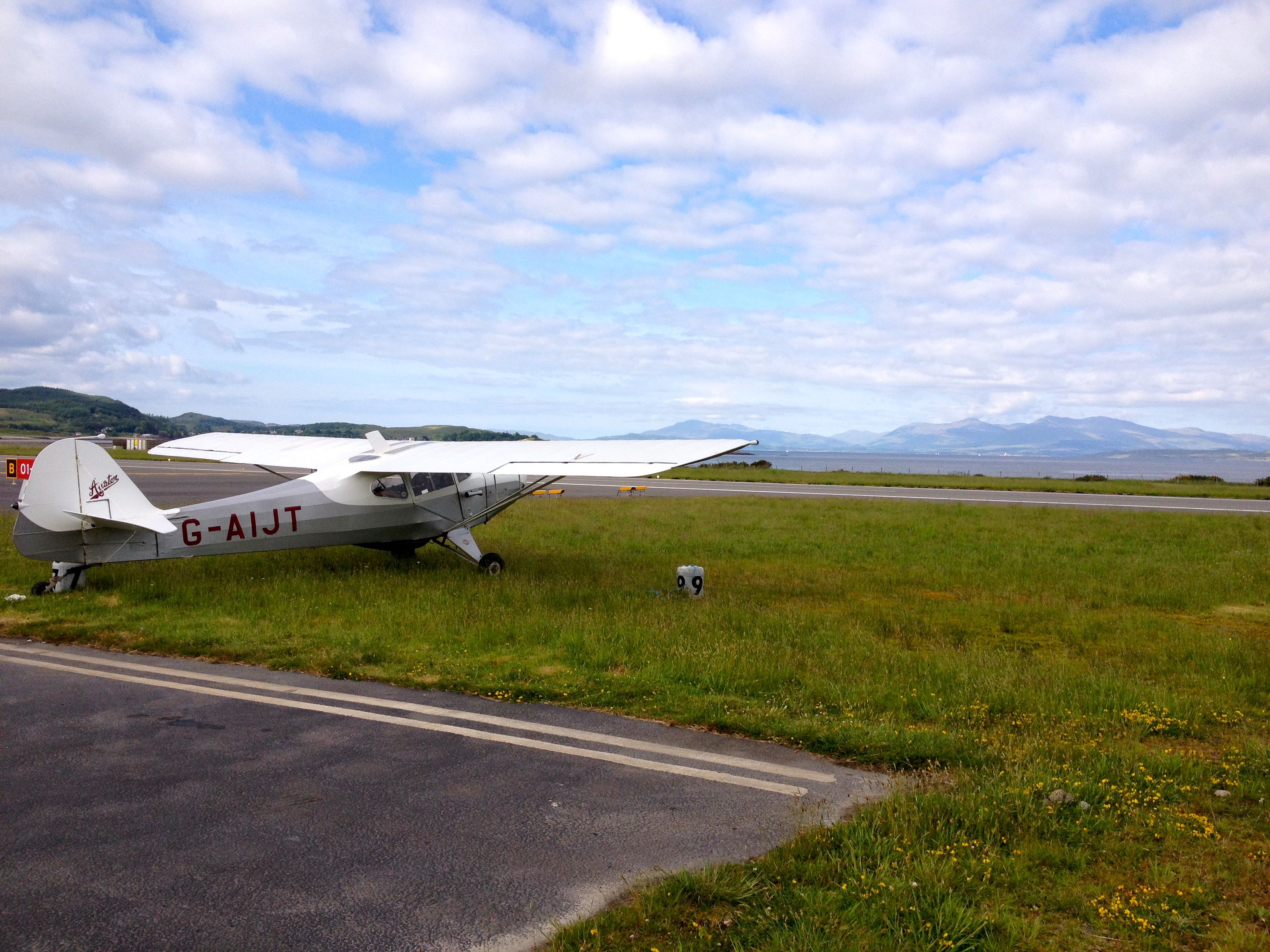
Another lovely day! JT at the tie downs at Oban with Mull on the horizon.
The route to north Uist was spectacular, and more than a little intimidating. I flew up the Sound of Mull and then north to Skye, before traversing the sheer cliffs and mountains of the island to the north-western tip at Dunvegan Head and then crossing The Minch to the Uists. Although I got a good service from Scottish Information, the sheer ruggedness and remoteness of the landscape, combined with the water crossing, really leaves you feeling exposed. There seemed very few places to land if I had engine trouble and even before the main sea crossing to Uist, much of the flight was over water. I was traversing the southern side of Skye and with a healthy northerly wind that morning, made sure I gave the imposing Cuillin Mountains as wide a berth as possible. I still got buffeted about quite a bit as I turned the corner of the head-land before heading out over the Minch. Not to be messed with, these mountains, whichever way you tackle them.
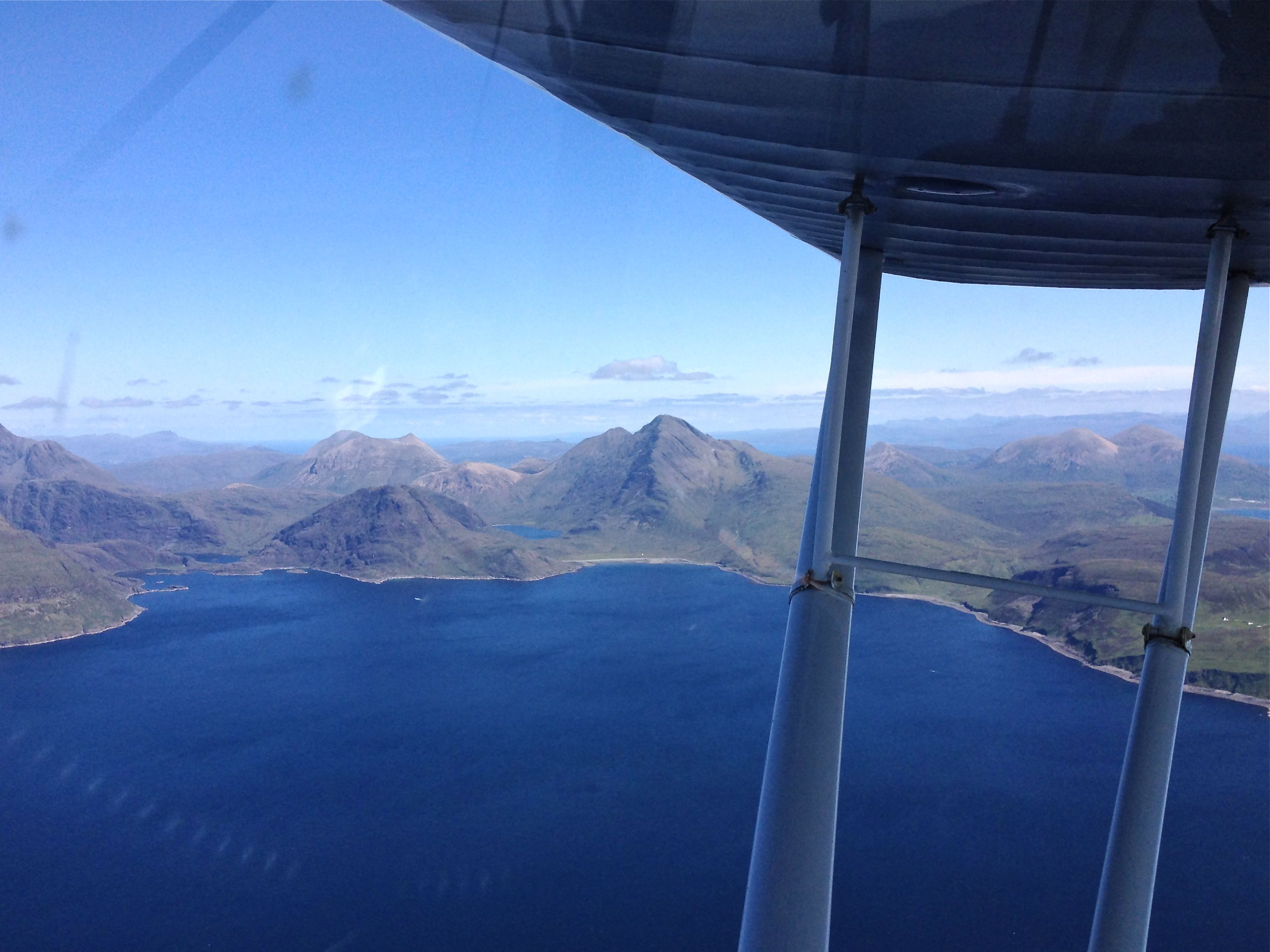
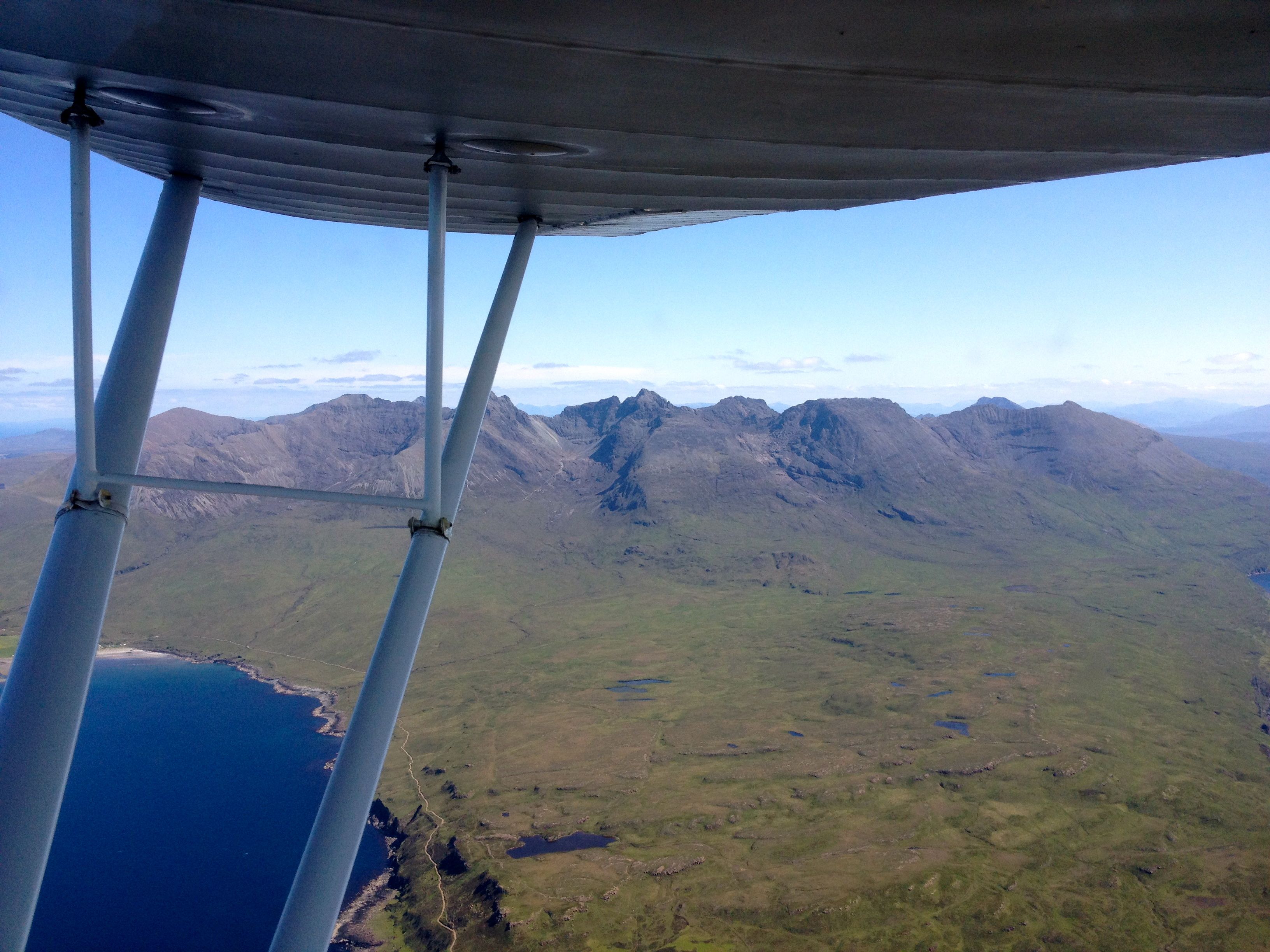
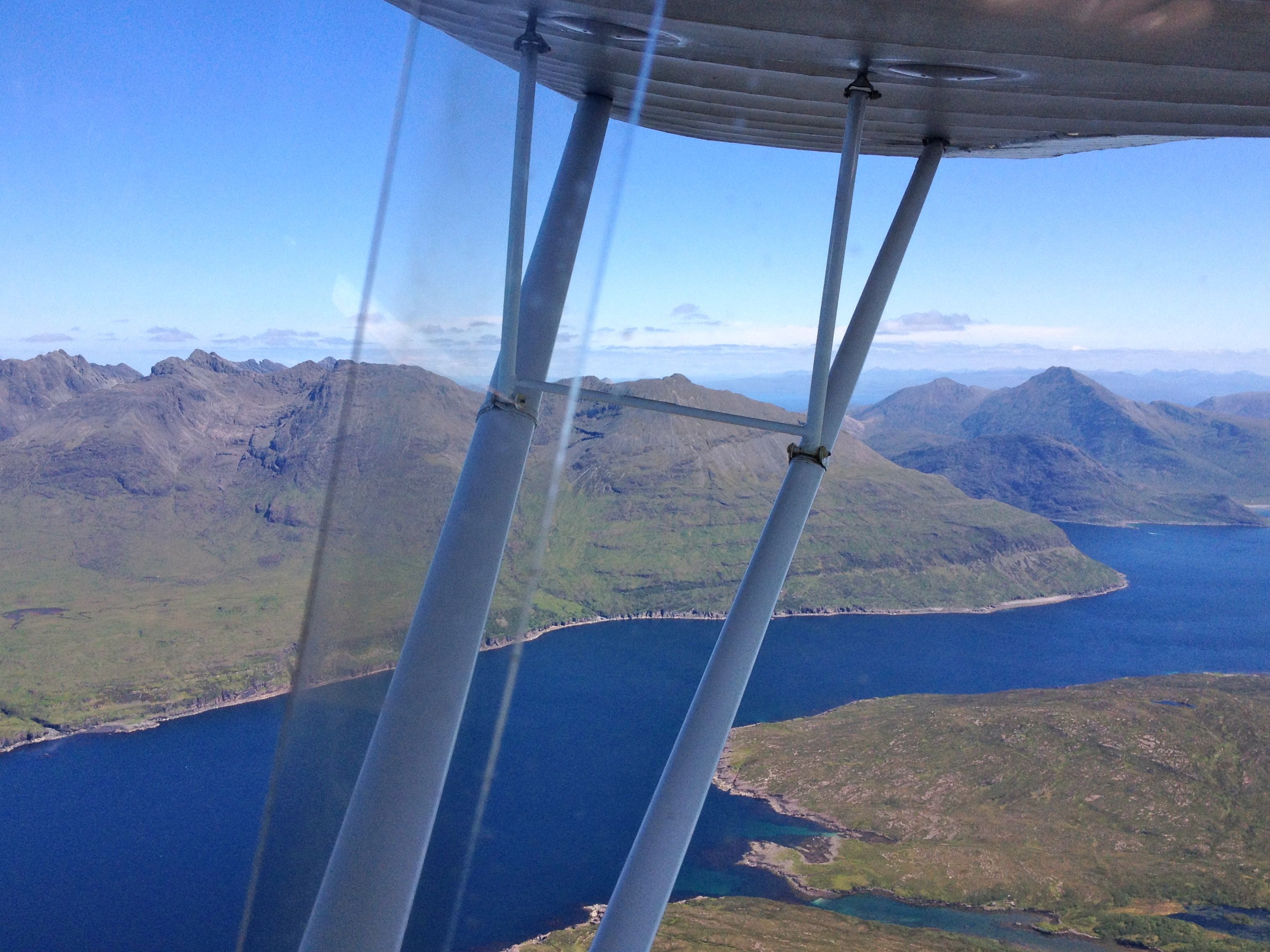
With a final look at the engine oil Ts and Ps, I headed across the water for Uist. The air was nice and smooth over the water once away from Skye and the engine carried on running just as sweetly. I could see the Uists clearly before I’d even got to Skye, the visibility was so good, which made them look perhaps a little closer. That helped, and in a little over ten minutes I was across and gazing down to the unique and watery world of north Uist.
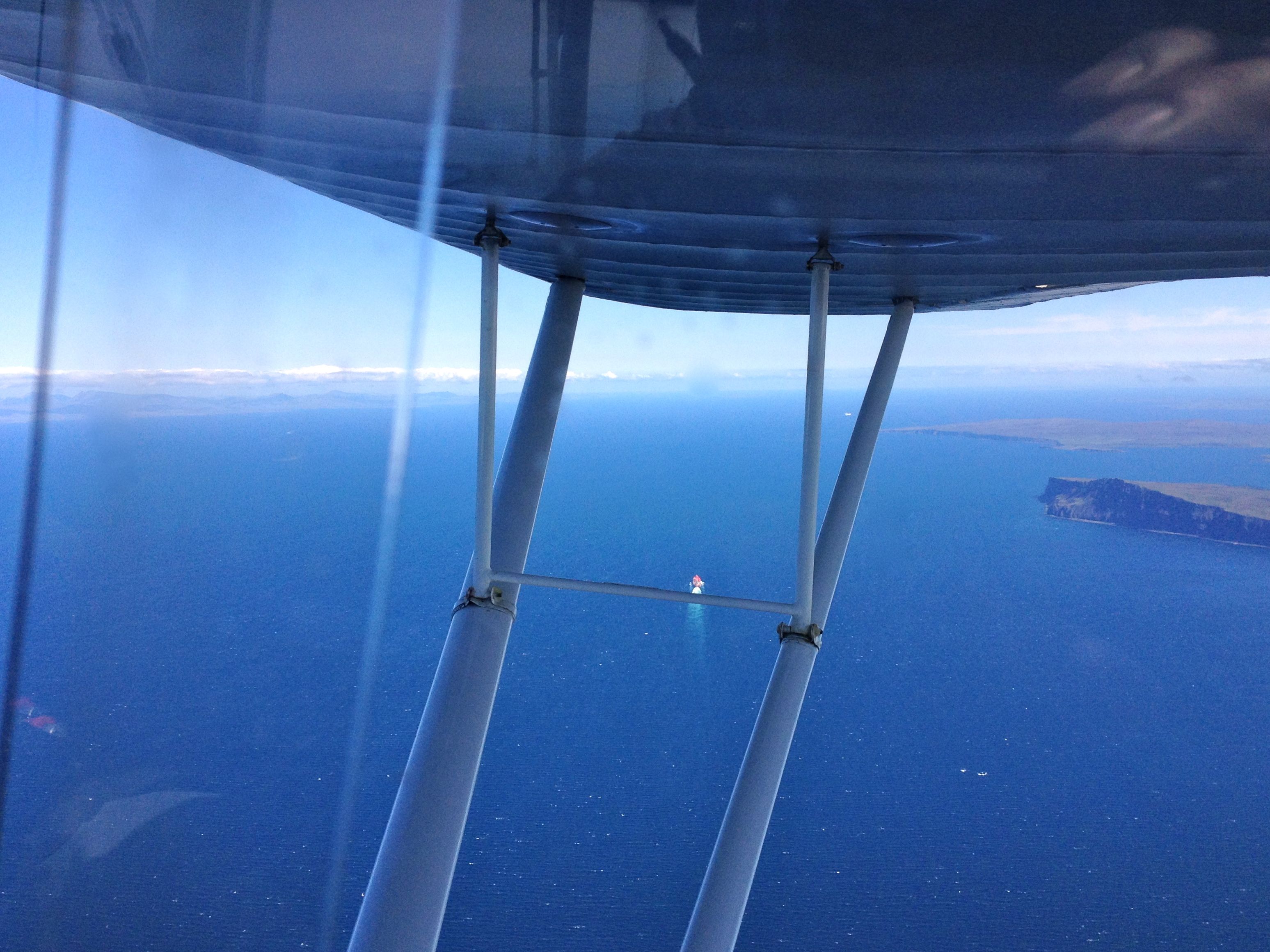
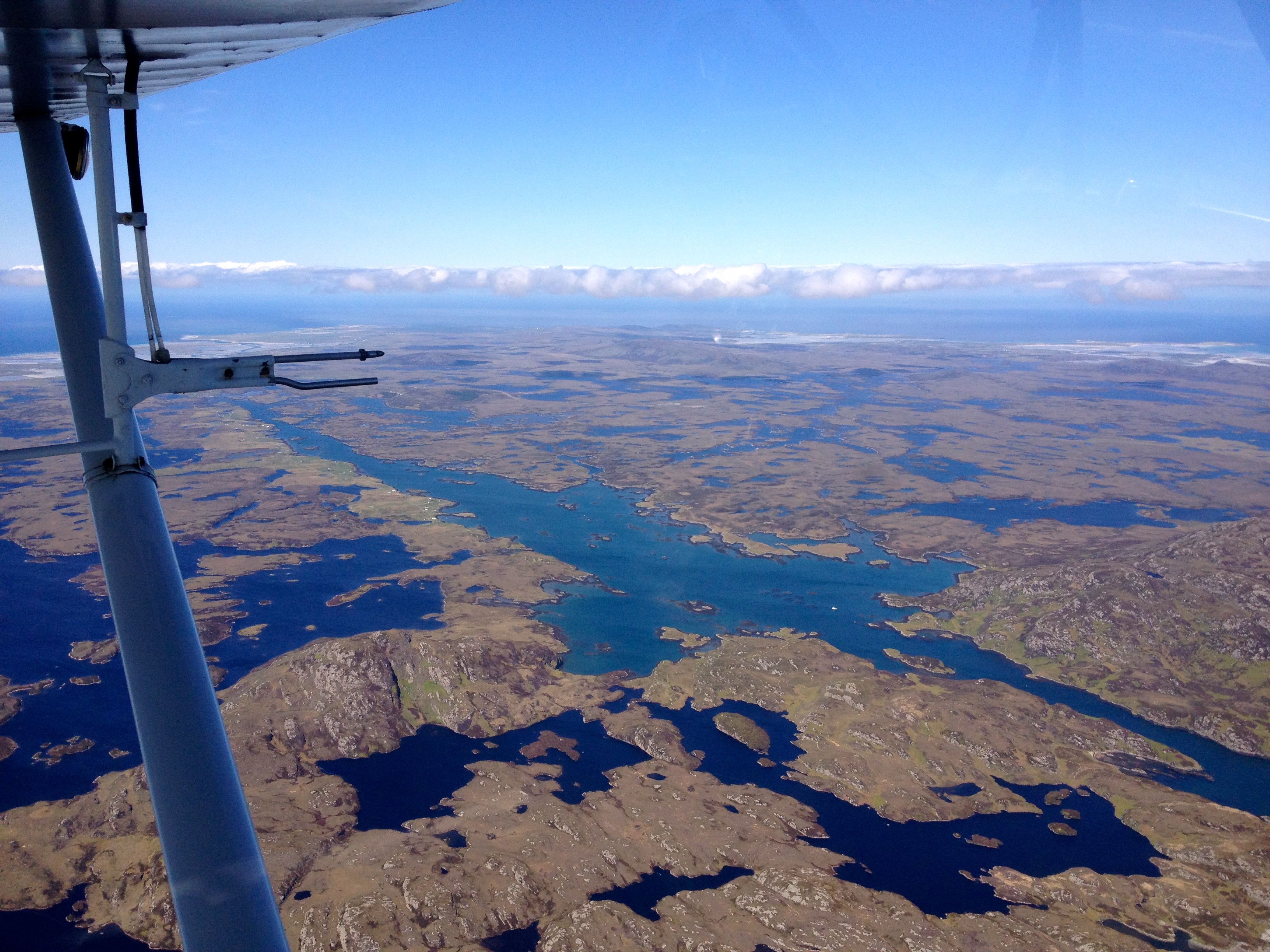
Crossing The Minch The watery world of North Uist
The Uists are strangely beautiful with their other-worldly, flooded landscape, stretched out in a midst of endless blue water, separating the inland water-ways of the west of Scotland from the vastness of the Atlantic, beyond. Soon, the gorgeous white sands of Sollas itself, came into view on the northern shores of the islands.
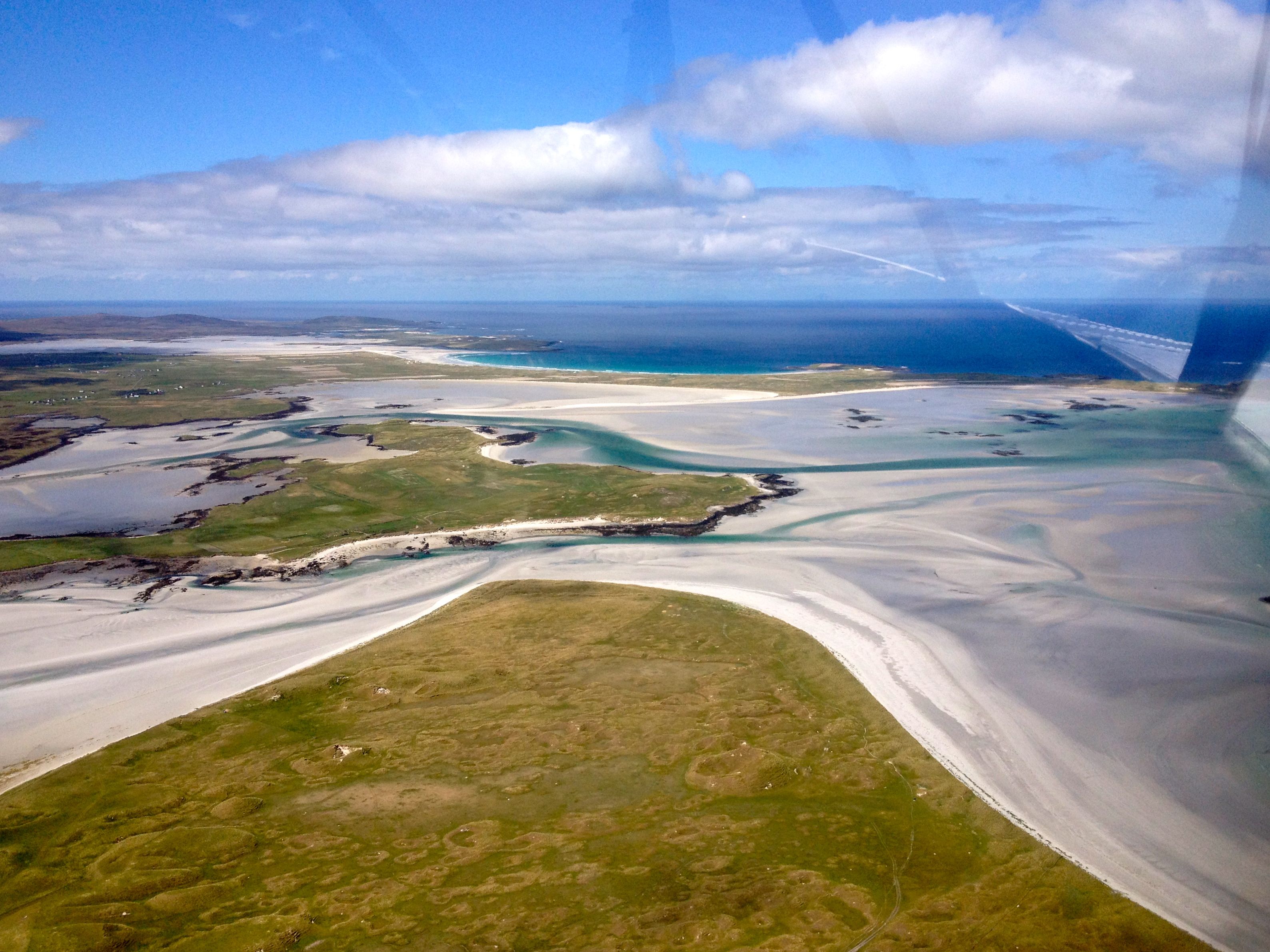
Sollas beach – the ‘boomerang’ shaped stretch of sand in the upper mid section of the frame
I couldn’t quite believe I was going to land there – but it had been used for decades and the Highlands and Islands strut of the LAA have a fly-in there each year. I’d also got a lot of advice from John Angus of Stornoway, who organises the Fly-In and knowing there was a mile long stretch of consolidated sand to land on at low tide was comforting. I’d been told the northern end was best.
I set myself up for a left-hand circuit, judging the direction from the clear wind-lanes on the sea to the west of the beach and checking my ground-speed off the GPS, could see there was about twenty knots or so coming out the northeast. I did a recce’ circuit and had a good look at the sand, which appeared almost entirely dry, so followed that up with a low approach and go-around, picking my spot. The anticipation built – there was not a soul around for miles and the water was crystal clear – to the north of the beach, the high ground of Harris rose up out the sea and I could see white tops breaking off the surface of the waves below. It’s a truly stunning location.
I came round for a final approach, the Auster curving gracefully as I turned base-leg and then we almost seemed to come to a stand-still as I lined up into the wind. Down we came – the wind was very steady but must have been up close to 25 knots and after a small check back to round out, we touched down smooth as silk and rolled to a stop very quickly. The sand beneath the wheels felt very solid and the Auster tracked straight as a dye, with no dragging at any of the wheels or tendency to nose over. After coming to a stop, with plenty of beach still ahead of me, I let the engine cool a minute or two and then shut down.
Immediately I was greeted by the sound of the wind and the little Auster was rocking about in the breeze. I opened the door and was hit by a blast of air, whistling across the sands. It was a curious feeling, sat there in the Auster and looking out to nothing but sand either side. I put the parking brake on and stepped outside to take in the view and the feeling of being alone on this remote beach in the Outer Hebrides.
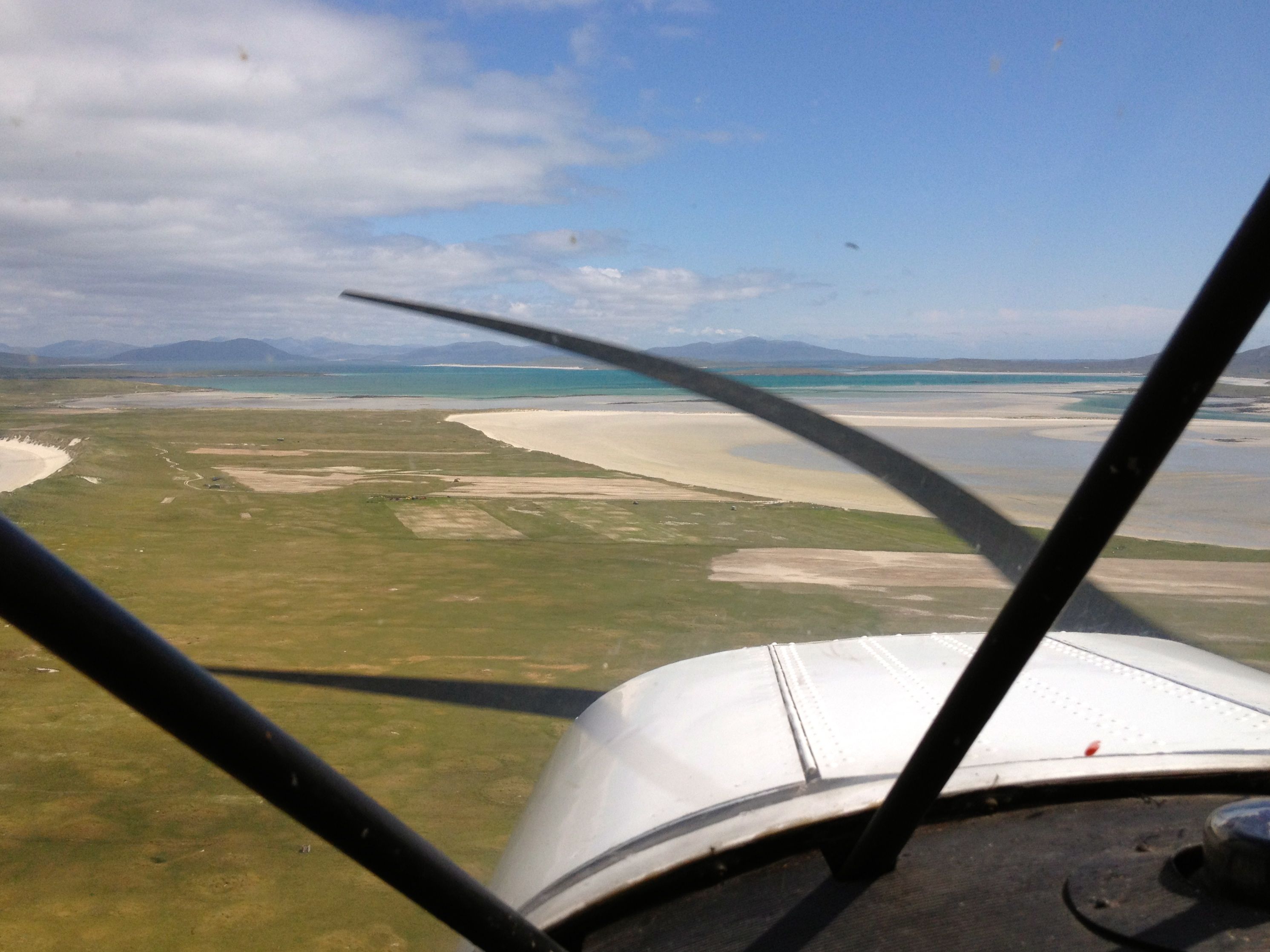
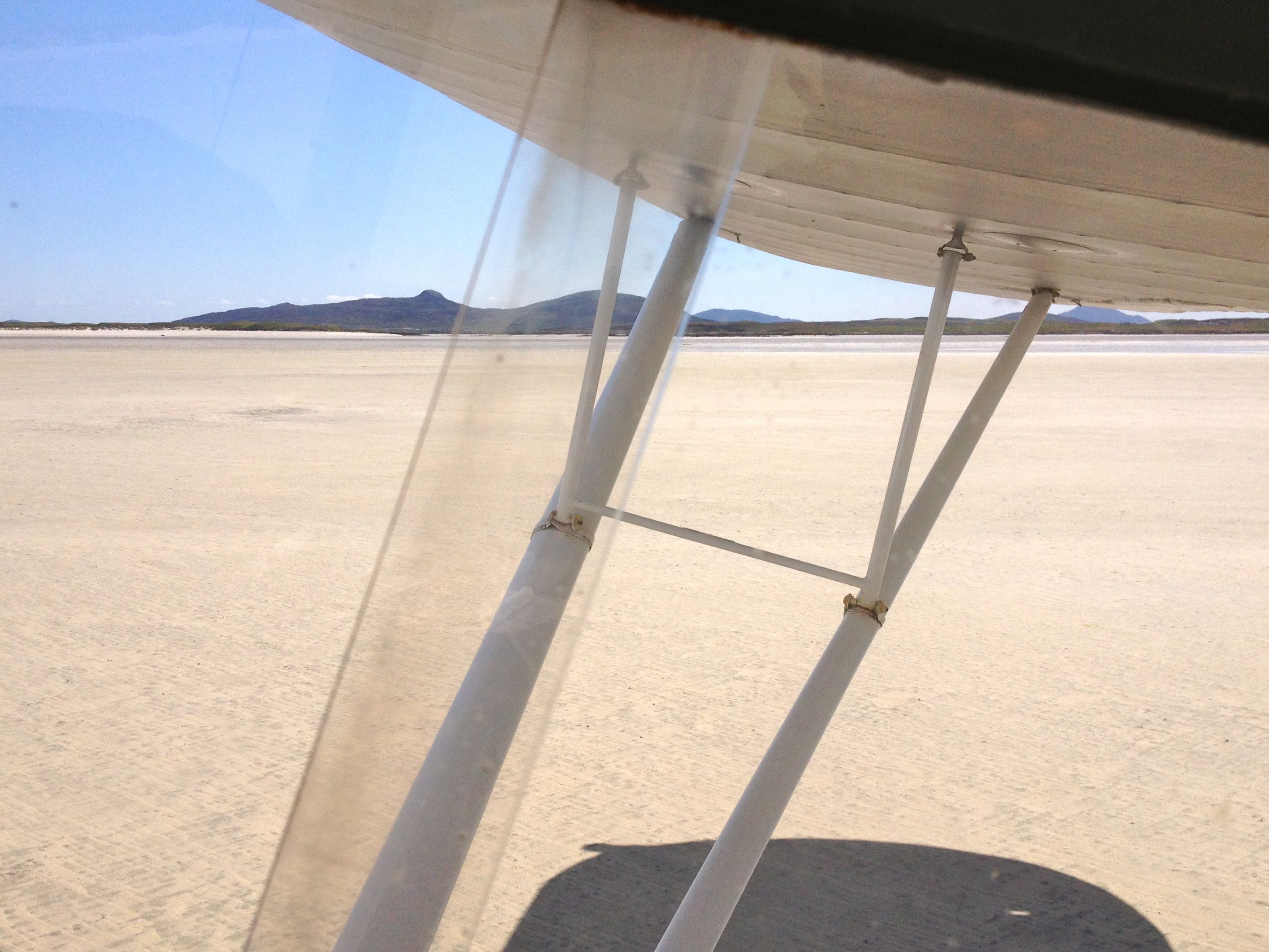
On approach Nothing but sand!
The feeling of remoteness and freedom standing on that beach, looking back at the old Auster, was palpable. I couldn’t quite believe that such an old and flimsy looking machine had the ability to transport its pilot across mountains and seas to the far western reaches of our British isles. I couldn’t help but chuckle, stood there looking at old JT. This was my first ever beach landing by light aeroplane and I was enjoying the novelty. It was re-assuring, in this health and safety world gone a little a mad, that it was still possible to enjoy a truly independent and care-free form of flying.
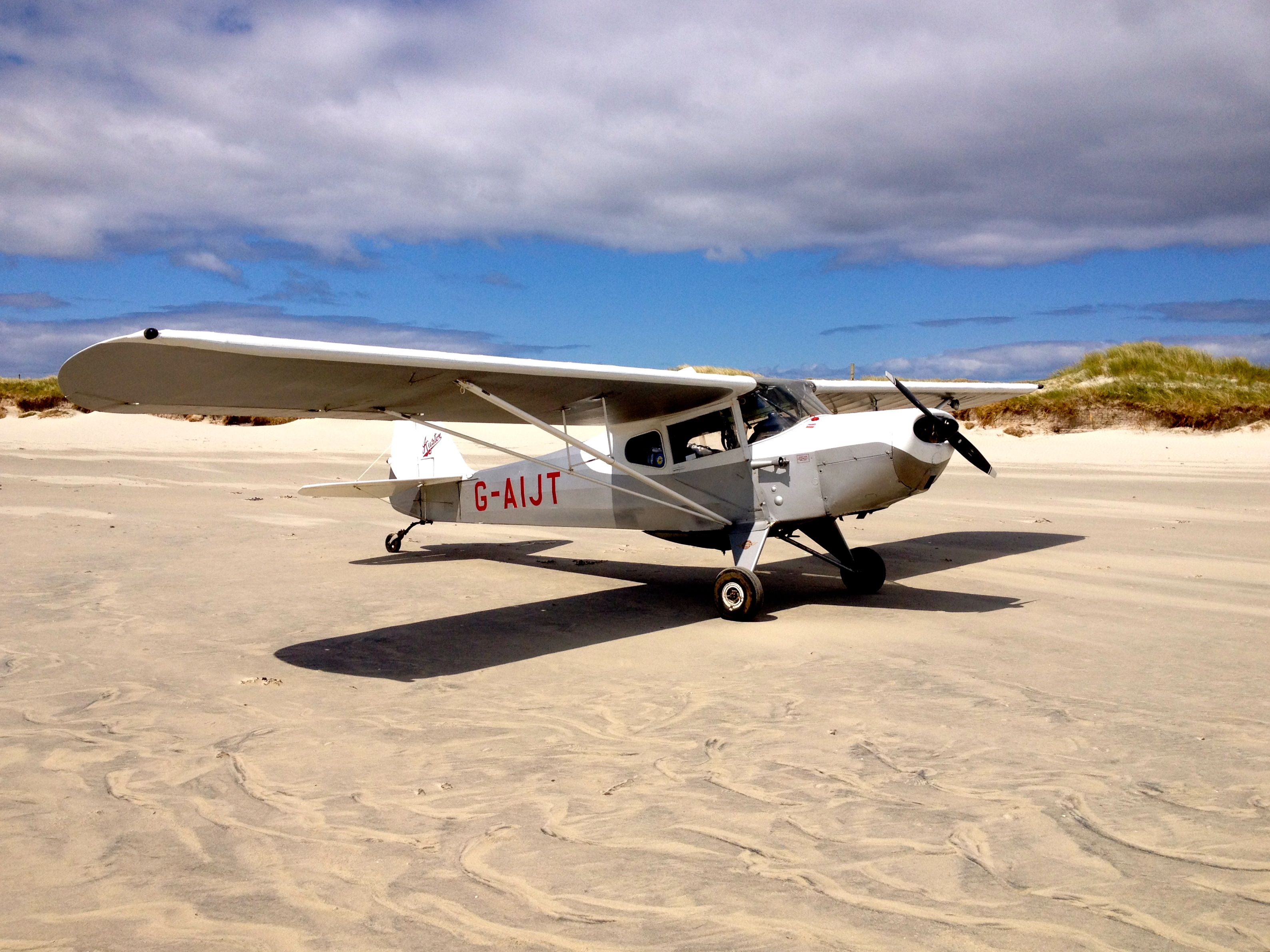
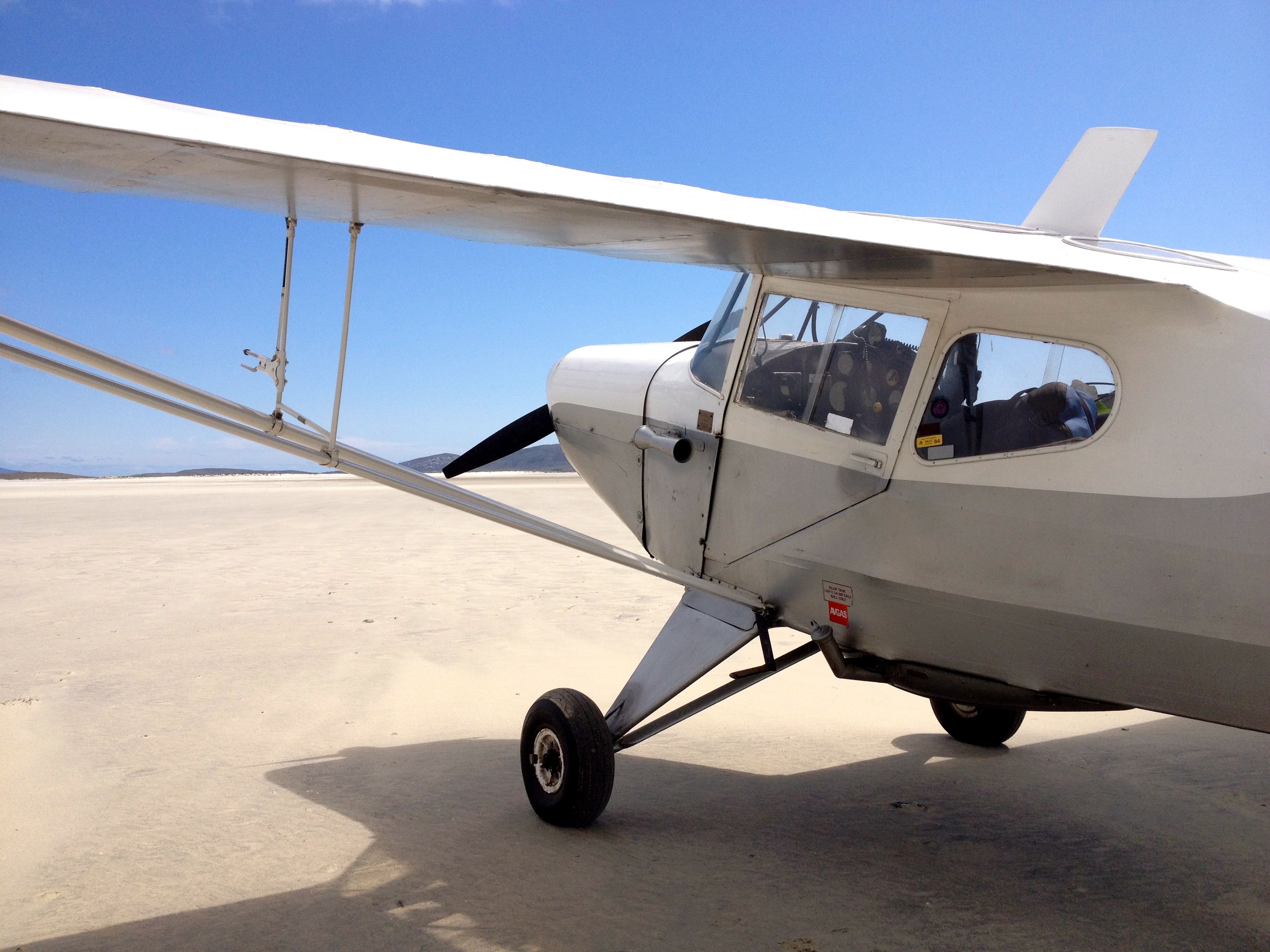
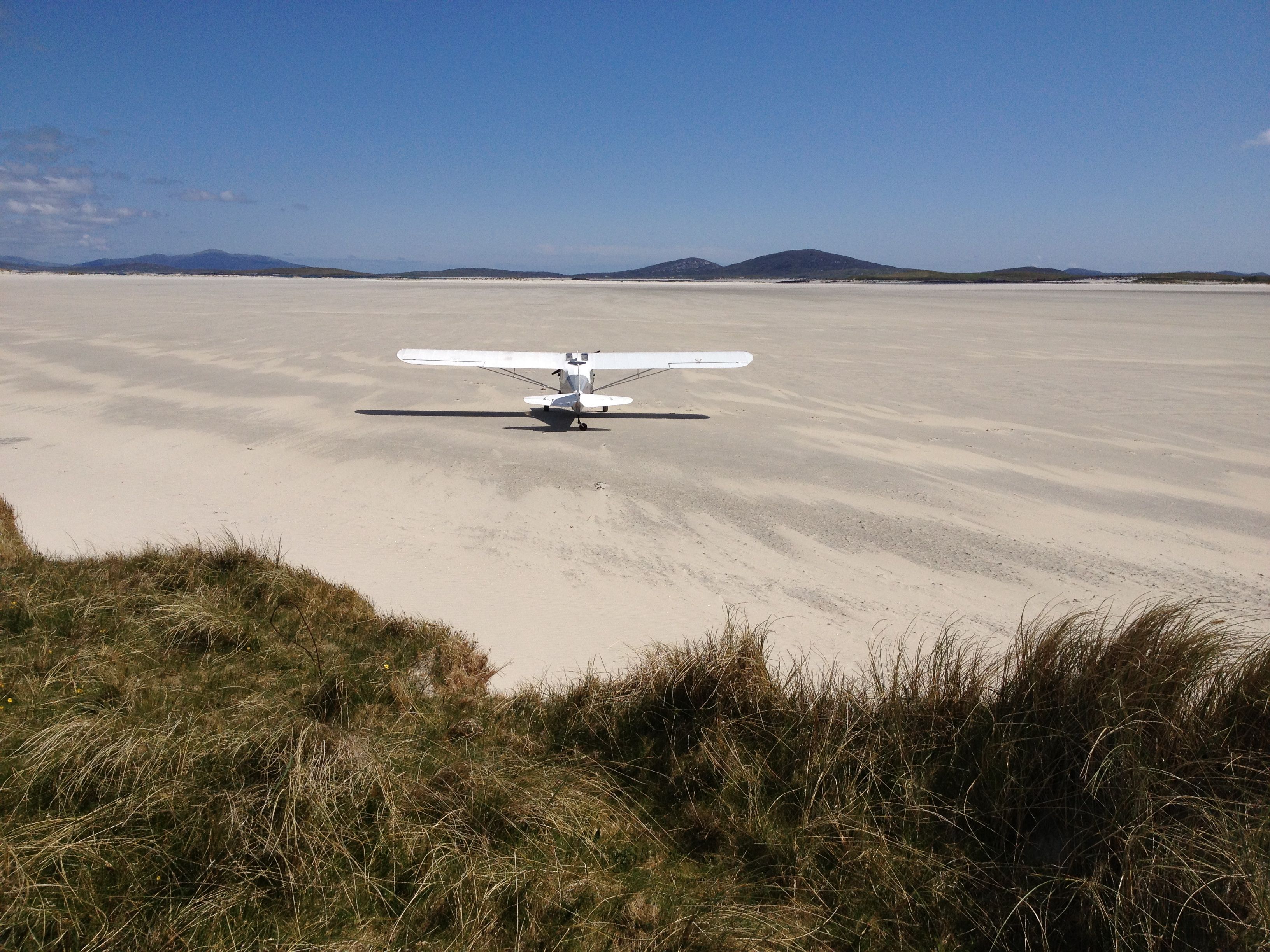
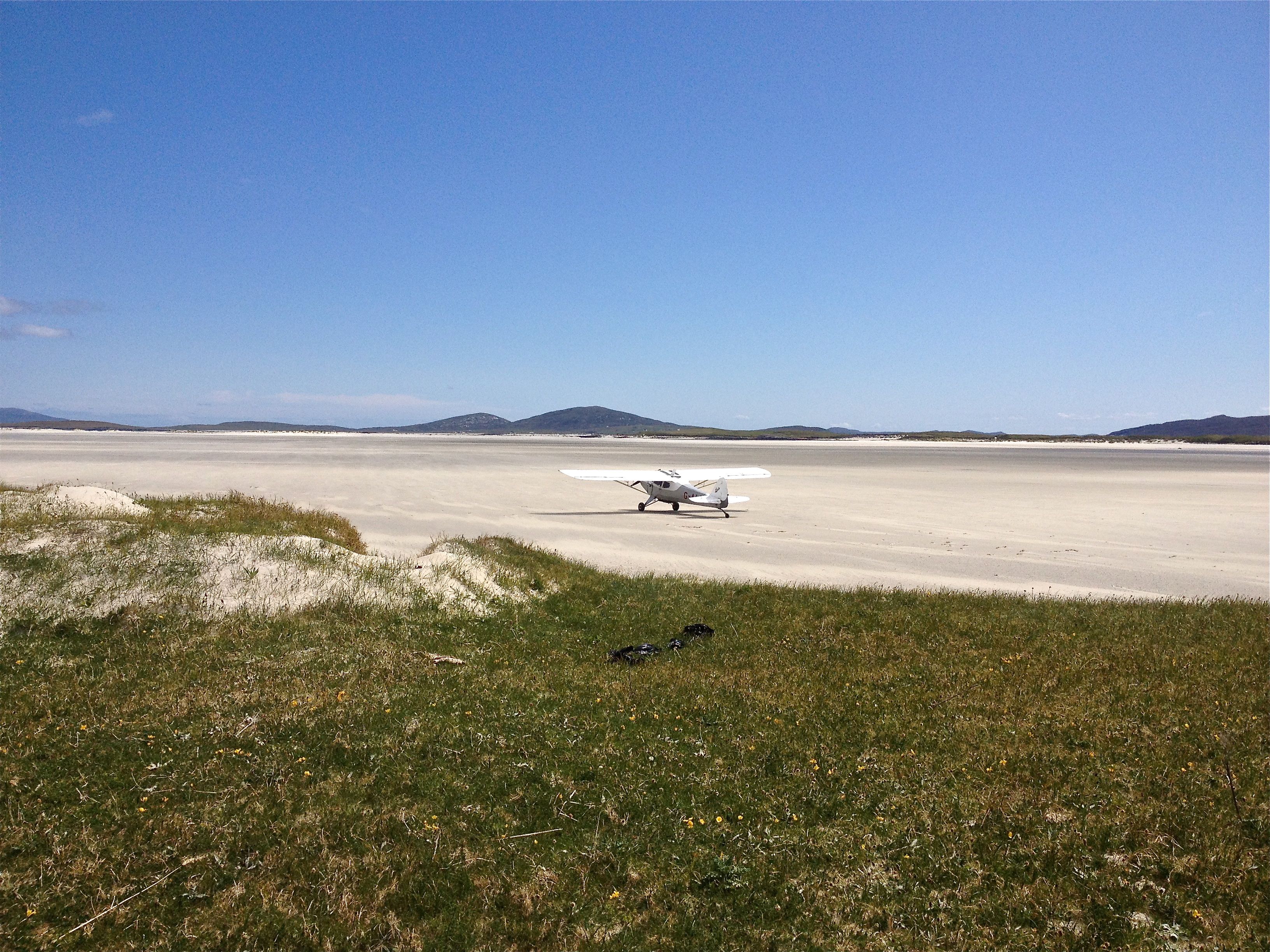
I would have loved to have camped there, but the high tide precluded it at 5m, which would have covered much of the beach. To stay over-night, you’d need a high tide of less than 4m. There’s a grass area to the south of the beach where you could push an aircraft clear and tie it down for the night. I’d already decided that I’d be back to try to do just that. A night on Sollas, having flown in with your machine, with a fire and a friend – maybe a dram or two – would be great.
I ate my packed lunch in the relative shelter of the Auster’s cockpit and texted John Angus that I’d be up in Stornoway by 2 pm to say Hi. John had been a great help with planning the beach landing and in the past had ferried Jerry Cans of fuel for me to Glenforsa, when I needed to get my Pitts back to the main-land but couldn’t go into Oban because of cross-winds. He’d also helped me with the nuances of maintaining an aircraft on a permit, whilst I was living in Stornoway between 2005 and 2007. He’d been building a Jodel when I had last left the island in 2008, and I was keen to see how far he’d come with the project.
So after a not so nice sandwich and an apple, I prepared to set off, right from where I was sat. I amused myself for an instant with the thought of just what I would do, exactly, if the engine refused to start, but that was soon dispelled with the sound of JT’s perky little 0-200 bursting into life again.
We were off in no time with the wind and climbing out above one spectacular beach of white sand after another. With the mountains to the north, the clear turquoise sea and the beaches below, it was a combination that defies words.
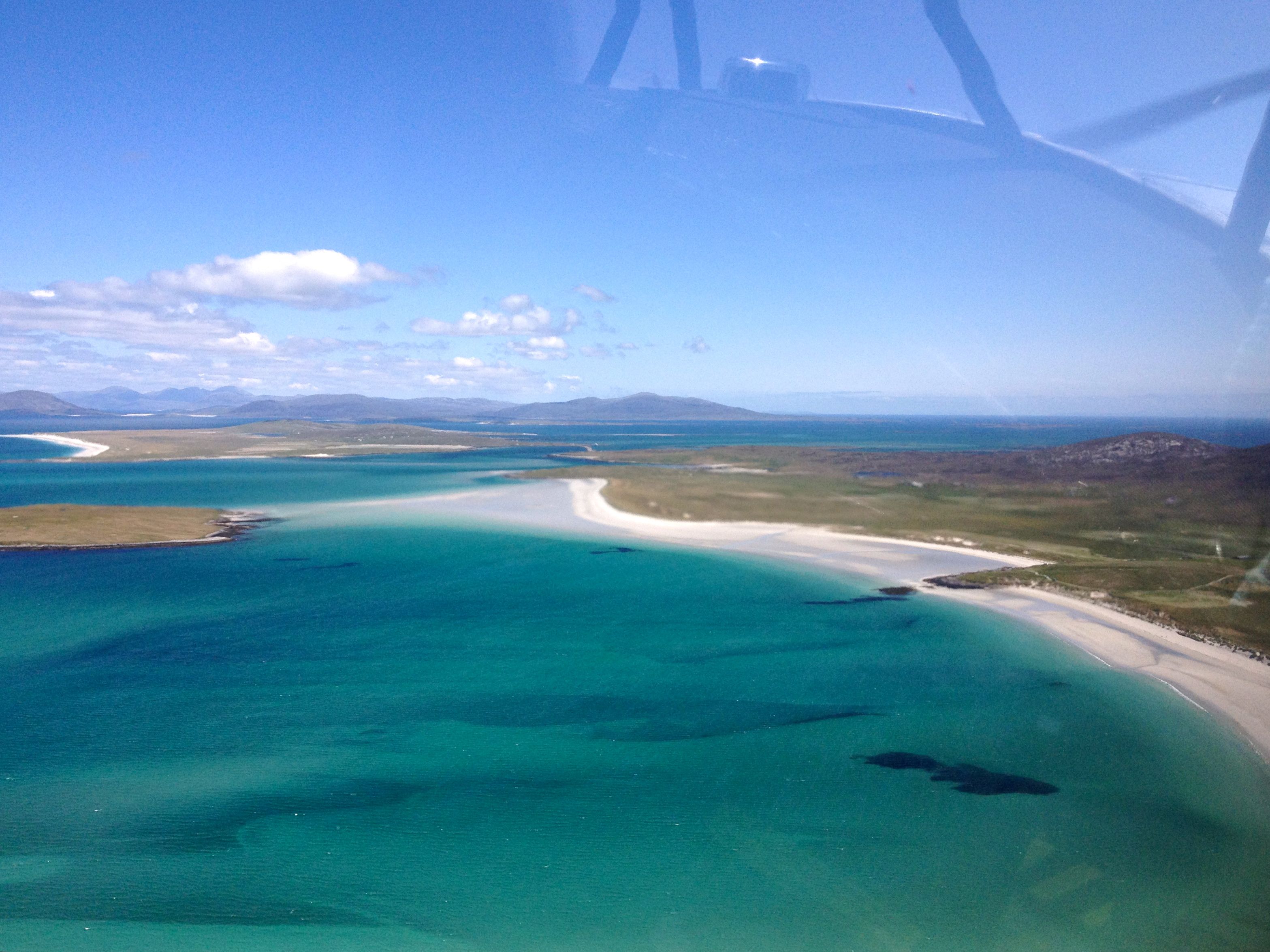
On climb out from Sollas
I got hold of Benbecular as I climbed out, who’d opened whilst I was sat on the beach at Sollas and they provided a basic service until I was two-way with Stornoway. Headed up the eastern side of Harris and Lewis, I was again treated to stunning views, looking back at Loch Mady as I climbed and then after crossing the Sound of Harris, looking west to the high ground and eye-wateringly beautiful sands of Luskintyre.
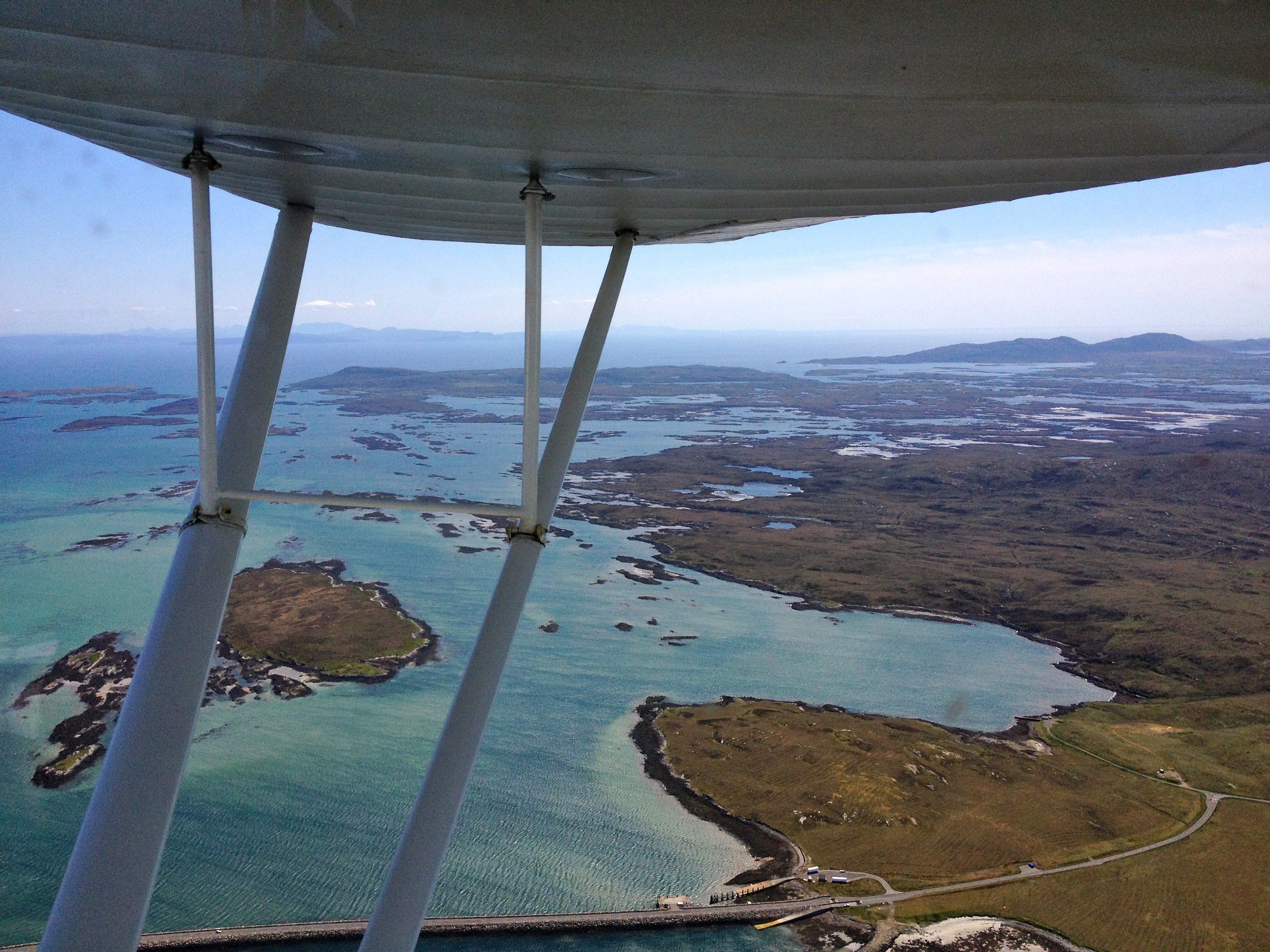
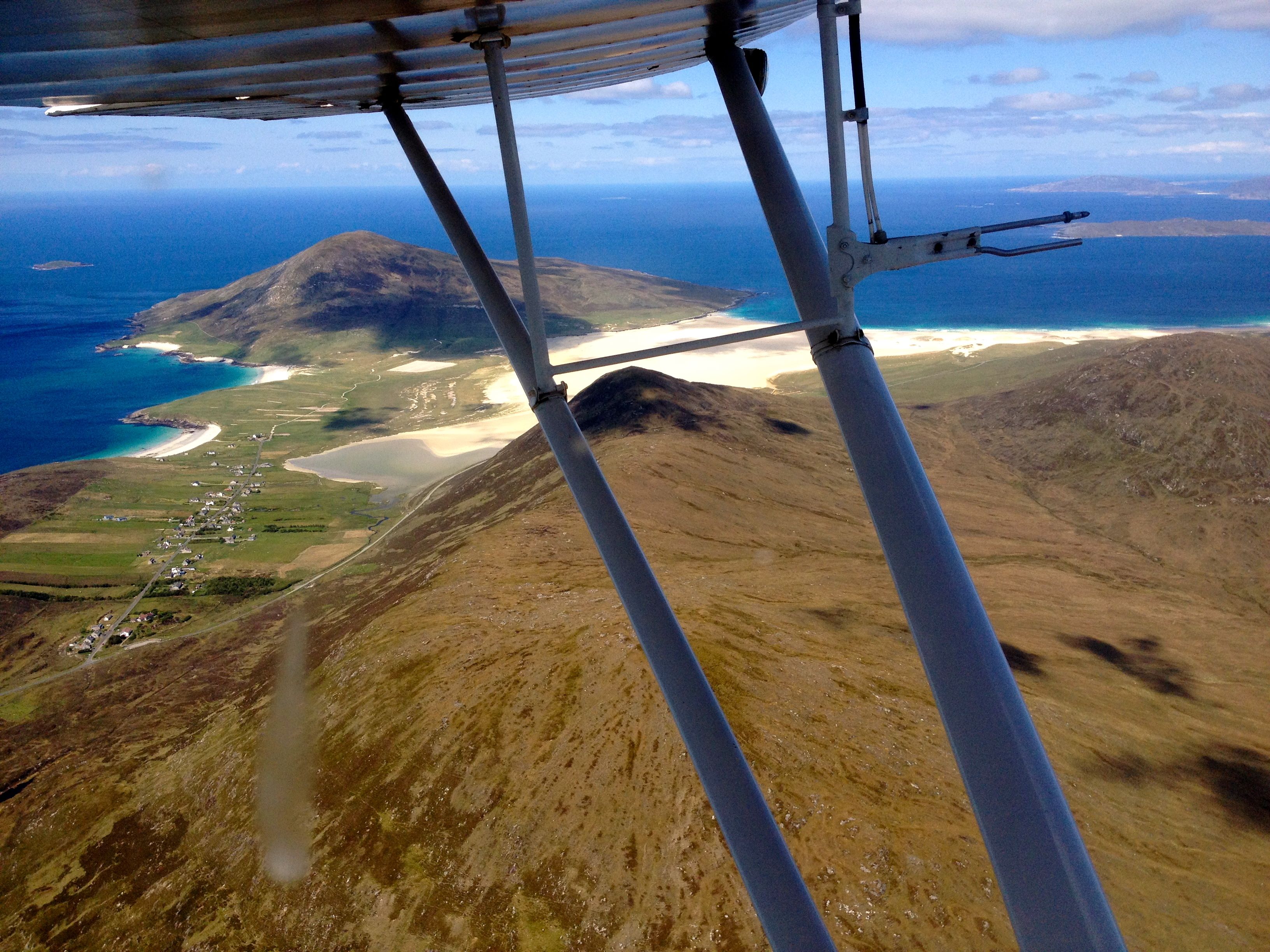
I was into the teeth of the wind as I headed up the eastern coast of Lewis and the ground-speed dropped to less than 60 knots. Once again, the flight became a little bumpy and the terrain gave way to an unforgiving moon-scape of rocks and hills, with little option in the event of engine failure. You’d be better going for one of the little bays and trying to ditch in the shallows, than take your chances on the terrain of the island.
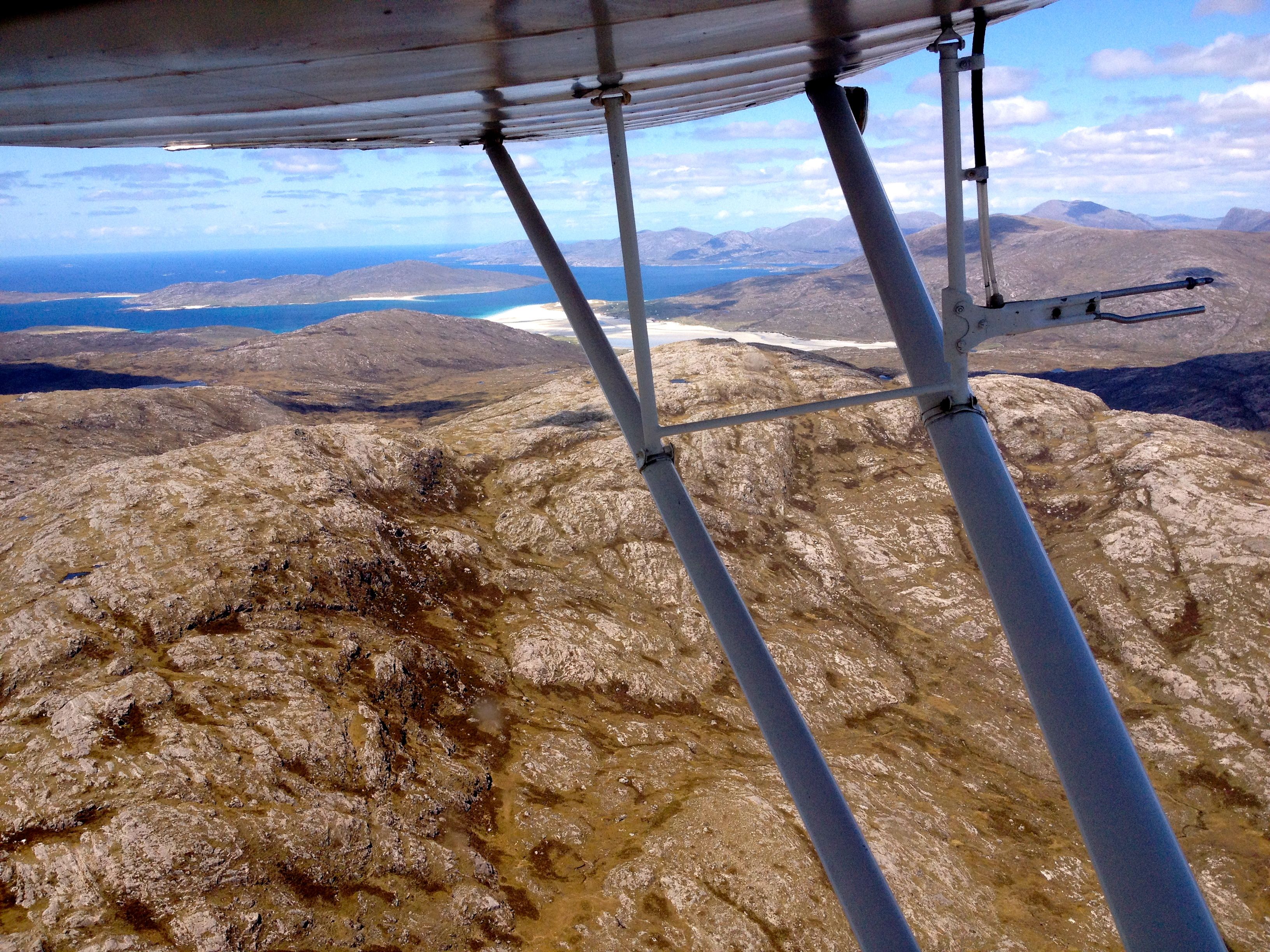
It took nearly an hour to cover the 60 miles to Stornoway and they had 15G25 at the field, luckily straight down runway 06. A bumpy approach was followed by a smooth landing and then an ultra-cautious taxi to the hangar where I would be meeting John.
It was a little like coming home arriving in Stornoway – I’d left the island in 2007 and had only lived there two years ( coming back in 2008 to get my Pitts off the island ) but it all seemed so familiar. It was good to see John again, too and his Jodel was almost finished – he was just preparing the engine cylinders to install in the C65 he’s decided to use for the airframe. The last time I had seen it, it had been in numerous bits dotted about his house!
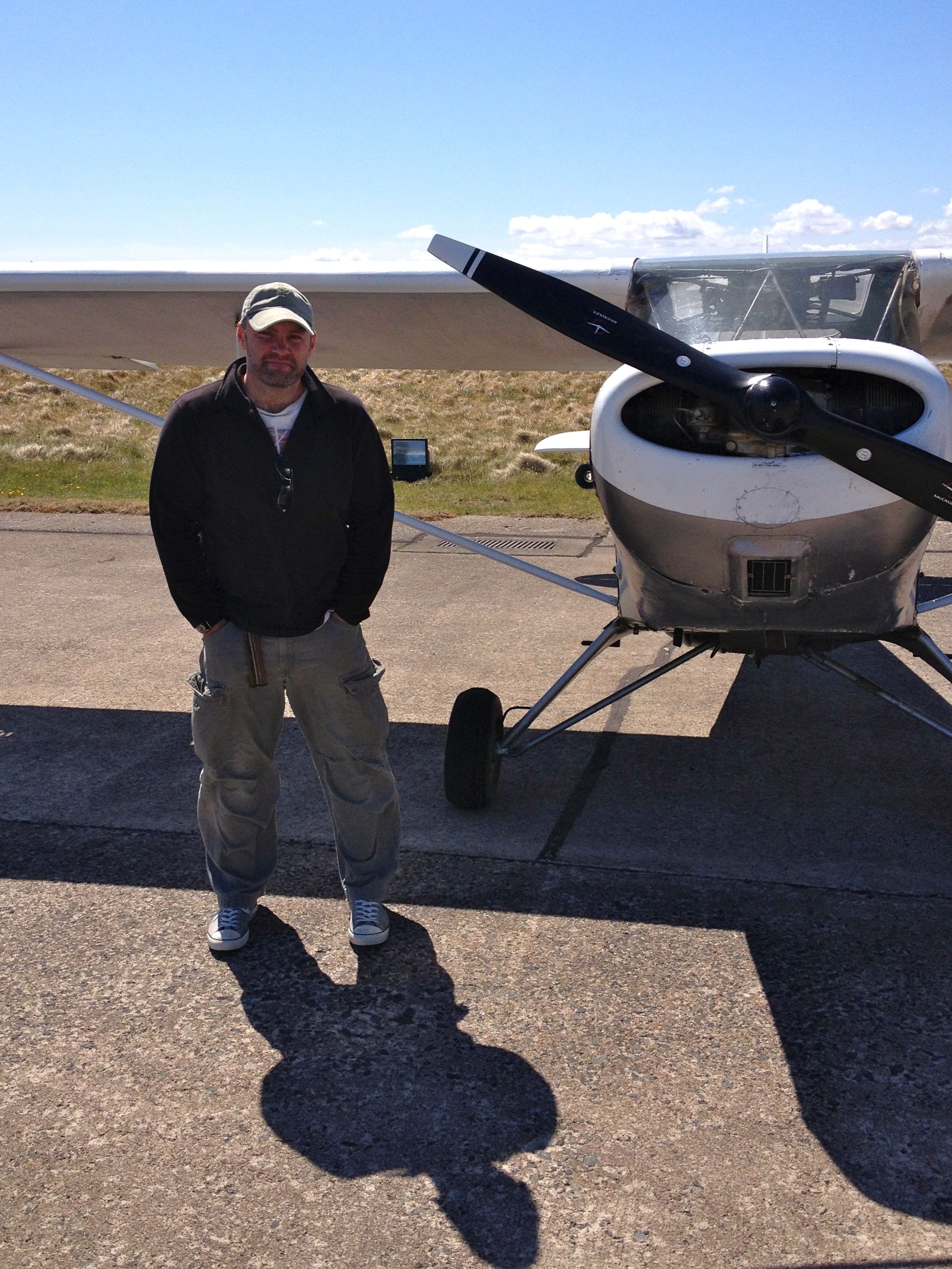
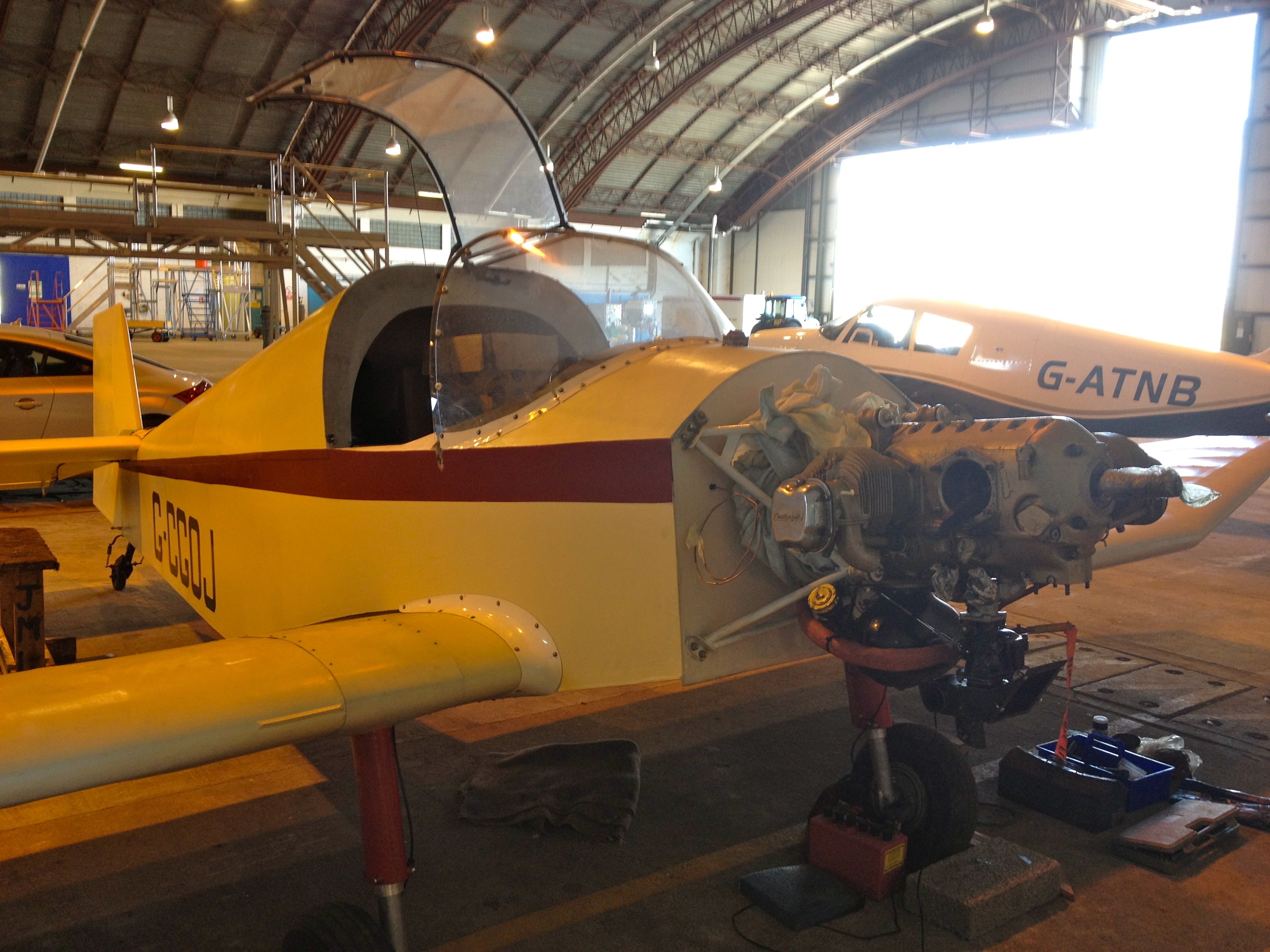
Author at a gusty Stornoway John’s Jodel, nearly complete.
I took on fuel and got a wind check at Glenforsa – which now was straight down their easterly strip at a contrasting 10 knots to Stornoway’s north-easterly 15G25. I had wanted to take John up for a flight, but the taxiing conditions weren’t great for coming in and out another couple of times and the wind was increasing.
I said hello to one of the guys over at the Coastguard helicopter unit where I used to work ( the crew were away on a job ) and got a lift across to the tower to pay the landing fee. After a quick coffee and a sausage roll ( my body is a temple ) I was keen to get going again and cash in on that tail-wind I would have going south before I bottled it!
The taxi down to the threshold of 06 was the most worrying part of the day – keeping the Auster tracking straight required almost constant use of the left heel brake as she just wanted to turn right, into the wind, the whole way down the runway. The gusts didn’t help on the take-off roll, either and she felt very twitchy until we were off and climbing. I watched John’s shrinking frame, stood on the apron, as I climbed away, giving him a quick wing wave before I turned south and headed back for Skye.
This time I was crossing the Minch via the Shant islands, lying a short way off the eastern Lewis coast about mid-way down the island. Skye, again, was visible from the moment I got airborne and looked invitingly close, so the water crossing didn’t seem too bad. I noticed the distinct wind lanes on the surface of the sea and white tops getting more pronounced, so the wind had been picking up all afternoon. I would be traversing the northern end of Skye on the route down, so this at least was up-wind of the high ground and would keep me clear of most of the turbulence, until I got closer to the mainland.
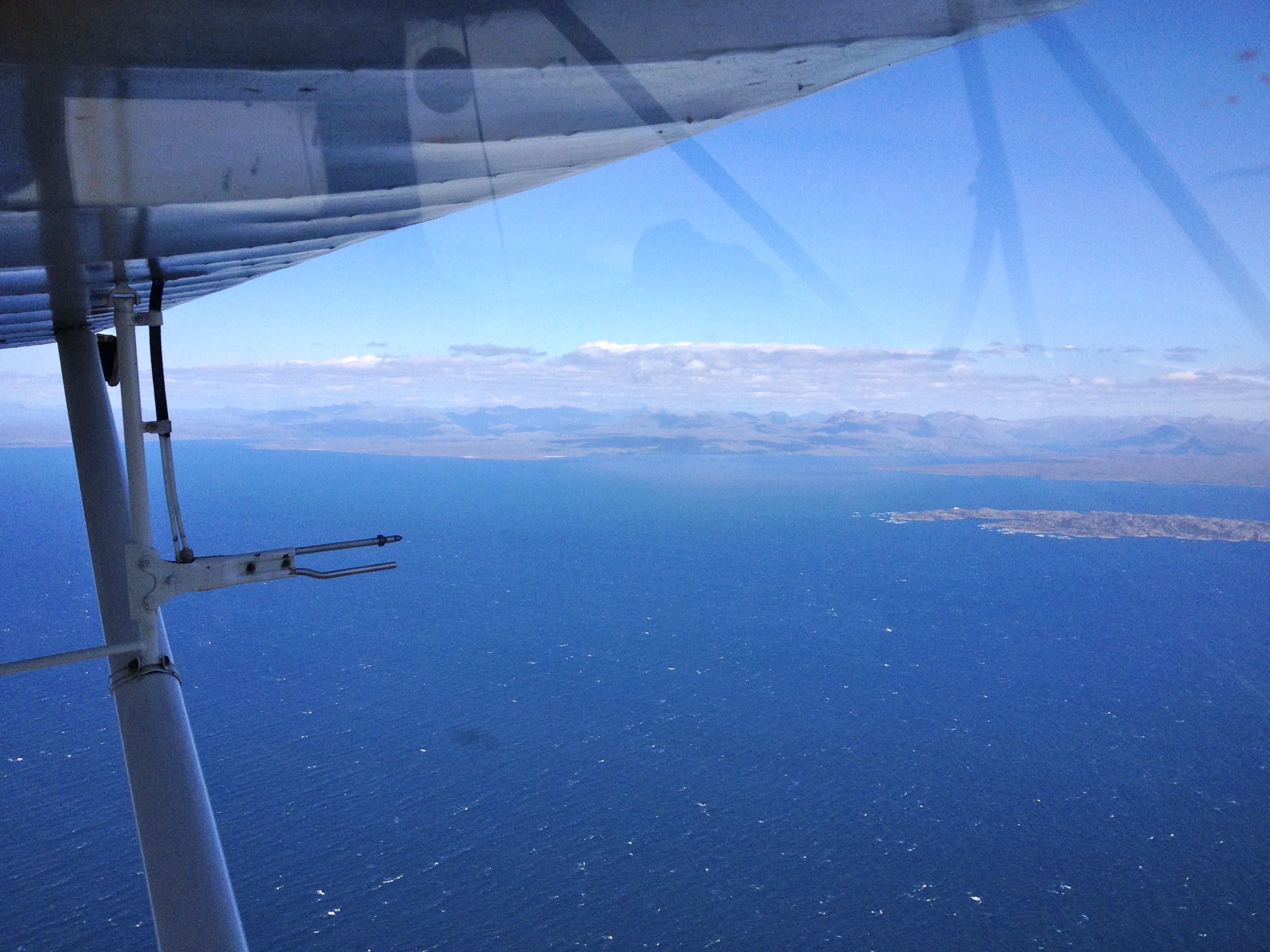
The flight was a lot smoother than I expected, however and it wasn’t until I was nearing Mull that I picked up any turbulence. Again, the scenery was stunning, and less intimidating now that I had become accustomed to flying over it. Skye was fascinating in the intricacy of its landscape – the mountain’s folds and terraces, dips and sheer cliffs made for a wonderful half an hour or more of viewing, as I drifted along, an airborne spectator blown by the wind.
I knew that the rocks and features in this part of Scotland were among the oldest in the world, weathered for thousands of years by the wind and the waves, but otherwise unchanged since the last ice-age. Looking out of the thin perspex window that separated me from this incredible landscape, I could almost feel how pre-historic it was; how ancient and unmoving. It was a humbling experience, flying along above those mountains and the twisted lines of its coast.
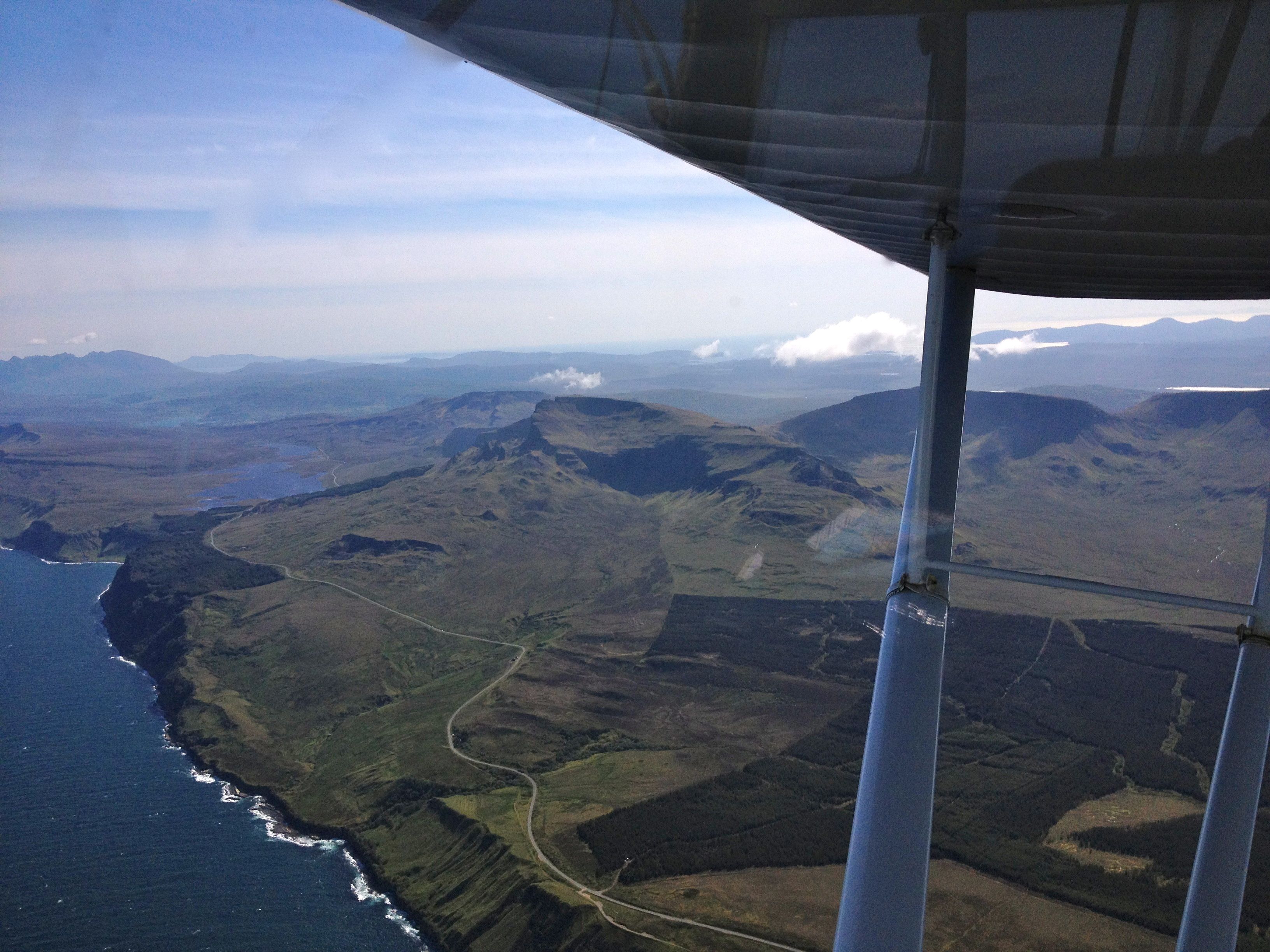
At last, I came to the Sound of Mull again, and the beautiful sight of Glenforsa, landing there at 17:15 local.
Glenforsa has to be one of my favourite airfields. It’s in such a beautiful location – 720 m of perfectly kept grass running along a shore-line at the foot of one of Mull’s many hills and landing there, you gaze out across the Sound of Mull, to the mountains to the north. It’s a truly wonderful spot. On site, is a nice Norwegian style, wooden chalet hotel, complete with a cosy Flyers bar, full of flying pictures, that does great food and has a far too tempting selection of good whisky! If you have the time, it’s worth staying here a couple of days or more – you can arrange car-hire at the hotel and explore Mull – visit the distillery and the colourful coastal town of Tobermory ( Ballamory in the children’s TV programme ). I had been determined to spend at least one night here for a long time and arriving felt a little like finding ‘Shangri-La’.
I found a spot in the parking area and was greeted by some onlookers, who bought me a pint! One of them turned out to be the uncle of one of the pilots at work! Small world….I enjoyed that, after over four hours flying that day, and then set up camp.
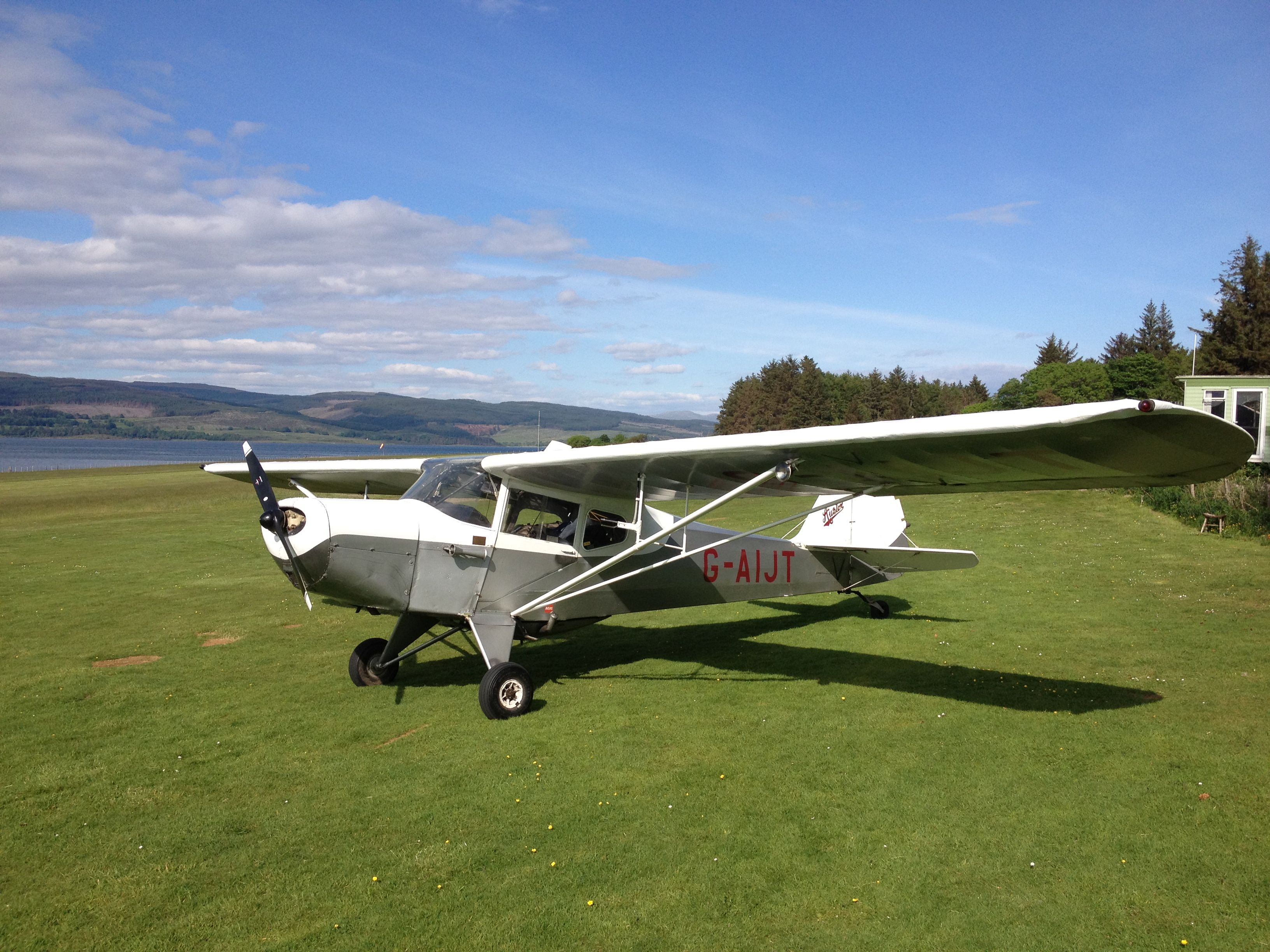
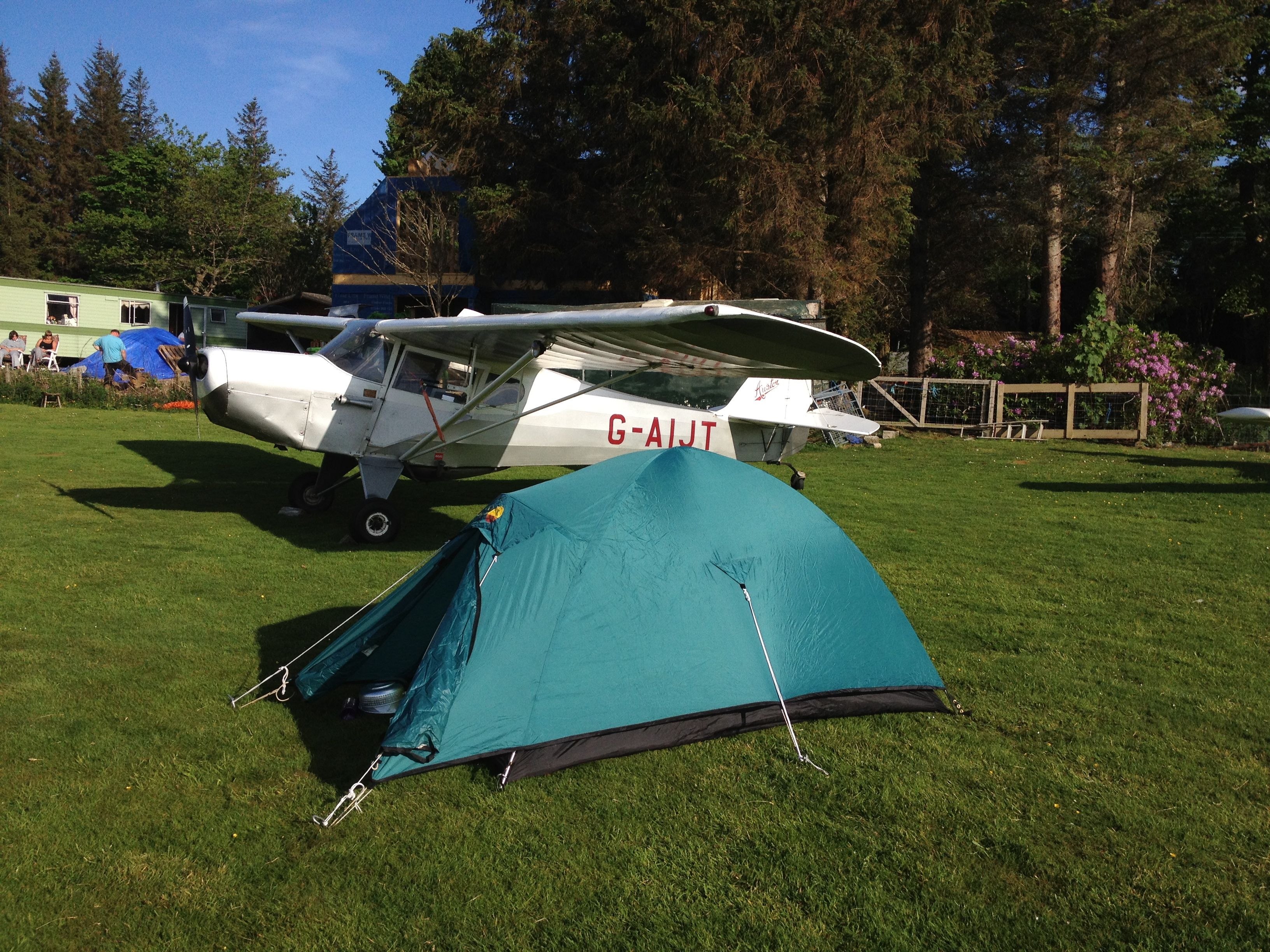
The landing fee is £10.00 and includes camping if you so wish, which I think is pretty good. For another £10.00 to the hotel, you get hot showers and a cooked breakfast thrown in. Not bad.
I truly felt like I had arrived in heaven but there’s always something to spoil an idyll and on this occasion, that something was the dreaded Midge. Any time spent outside resulted in being eaten alive, but many people braved it for a spectacular sun-set that was hard to resist. There were a few other machines parked up there – a Sport-Cruiser whose pilots had flown up through some bad weather from Carlisle and then later, two Sky-Ranger Microlights arrived, whose affable pilots had experienced quite a trip all the way from Lincoln – dodging 200 ft cloud in places! And here I was, thinking I was intrepid……..
I enjoyed a good meal and a few beers and then hit the sack, by which time the Midges appeared to have gone to bed, too, luckily. I kept the tent door flaps open for a while, watching the last throes of a gorgeous sun-set over The Sound and then crawled into my sleeping bag and fell asleep pretty much instantly. It had been a long but wonderful day’s flying – the sort of day’s flying I’d dreamt of for a very long time.
Day 3: Today, I ideally wanted to head for Inverness, giving me the option of continuing on to Orkney or heading for the home strip. A trip up the Great Glen sounded feasible, with the military off for the weekend and being into wind, but a fresh north-easterly would have made slow going all the way up the Glen and the potential for a long, turbulent flight had me thinking of other options.
Another possibility would be to head for Perth. They had rain and low cloud forecast by 16:00, so I needed to get there by 14:00, ideally, giving me a clear run. A check at Inverness revealed increasing showers to the north and that made my mind up to just head for Perth and then home. I could assess the weather from there and go on to Orkney later in the week. I thought I might try to route via the Glens to Perth, hooking up with a valley south of Oban that would lead to Loch Tay – if I was careful, I thought, I could stay up-wind of the high-ground in the valleys and avoid getting thrown around too much.
My back up plan was to turn south and head for the Clyde, before routing up the low-ground to Perth, if the cloud base or the winds in the hills made life a bit too difficult. The good thing about JT is that she carries plenty of fuel and I had no worries in that regard. The bad things are that: 1) She’s underpowered and 2) She has a very light wing-loading. These facts make flying through the hills in anything but very light winds something to think very carefully about.
After a good breakfast, packing away my gear and saying my goodbyes, I got airborne with a loose plan at 10:15.
I climbed out over the green flanks of Mull and headed for the Oban over-head, 16 nm away. It was another lovely day, though with a thickening cloud base over the hills at about 5000 ft or so. Once more, the beautiful back-drop of Oban and its airport didn’t fail to impress.
I routed south of the airfield due to west bound traffic that had just gone through Oban’s over-head and headed straight for my ‘link’ valley, which looked to have some space at its northern end before the high flanks of its southern extreme, where I was planning to route up.
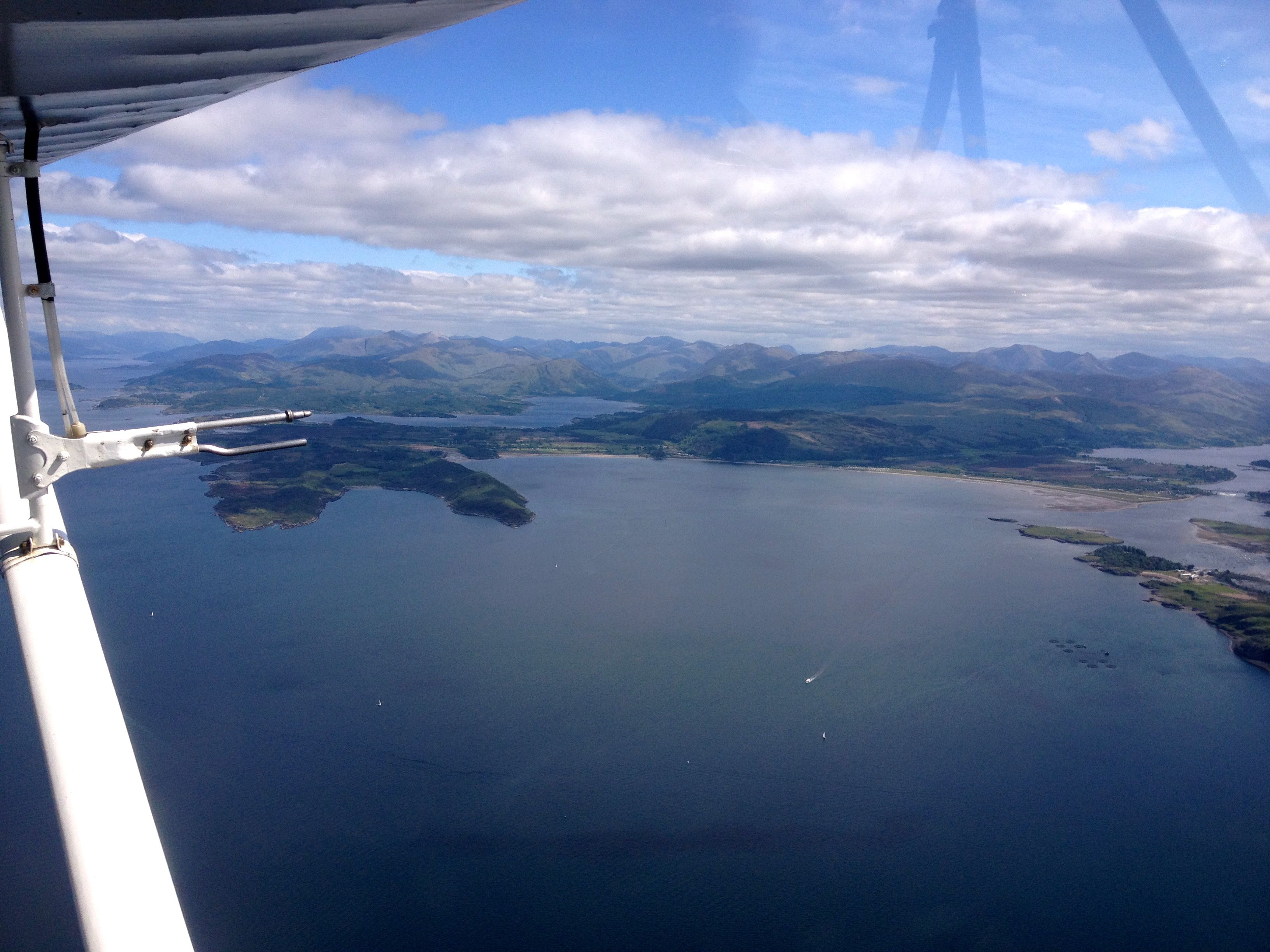
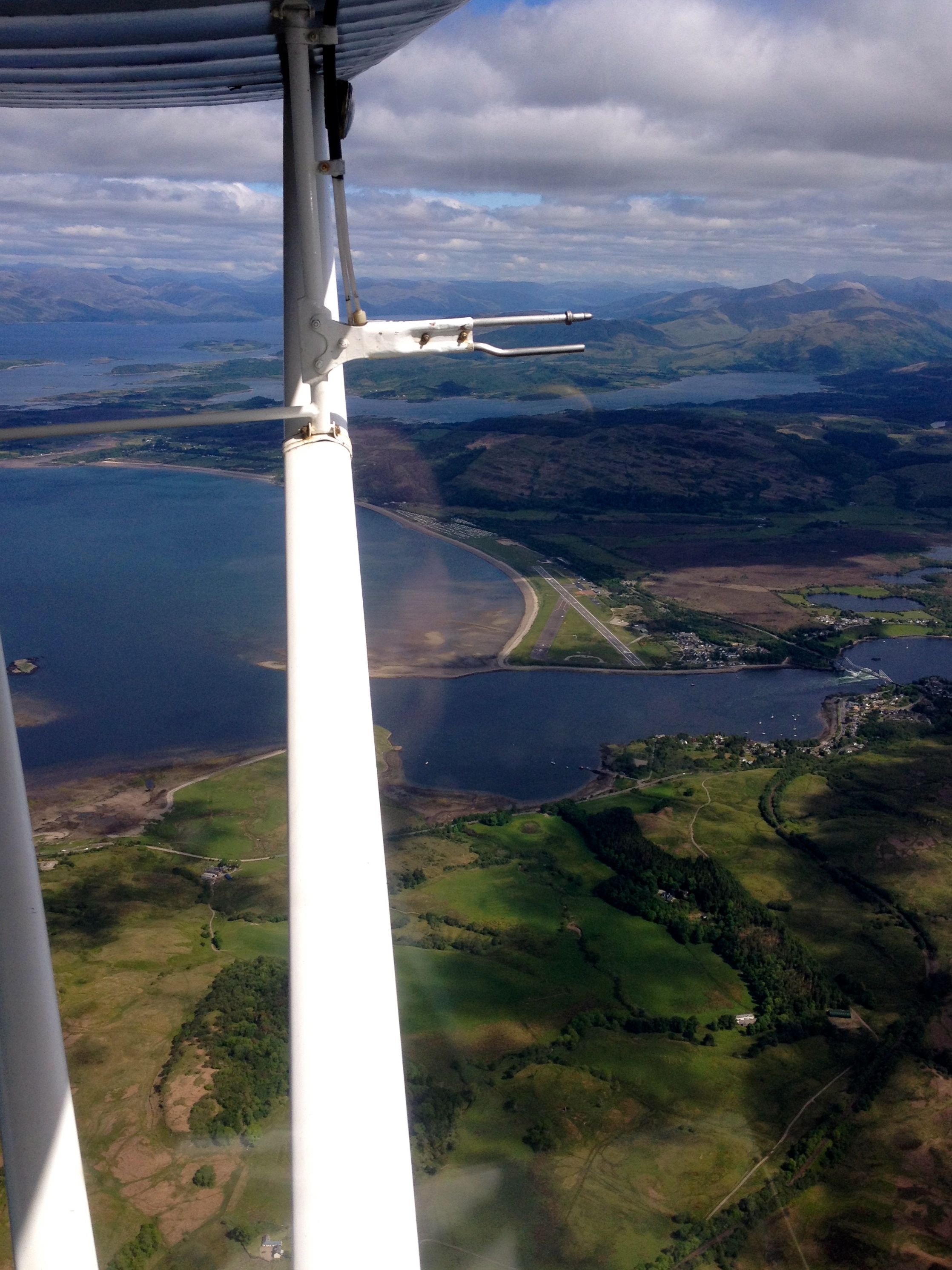
Approaching Oban from Mull Oban airport
As soon as I passed Oban and got near the hills I started getting buffeted around more severely than I had experienced on the trip so far and was forced to head further and further south, missing out a couple of waypoints and route more circuitously for my ‘linking’ valley. It only got worse and the cloud-base meant that I couldn’t fly much higher than 4,500 ft, which left me still in a very turbulent zone. Employing that well-worn axiom of ‘discretion being the better half of valour’, I decided to high-tail it for the Clyde.
I still had a few valleys and peaks to cross, however and for a while I had to grin and bear it until I was headed for ‘The Clyde’ reporting point. This was after, only just. successfully negotiating the Faslane restricted area and the need to avoid a down-wind section of high ridges in the valley leading south.
Eventually, I was spat out over the estuary and could route happily for Alexandria, another reporting point for transiting the northern edge of Glasgow’s airspace. The buffeting continued but I was, at least, now over lower ground and was treated to the lovely sight of Loch Lomond before at last, reaching the wide, fertile valley that runs from Glasgow to Perth.
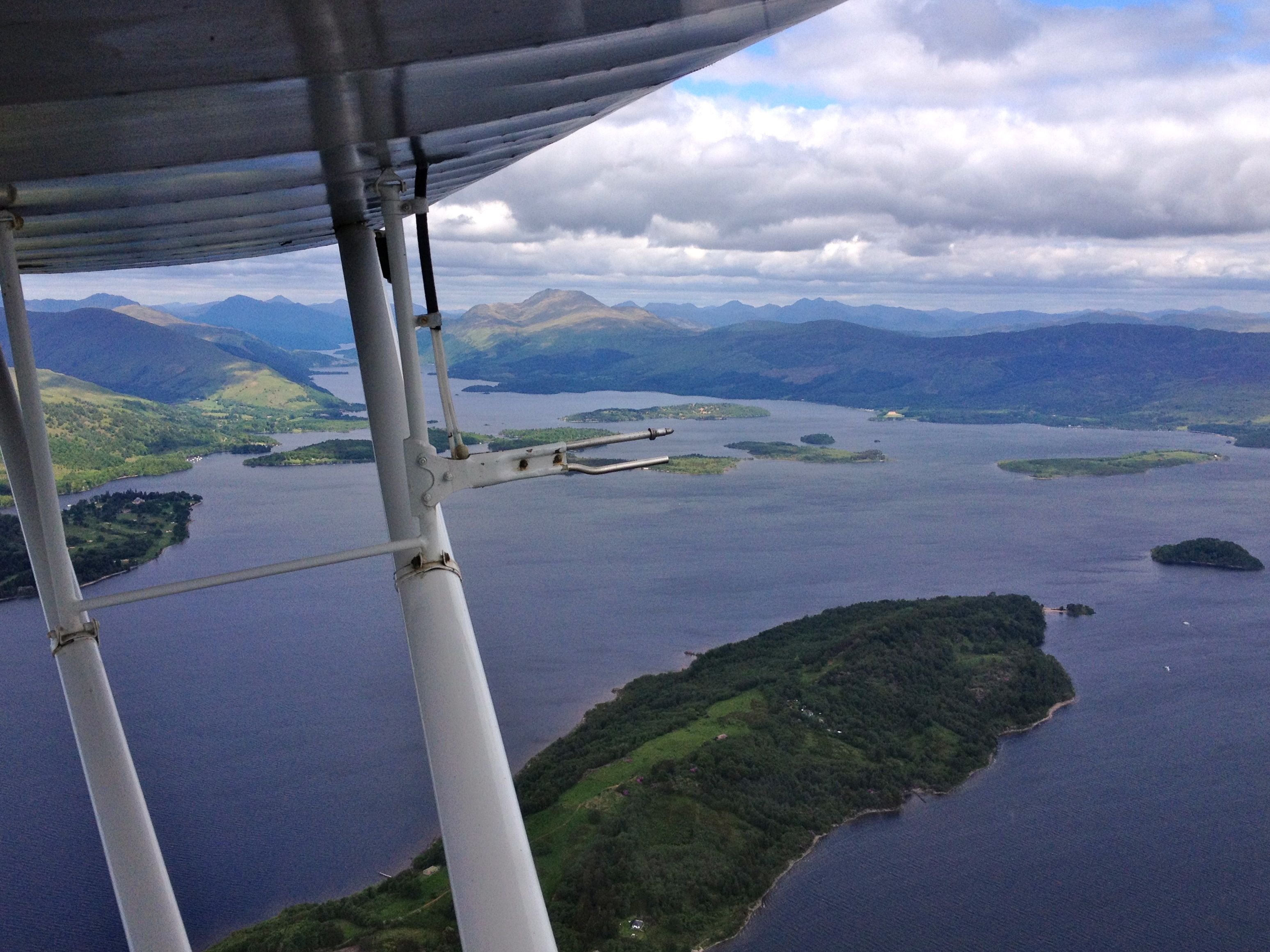 A welcome Loch Lomond on the flight from Glenforsa to Perth
From here the flight to Perth was very pleasant – enjoying what the Auster is best at: chugging sedately along at 1,500 ft above a lush, green landscape of fields and villages. The flying now practically took care of itself and I was content to just take in the view as JT tracked across the landscape below, at a pedestrian 70 knots. At one point, we paralleled the M74 motorway and the traffic below was over-taking me! I still had that head-wind, making us hard-to-believe slow, but my mode of travel, to my mind, was still far better than those in their cars below. Still, it was a little embarrassing.
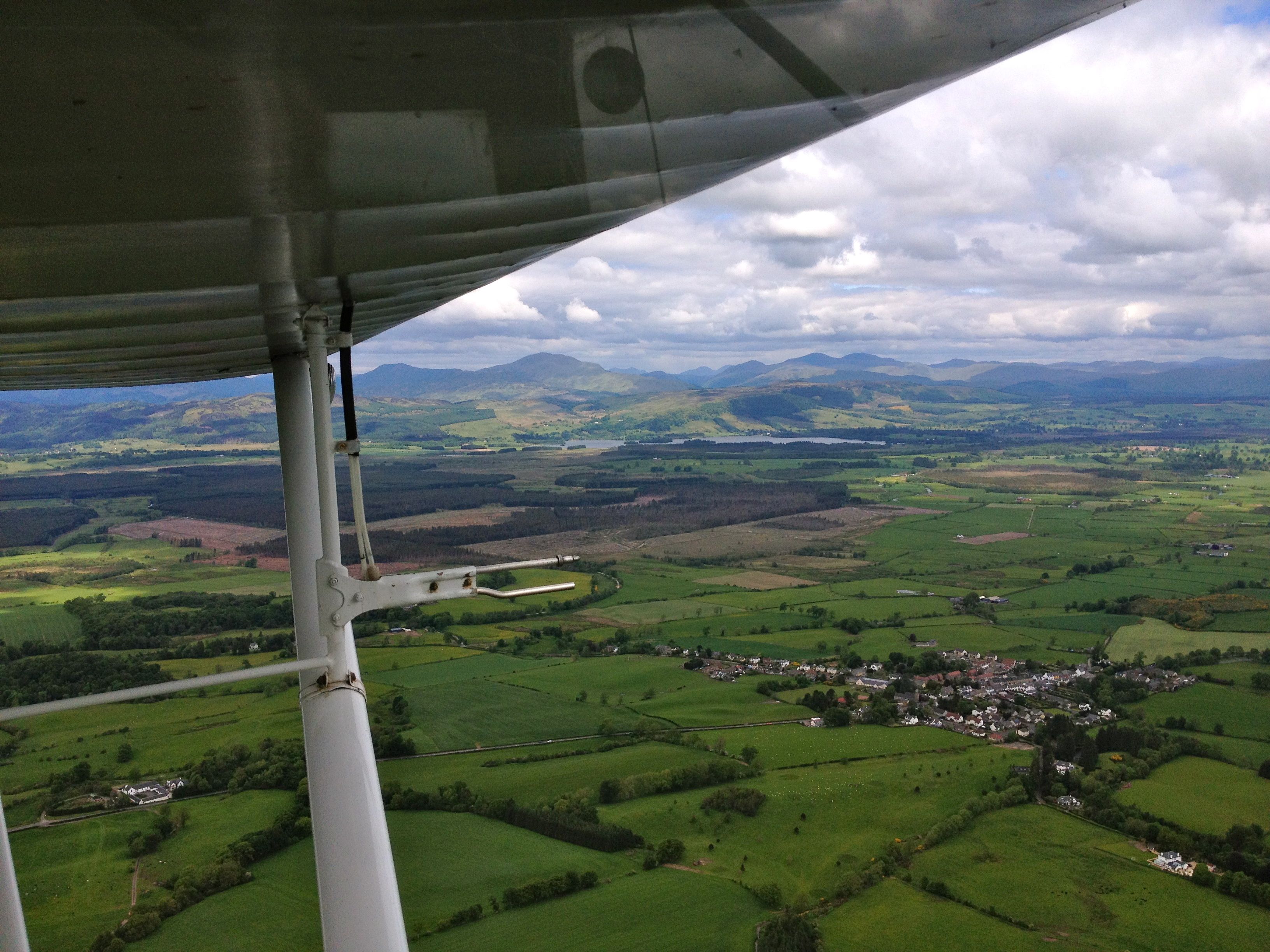 Routing north to Perth
At just before mid-day, I landed at Perth with the wind straight down the easterly runway and the cloud just beginning to thicken and lower. I topped up the main tank and checked the weather at Aberdeen, which also had rain forecast for the afternoon. The rain was holding off, however and the cloud base holding up, so after a quick coffee and bite to eat, the Auster tank filled, mine emptied and the bills paid, we were off again at 13:00.
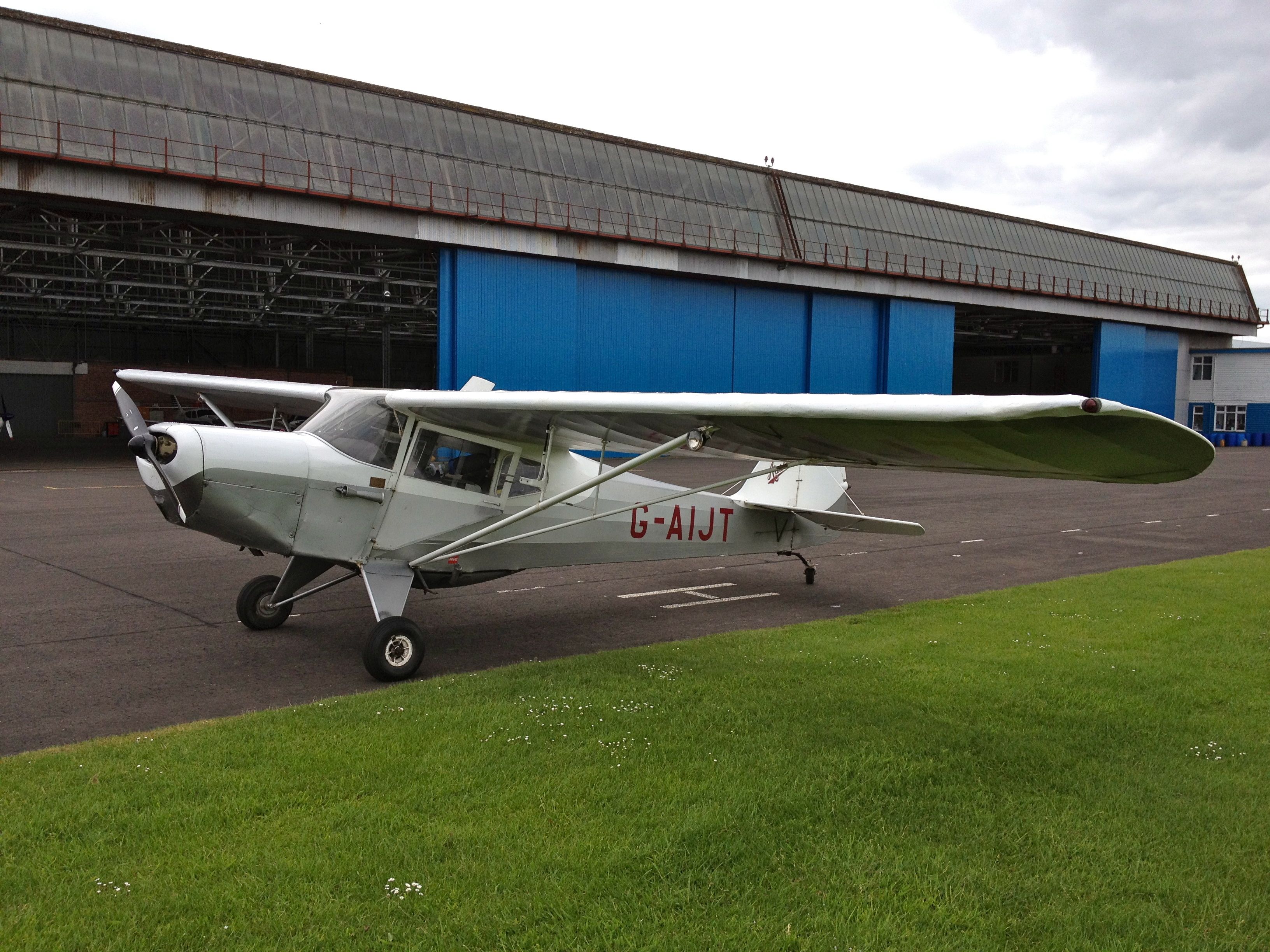
JT at Perth on the way home
The flight up was now a familiar one. Once again, I was almost the passive observer, gazing out the window as the Auster took me north, occasionally checking the position on the chart or making a radio call and position report to Scottish.
Arriving back over the even more familiar Aberdeenshire landscape, with the lovely Deeside valley leading from Banchory to the rounded domes of the Cairngorms to the west, it all felt quite cosy and tame in comparison to the dramatic Highlands and Islands landscape I had been flying over the last couple of days. The dips and folds of Aberdeenshire’s lush valleys and gentle farm-land seemed to be welcoming me home. Soon, the home strip itself came into view, standing out starkly against the surrounding fields after being cut so recently. The northerly wind meant an approach into the cross-strip, which had been out of action due to soft ground and water logging for months, but which was now in surprisingly good condition. We bumped down and I taxied back to the hangar, cutting the engine at 15:10. The seemingly almost continuous rumble that had been my companion for the last three days, now went quiet and I could hear only the sound of the birds that lined the trees around the strip.
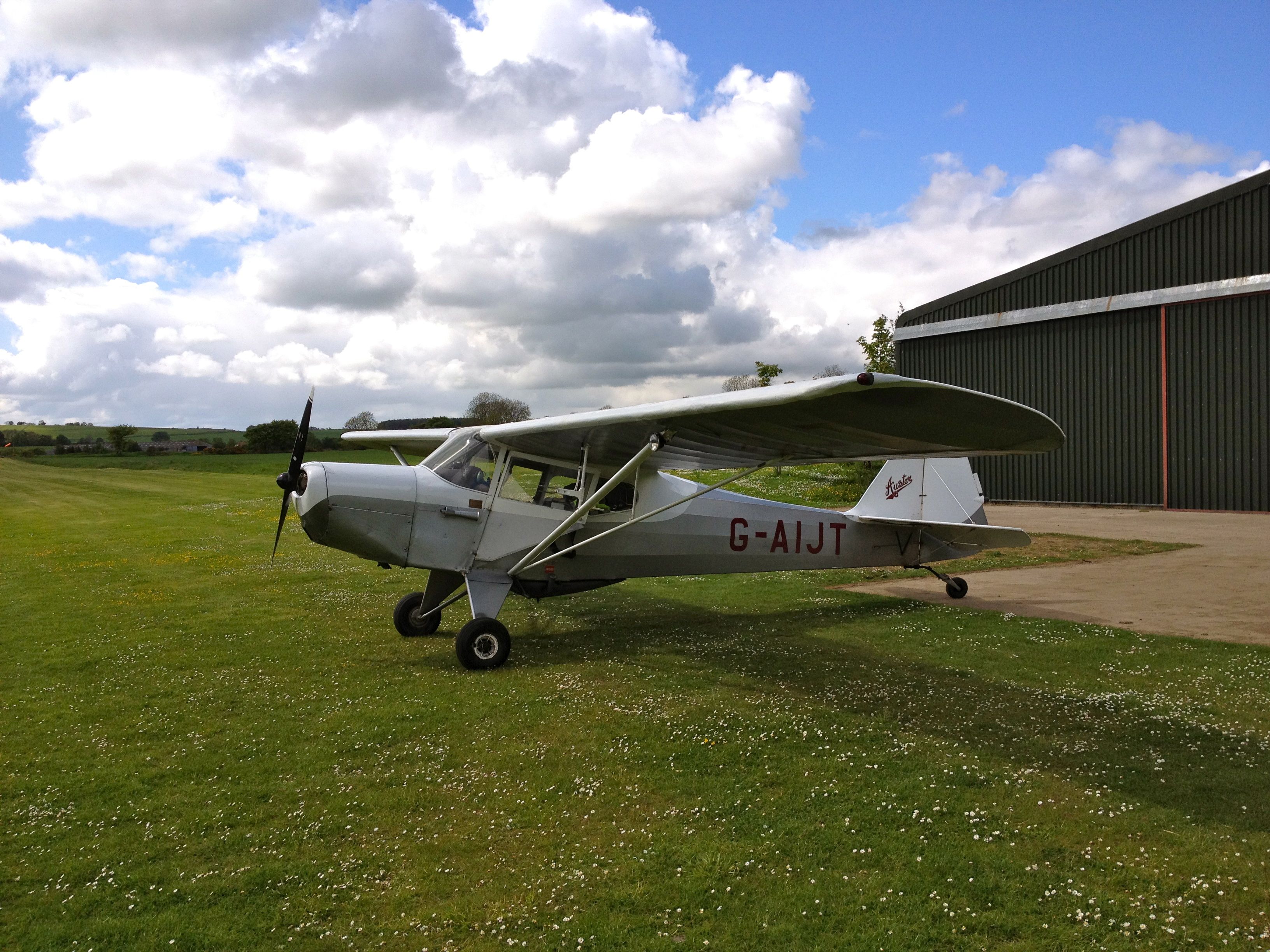
It was a lovely place to come back to – deserted, again, like the beach on Sollas. No terminal, no landing fees, no security passes. Just a field and a small hangar full of simple flying machines belonging to people who simply like to fly. It had been quite a trip and one I was glad to have made. Some things stay in the mind, and the sight of the Auster parked up on that beach is one of them; not because of the sight itself, but because of what it represents – the rewards and the adventure that flight offers us.
I’m looking forward to the Orkneys.
 The Auster Diaries
Looks like an excellent trip buddy!
Steve D
Cheers Steve!
Keep enjoying that sunshine! 🙂 And keep in touch.
Pingback: West Coast and Islands | The Auster Diaries
Pingback: JT featured in Jan Edition of Pilot Magazine | The Auster Diaries