
The airport at Dyce, about seven miles north of the city centre, first opened on the 28th July 1934 and is now the second busiest airport in Scotland and the fifth busiest in the UK, with passenger numbers expected to reach five million by 2030. Forty percent of the aircraft traffic in and out of the airport is accounted for by helicopter flights, which fly out and back to the rigs and vessels of the North Sea on a daily basis and in all weathers. I have spent half my flying career to date, flying in and out of this airport and watching it continue to grow, I am ever mindful of its humble beginnings at that brief but frantic period in the decade before WWII.

The airport owes its existence to the flamboyant and ambitious Eric Leslie Gander Dower, who first set up the airport proper at Dyce and entered into a commercial war of attrition with his airline, Aberdeen Airways, against Fresson’s Highland Airways to the north in the heady days between the two world wars.
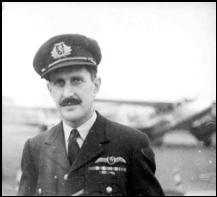
But what brought Dower to Aberdeen in the first place? He was born into a wealthy family in London in the year 1894 and was educated at Cambridge after the Great War. His early life is dominated by the stage; first with touring production companies and then with the Cambridge Footlights crowd. In parallel to his passion for acting, however, a burgeoning love of flying was also dominating his young life.
Like Fresson, he was inspired by the first pioneers and had taken his motorbike to Dover to watch Bleriot arrive on the first crossing of the Channel. He ran away from his boarding college in 1910 in a failed attempt to convince the newly formed British Colonial Flying School to take him on, much to the disapproval of his exasperated parents. His acting skills were being honed, however and he pursued this line after school, managing to find parts in productions by the well known directors of the time. His interest in aviation continued in parallel to his love of the stage and he took a flight out of Shoreham with a famous pilot of the time, taking the first aerial photograph of Brighton Pier whilst doing so.
In 1914, whilst touring Scotland with a stage company, he heard of an upcoming aerial event taking place just north of Aberdeen. A Norwegian adventurer and pilot named Tryggve Gran would be attempting the first crossing of the North Sea in a Bleriot Monoplane, taking off from the small, crescent shaped beach at Cruden Bay to strike out for Stavanger. Eric somehow managed to convince the respected aviation magazine ‘The Aeroplane’ to allow him to cover the event for them and he travelled up to the region to meet the intrepid pilot and witness the crossing.
In the end, Gran had to wait three weeks for suitable weather, finally departing from the small beach at Cruden Bay on the 30th July, 1914, making the hazardous 350 mile crossing successfully in five hours and forty minutes. By this time, Dower had to return to his acting career and had gained a place at the prestigious Royal Academy of Dramatic Art, but he had become friendly with Gran during his Aberdeen visit and wrote several articles about his ‘courageous achievement’ in the aviation press. The crossing left a deep impression on Dower, one which he would carry with him for many years and would be poignantly remembered when he eventually set up his own airline in the Granite City, inaugurating the first passenger carrying service across the North Sea to Stavanger with Eric Starling at the controls.
The advent of the Great War shifted Dower’s focus back to aviation. His three brothers had enlisted whilst Eric was still at RADA and his disapproving father had put a clause into his inheritance that greatly reduced any allowance if he should still be acting by the age of 28. Dower followed his brothers into the Army in the spring of 1915, aged twenty-one, enlisting in the Cavalry, but caught a bad bout of influenza and was sent on a month’s recuperation leave in June/July of that year.
Whilst on leave he wisely decided that the Cavalry was not for him and spent the month learning to fly at Hendon, with the intention of changing his service career. On return from his leave he got a transfer from the Army to the Navy and gained his pilot wings. He spent the remaining three years of the war flying as a Naval Pilot, taking part in anti-Zeppelin patrols and Fleet protection duties from bases throughout the UK. This did nothing to appease his father, however, who regarded his son flying aeroplanes in much the same way as he regarded Eric’s youthful escapades on his motorbike.
After the war was over and by 1919 Dower had returned to an acting career and was making enough of a living out of it not to have to rely on his parents’ money. This small success came tragically a little late to ease the tension between himself and his father, who had passed away following an illness and through the grief of losing his eldest son, and Eric’s oldest brother, to the war. Despite further misgivings from his surviving brothers about his acting, Dower devoted his efforts entirely to his stage career and was doing well, playing all the major Shakespearian roles with the London Shakespearian Company and going on to found his own Stage Production Company off the back of this success. Two of his brothers had enrolled at Oxford in 1921, however and ever conscious of the clause in his Father’s Trust Fund, Dower decided to go for a degree himself, entering Jesus College, Cambridge, in the October of 1922. It was whilst studying at Cambridge that the final link to the north and his calling to fly would complete the chain which would forever associate him with Aberdeen.
Dower became friendly with another student, named Robert Cowell Smith, who had helped him to provide transport in London as volunteers during their last year as undergraduates in 1926, following a general strike. Smith came from the small Deeside town of Banchory, resting on the banks of the Dee and just fifteen miles west of Aberdeen. Dower was still very much passionate about flying, keeping in touch with events and having all his mail, somewhat pompously, delivered at the Royal Aero Club in London. Smith knew this and had seen Dower’s adventurous spirit and organisational skills in full play whilst rallying the other undergraduates to assist the government during the general strike. Visiting Dower one day, he almost casually suggested that the two of them should look into setting up a Flying School in the Aberdeen area. Dower was, of course, interested and pronounced to Smith that one day he would fly up to the area and survey it for potential. The brief discussion was all but forgotten whilst the two finished their degrees, but it would lead to a great deal more than either of them could have suspected at the time.
He spent the next few years after graduation more or less as an aviation socialite, frequenting the many flying clubs and air events around the UK and buying his first aircraft, the Blackburn Bluebird that would come to be so hated later by Eric Starling, in December 1929. Meanwhile Robert Cowell Smith, now living back in Aberdeenshire, had got together with a band of other local men of note to try to establish a new aerodrome at Dyce. In 1930 they met with Dower at a hotel in Belfast, where he was staying for the Ulster Grand Prix; one of the many events on his busy social calendar, to talk with him about the proposal.
The following year Eric flew up to Aberdeen in the Bluebird with his great friend and experienced pilot, Angus Irwin, at the controls. Angus was still in the RAF Reserve after a distinguished career with the Royal Flying Corps during the Great War and had met Dower at the Royal Aero Club, going on to fly for him in four King’s Cup Air Races. Dower preferred to have a pilot of such experience with him when he flew and had invited him for the trip north. They landed after a few days, with numerous stops along the way, at a nondescript fifteen acre field at Dyce. This humble field would eventually become Aberdeen’s official airport.
Leaving the south and his life of leisure behind him, the flight north to Aberdeen marked the beginning of a new era for Dower; one that would come to define him. On touching down, surrounded by a throng of waiting spectators, he proclaimed that he would, “build an airport and found an airline here, and start routes to different places!”
This dramatic proclamation is tellingly vague and characteristically spare of the moment. Dower clearly wanted to make his mark on the world and his ideas were always grand in scale, if not carefully thought out. I think it’s fair to say that he enjoyed the spotlight, but his acting career had always been frowned upon by his family and ultimately hindered by the clause in his trust fund. He greatly admired the many famous pilots of the era, going out of his way to get to know them and it seems as though he was searching to create a fame of his own; perhaps to somehow gain a wider acceptance that was always lacking from his Father. He readily admitted to his friends at the time that he was not the great aviator that perhaps he wished to be and it was here, in Aberdeen, that he saw his chance to really create something and make a name for himself. His skills lay in showmanship, motivation and organisation, and he had the Capital. Creating an airline in this quite corner of Scotland was the perfect thing for him.
Smith and the other local businessmen, who had leased the fifteen acre field for the use of Aberdeen Aero Club, which they had already formed, now looked to Dower to help them form a company to buy up more land and build a proper aerodrome, with hangars and a club-house, as well as additional aircraft. They decided to form Aberdeen Aero Services Limited, with Eric acting as principal director and providing 25% of the £10,000 required to set up the company and the aerodrome. The scheme was stalled for three years in the end, however, as Dower needed to return south with Irwin in the Bluebird to make arrangements with the banks and during this time, the economic depression hit. This and the death of his mother, who he had always been closest to, kept him in London throughout 1932.
Dower remained in the south through to the end of 1933, keeping in touch regularly with his business associates in the north, but unable or unwilling to act during this time. He had also got caught up in a new passion: air racing and had bought a new machine for the job; a DH80A Puss Moth in the Cambridge Footlights colour scheme of purple, white and yellow. He entered this into five Kings Cup Races in total, with Irwin at the controls, flying into eighth place in the final of 1931.
Things finally started happening at Aberdeen in October 1933, spurned on, no doubt, by the rapid progression of Fresson’s service to the Orkneys out of Inverness to the north. Fresson had also acquired the use of two fields at Dyce when flying into Aberdeen on occasional charter runs and they now lay in the area of additional land that was in Dower and the other’s plans for the proposed aerodrome. Fresson’s activities hastened the work and Dower was quick to monopolise on the use of the airport and his future business plans. In January of 1934 he registered four companies: Aberdeen Airways Ltd, Aberdeen Aerodrome Fuel Supplies Ltd, Aberdeen Flying School Ltd and Aberdeen Flying Club Ltd. The small fifteen acre site at Dyce, lying between Dyce village and the Railway station to the east and Tyrebagger hill to the west, was now much larger and had three main grass runways of 1000 yards each and a fourth of 600 yards, with two large hangars, complete with concrete ramp areas, a club house for flying club members, as well as offices. Its presence would forever reshape the city and the region as a whole.

To protect his interests, Dower withheld the use of the aerodrome from the other airlines ( which was resiprocated in the airfields to the north, controlled by Fresson ) and despite having an agreement in principal with Fresson to concentrate his efforts southward, leaving Highland Airways free to develop the routes to the north, he began looking into establishing his own services to Orkney and Shetland. He shrewdly saw that these routes would be more profitable than those to the south, which were in competition with an already reliable and well connected rail network with a loyal passenger base. Having previously attempted to establish routes southward to Glasgow and then Edinburgh without success, Dower was now convinced that the future of Aberdeen Airways lay to the north and a fierce battle for the Aberdeen to Orkney and Aberdeen to Shetland share of the market began.
Fresson was forced to use an alternative landing site at Seaton, near the coast and then later established a small aerodrome at Kintore, just a few miles north and west of Dyce and still used today by a small helicopter company. Fresson controlled the Wick and Kirkwall aerodromes to the north, however and both competitors were refusing access into each others’ airports without stiff landing charges. Dower surveyed alternate sites at Thurso and in Orkney, as well as in the Shetlands, with his chief pilot, Eric Starling in their Shorts Scion. Each site selected needed to be prepared for use, at great expense and Dower’s account was haemorrhaging money at an alarming rate, which wasn’t helped by meagre passenger numbers. Looking back on the ambition which characterised the early days of Aberdeen Airways, he once said, “I was far too ambitious. I arrived in Aberdeen to start a flying school, and immediately I wanted to start an airline as well. I was full of conceit………………….Caroline [Dower’s wife] begged me not to be so stupid and told me: ‘You will lose all your money’ – and how near she came to being so right!”
The only truly profitable service for both companies was the cross Pentland Firth service, from Wick for Fresson and from Thurso for Dower, since it offered a much quicker and more comfortable crossing for the passengers than the often rough and tumble experience of the ferry. The fierce competition between the two airlines on these routes, with neither side ever gaining an advantage, continued throughout the mid 1930s and ever looking for an advantage, Dower announced his latest venture in 1937; a proposed route connecting Aberdeen to Stavanger, in Norway.
This had been a ‘burning ambition’* in him since meeting Tryggve Gran back in 1914 and being so impressed with the man’s daring crossing in the open cockpit, ‘string and wires’ Bleriot monoplane. Tryggve had been a Polar explorer before he had become an aviator and had even helped bury the bodies of Scott and the others on their ill-fated South Pole expedition. He was the sort of man Dower looked up to, aspired to even, and setting up the Aberdeen to Stavanger service, almost in homage to Gran, was one way he could play his own part as a pioneer.
Gran had returned to Aberdeen in 1934, to fly across the North Sea once more on the twentieth anniversary of his first, record breaking flight. Gander Dower still had a good eye for free advertising and knew how to keep things in the spotlight. He had wired Tryggve in Paris, where he was being entertained by the legendary Bleriot himself, to offer his new facilities at Dyce as a launching point. Gran arrived with much pomp and fanfare with three Fokker aircraft of the Royal Norwegian Airforce, in which he was now a Major with a Military Cross, the day after Eric’s official opening ceremony for the new airport. Gran had wanted to depart on the 30th July, exactly twenty years to the day since his first crossing, but once more poor weather delayed him and Dower wined and dined Tryggve and his party at the Caledonian hotel in Aberdeen. Dower was caught up in the occasion, remembering the excitement of twenty years before and made his mind up then, that he would follow in Gran’s footsteps and inaugurate a service across the North Sea.
To make the service a practical possibility, the airport at Dyce badly needed a radio ranging facility, to allow aircraft to home to the airfield in bad weather, but the costs of this would be prohibitive for Dower and he was forced to change his North Sea crossing routing from Newcastle, which did have radio finding equipment, instead of Dyce. To reflect the upcoming international aspirations of Eric’s airline and a working partnership with Eastern Airlines, which would connect a service from London, Aberdeen Airways became Allied Airways in February 1937.
On May the 22nd of that year, Dower, his wife Caroline, Radio Operator Alec Milnes and Engineer Cecil Goodall, with Eric Starling as Chief Pilot, set off from Aberdeen to Norway on their first crossing of the North Sea. This was a ceremonial flight, with the intention of raising publicity for the later Newcastle – Stavanger service and to survey the state of the newly completed airport at Sola, just outside Stavanger. They took off at 13:55, enjoying beautiful weather for the entire crossing and landed at Sola two hours and twenty five minutes later, being the first overseas aircraft ever to land at Sola.
Dower had acquired yet another aeroplane for the North Sea service, a four engine Express airliner with two radios, de-icing equipment, cabin heating and even a toilet. It was a huge step forward from the basic Rapides that Starling and the other pilots were struggling with over the high ground of the north and west coast and it was the first step change in a rapidly evolving industry.
Gander Dower and Starling flew the first passenger carrying flight across the North Sea from Newcastle to Sola on Monday, July the 12th, 1937, but the service only lasted two summer seasons before that too, proved unprofitable and was abandoned. The outbreak of war in 1939 saw Dyce airfield taken over under a compulsory purchase order by the Air Ministry and became the home of 612 Coastal Command Squadron in the reconnaissance role, but not before Eric saw his best season in the spring and summer of that year.
The summer of 1939 saw an explosion of business traffic from Aberdeen to the Northern Isles and for one, brief, glorious summer, Dower saw his struggling airline flourish beyond even his own expectations, before the dark clouds of war effectively ended his dream for good.
In ‘Flying Against the Elements’ by Peter V Clegg, Eric’s own words sum up the end of this incredible period best of all. “We were ordered to shut down, all the staff were to be dismissed, and gloom descended upon us.”
Two of his best pilots had resigned; Starling and another famous pilot of the time, Henry Vallance. Despite, by then, having a Royal Mail contract for the Shetland route and serving the Royal Navy bases at Scapa Flow, as well as the RAF bases in Shetland and Orkney, the government did not seem to want to relent. His aircraft were possessed by the RAF, all the wireless stations in the north, which had taken years to establish, were shut down and barbed wire encircled his offices at Dyce.
Flying out of Aberdeen now, with its busy heliports and almost constant airline traffic in and out of the main tarmac runway, it is hard to picture the airfield as it was, with just a few grass landing areas and a couple of hangars. It’s hard to picture, too, the site of a Dragon Rapide with Eric Starling at the controls, climbing up into the vastness of one of Aberdeenshire’s winter skies on a flight northward to the remote Orkney or Shetland Isles. Their flying was done often in a desperate bid to keep a company and airline afloat, against all the odds stacked up against them; from competition with Fresson, the changeable weather and a lack of basic navigation aids without which it would be unthinkable to try and operate today.

It all began at that small beach at Cruden Bay, out on the eastern fringe of a distant coastline that Gander Dower had never even heard of before he travelled up there to meet Tryggve Gran and see his Bleriot monoplane. I often fly over Cruden Bay, coming back from a Rig flight or flying into a private strip at Hatton with the Auster, which lies just inland from the curved, dune lined sands of the beach. There is nothing to tell from the air that it was the site from which one man’s ambition to cross the North Sea by air inspired another man’s ambition to build an entire airport and establish regular air-links for the whole region.

In the village at Cruden, at the end of a narrow street lined with neat gardening sheds and cottages, leading down to the small fishing harbour, is a small plaque. On it you can read that the beach was once the site from where Tryggve Gran made that first crossing of the treacherous stretch of water that is the North Sea. Only a few linger to read it and fewer still, will look across to that small stretch of sand and out across the waves to a distant horizon, the cloud filled skies above, and wonder.
 The Auster Diaries
Thoroughly enjoyed this article as I worked at Dyce Airport in the 1970s when the original terminal was called the Gander Dower Building. Would it be OK for me to use some of the facts you have gathered in a talk I am preparing for Fair City Probus Club in Perth? I wanted to do a talk about the development of aviation in Scotland and this would help greatly.
Thanks, Bob
Hi Bob – many thanks and of course. I can only apologise for the late reply! It’s been a while since I’ve been active with this site but glad to see it’s still finding an enthusiast here and there. Hope the talk went well!
The photo of the gentleman at the beginning of this interesting article is Capt.Eric Starling who later became Flight Manager BEA. Scotland based at Renfrew Airport. There appears very few photographs of Eric Gandar Dower! Since Alan Fresson is honoured with a statue at Inverness Airport, its about time Aberdeen Airports founder was likewise appreciated!
Thanks for the comment J. Edwin, and yes: agreed!
I found the article on Gander Dower, most interesting. In 82/83, I was the interim General Manager of the airport, that had been taken over by BAA in 1975. Just before I left the airport to pastures new I was invited to dinner at his home to be vetted to see if I would be a suitable person to come to his wedding. I “passed the test” and was invited to the celebrations. There were many “aviation celebs” at the wedding, along with the local press, including the P& J and photographers, so somewhere in the media archives in the city, there should be a photo of the said GD.
Lovely to hear from you Michael – and wow, I’ve only read about him, so a pleasure to hear from someone who’s met Dowar and was so involved in the running of the airport and with a living memory of the people involved in those early pioneering years. I don’t add content to this blog anymore but nice to know folk are still finding it and getting something from it. Thanks for your message and all the very best. Would love to see those photos if you ever get hold of them…!