
Ranald Logan Porteous is perhaps the world’s most famous Auster pilot and yet is little known outside of a very small circle of Auster and Aerobatic enthusiasts. He was Auster’s Chief Test Pilot for many years, displaying the famous Auster Aiglet Trainer G – AMMS to incredible effect throughout the 1950s. He is most famous for his ‘Avalanche’ manoeuvre – a loop with a complete flick roll at the apex – which later became known as ‘The Porteous loop’ in the RAF pilot training syllabus. He was often credited for inventing this figure, but it was first carried out some thirty years previous by Earl Daugherty in the States. Nevertheless, Ranald was a remarkable pilot, making the Aiglet perform to its maximum capability and outshining displays done in much more capable aerobatic aircraft.

Ranald was born in Edinburgh in 1916 and from an early age knew that he would one day fly. In his personal memoir he recalls; ” one of my first recollections is of a great longing to take off and soar upwards until I could see over the Ochil Hills which loomed close and steep behind the small town of Alva, where we lived. Some twenty-two years were to pass before I actually took off in the little Chilton from a farm field there and fulfilled this ambition but the seeds of a lifelong love of ‘personal’ flying were surely sewn then.”
After school, Ranald turned down a place at London University to join De Havilland’s Technical school at Stag Lane as an apprentice in 1934; days which he recalled fondly:
” At DeHavillands the workshop and lecture room was happily complimented by Clem Pike’s Reserve Flying School and the London Aeroplane Club, where by special arrangement students could fly for £1.00 an hour! Needless to say, I took every advantage of this and, having obtained my private Pilot’s licence wheedled my way into the cockpit of every light ( and ultralight ) aircraft on offer.”
His studies were interrupted in 1936 when the engine of a Luton Buzzard that he was flying, failed and Ranald crashed into a tree, leaving him with a fractured spine. He recovered enough to return to flying, however and later test flew the early Chilton DW1 prototype developed by his colleagues Reggie Ward and Andrew Dairymple, in 1937. The following year he joined Phillips and Powis, which later became Miles Aircraft Ltd. Here he worked as a junior test pilot and flying instructor.
At the outbreak of WWII, Ranald spent 18 months instructing with an EFTS at Montrose Air Station and at Driffield, followed by a posting to Rhodesia in 1941. He flew with the Rhodesian Air Training Group until 1945 and become President of the Central Examination Board.
After the war, Ranald flew charter, including flying an Airspeed Consul from the UK to South Africa in just 4 days. In 1947 Ranald became CFI and Club Secretary of Derby Aero-Club and flew his own Chilton and personal favourite, G – AFGH. In 1947 Ranald flew the the Train-engined Chilton ‘SV’, belonging to Reggie Ward, in the Folkstone Air Racing Trophy, where he took the International 100Km Class A Closed Circuit Speed Record!
In 1948 Ranald joined Auster Aircraft Ltd as Sales Representative and Chief Test Pilot, for which his flying exploits are best known.
One famous account in particular stands out above the others: before the 1951 Farnborough airshow, Ranald was working on his display routine; “Finding that Farnborough was upon us and not wishing to be accused of serving up the ‘same mixture’ as before, I took up one of our new Aiglet Trainers shortly before lunch at Rearsby, determined to piece together a different and hopefully improved routine. After some experimentation it occurred to me that a flick roll from inverted to inverted at the top of a loop would look spectacular from the ground and might help attract the attention of wandering overseas customers which, in the event, it did. The Aiglet’s flick/spin recovery characteristics were crisp and consistent and, after a little practice, I found that this manoeuvre could be done accurately and without undue stress; the entry speed corresponding to what could be obtained at the top of a slightly fast loop. After some further practice at a discrete height, arriving back over Rearsby airfield I saw my colleagues and the workforce generally streaming towards the canteen for lunch, and entertained them overhead for a few minutes, including a few of my new-found ‘Avalanches’. After landing I strolled over to join Frank Bates, my Managing Director, and asked him if he had noticed what I had been doing and whether he thought this strange manoeuvre would look effective at Farnborough. He looked at me quizzically and said: ‘Are you trying to tell me that was intentional?'”
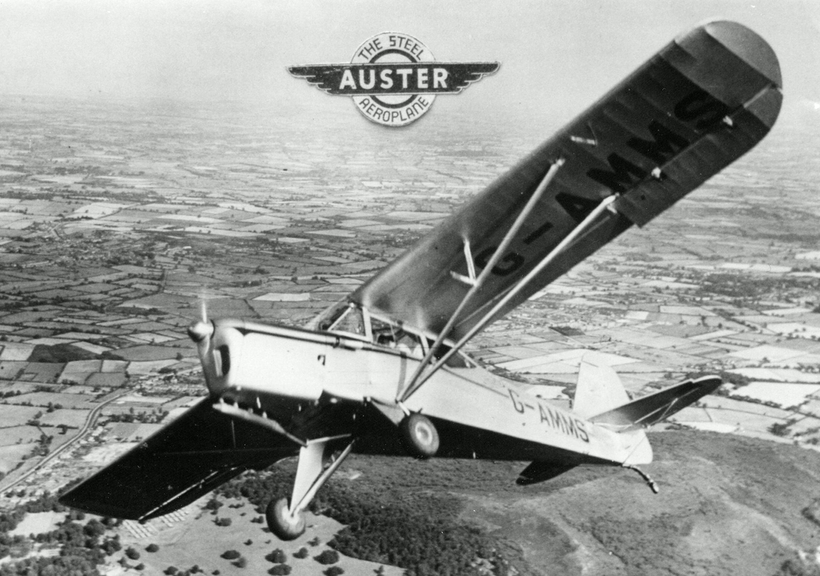
Ranald incorporated this figure into his flying routine for Farnborough and thereafter, where it became widely known as ‘The Porteous Loop’, much to Ranald’s surprise. His incredible Auster routines in the Aiglet became well-known and he won the Crazy Flying Championship during the Indian National Air rally in 1951.
During a sales trip to Japan in 1952, Ranald was compelled to give a display at an airfield named Tamagawa, where he discovered that apart from a fly-past of local Cessnas, he would be the only attraction and was expected to entertain a crowd of 20,000 for an hour and a half! Much to his relief he discovered that there would be a break in his performance for the fly-past, but it was a gruelling display where he carried out over half an hour of continuous low-level aerobatics for the crowds, “…..on landing, I was just able to totter out of the aircraft and lie flat on my back in the grass, panting and sweating like an overweight marathon runner.” An average display for Porteous in those days was no more than three of four minutes and. following the fly-past, he had to climb back aboard the aircraft and do it all over again! Following this he was asked to lead the procession of light aircraft over the centre of Tokyo in honour of Prince Akihito’s coming of Age. The arrangement was that Ranald would break off over the centre of the city and perform some aerobatics – by now he felt ‘totally punch drunk’ but came back to life on seeing the Imperial Palace. He went on to give another incredible display, the bottom of the dives and loops being virtually within the space enclosed by the palace walls. All ended well and Ranald was made an honorary member of the Japanese Pilots’ Brotherhood.
His aerobatic skills were well honed and in 1955 he placed fourth in the Lockheed Aerobatic Competition, flying a standard Aiglet Trainer against much more capable machines that gave their pilots a significant edge over Porteous. It’s a testament to his skill that he placed so highly in the competition and it was these skills in showing off the Aiglet, which lead to the machine being a success after securing lucrative overseas sales as a military trainer.
Auster and Miles merged to become Beagle in 1961 and Ranald left the company in 1968 when Beagle “went bust”. He moved back to Scotland and joined Scottish Aviation Ltd in January 1969, where he became Director of Marketing and played a central role in the Bulldog being sold to a number of countries against stiff, usually much cheaper, competition. Ranald left Scottish Aviation Ltd in 1976, along with a number of other directors, when Scottish Aviation became part of British Aerospace.
Ranald then joined Fairey Britten-Norman in January 1977, where he worked until his retirement in 1981. He sadly died, but at a ripe old age, in 1998 and left a legacy of successful light aeroplanes and his ‘own’ aerobatic manoeuvre behind him. For me, though, it is his sheer love of flight that shines through his many exploits. From ‘Memory is a Corridor ( Lined with distorting mirrors )’ printed in serial for the International Auster Club Magazine, his following words sum up his life-long love of flight, beautifully.
“The beauty of flying in the grotesque grandeur of sunlit cumulus cloudscapes never palled, nor did the wonder of bursting through heavy winter stratus into the dazzling blue and white world above. In a suitable aircraft, one could write poems of harmonised motion among the clouds, and the thrill of a perfect landing at the end of a flight never diminished. To those who are able to occasionally sample these experiences, surely the air is a segment of Paradise with its roof the very ceiling of the sky.”
Truly, a man possessed with a pilot’s mind and a poet’s heart.
With thanks and acknowledgement to the Porteous family and the International Auster Club. All above quotes taken from ‘ Memory is a Corridor’ by Ranald Logan Porteous, as printed in serial from June 2011 to June 2012 in the International Auster Club News.
 The Auster Diaries
Pingback: New Entry to ‘Pioneering Pilots’ | The Auster Diaries
I believe Ranald Porteous did some test flying of the Marendaz Trainer and became one of many collaborators of DMK Marendaz who had trouble getting his agreed payment.
I understand from Arthur Ord-Hume that RP kept an extensive file of newspaper cuttings and other documents relating to DMK.
I am currently preparing a book on Marendaz cars and would very much appreciate help in establishing contact with RP’s family,as I am sure his files, if they still exist, will be a real treasure trove of information.
Is it possible to get your assistance in this?
Best regards,
Robert M Cooper
07767 634 634
Hi Robert
Much of the information I used to compile the article was gleaned from sources on the Internet and through a series of articles written by Ranald and published posthumously in the International Auster Club News – the best starting point for your research would be to contact the Secretary of the International Auster Club, who could put you in touch with the Editor of the newsletter – he may be able to help you since Im sure the articles published in the IAC news would have been in collaboration with RPs family.
Thanks for getting in touch and best of luck!
Belated thanks for the suggestion. Have only just seen this!
Robert
Ranald Porteous taught my aunt Joyce Ratcliffe to fly at Derby Aero Club, and her husband the surgeon James Ratcliffe. They owned an Auster G-AJIY for a number of years and used it for pleasure as well as to fly to medical conferences.
My mum used to fly as an observer with Porteus in the early 50’s until my dad, who also worked at Auster persuaded her it was too dangerous.
As a young chap I stood beside the fence at the Farnborough Air Displays in the 1950s – and watched as the crowd gasped at Ranald Porteous’s aerobatics in the AOP 9. Rumours were about that pilots were watching much slowed down films of RP’s “‘Avalanches” to try to copy the routine. It was also said that the AOP 9 he flew was completely standard with no modifications.
My recollection is.of RP’s AOP 9 seemingly poised stationary in the air while he turned the machine inside out. He then allowed the aircraft to drop into a spin (almost flat) and to recover a few feet above the ground from where he alighted onto the runway gently as a butterfly. Not done, he then took off straight across the runway, climbed up and did it all over again. This time he got laughs from the crowd as he landed first on one mainwheel and then on the other and so it went on.
I was privileged to know and work with Ranald at Fairey Britten-Norman in the late 70s which he joined as Military Sales Manager. Latterly, as General Sales Manager, Ranald was always enormously helpful with advice born of a distinguished career as a superb pilot and former Marketing Director of Scottish Aviation.
We both shared a love of poetry and Ranald would often slip a Limerick or other verse under my office door. We kept in touch until his sad death in 1998. His widow, Susan, kindly sent me a copy of all his poems which were bound and presented to him.
I quote from one of these:-
’All aeroplanes bite fools’, it is said,
A simple truth which no-one need explain.
Though fools rush in where angels fear to tread:
-Only a fool would bite an aeroplane!
Wonderful wee story Robert. Thanks for sharing! Always great to hear from folk who were connected personally in some way to some of the things I’ve written about here. Happy landings to you.