
Captain David Barclay, likewise, did not form his own airline as Fresson had, but his
legacy as a prominent pilot in the pioneering decade of the 1930s is just as impressive. After learning to fly with the Scottish Flying Club at Renfrew in 1927, near to where he grew up in Greenock, he joined the RAF and was posted out to India, flying patrols along the North – West frontier with Afghanistan.
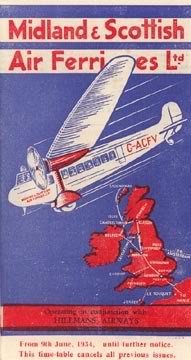
He was posted back to the UK in 1934 and decided to leave the RAF and look for employment with the airlines that were starting to become established. He spent time as an instructor with the Scottish Flying Club at Renfrew again, until an offer of employment came from John Sword’s pioneering Airline, Midland and Scottish Air Ferries, which established the first scheduled air services in Scotland, connecting the islands of the west coast with Glasgow out of their base at Renfrew.
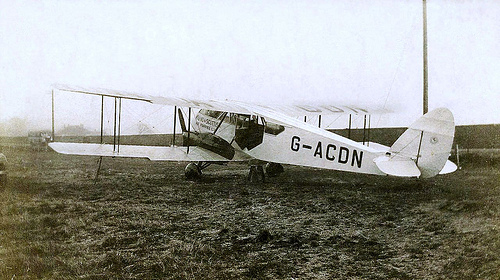
Barclay cut his teeth on the west coast flying the Renfrew –Campbeltown – Islay service in the ubiquitous and now classic Dragon Rapide.
He was later employed by Northern and Scottish Airways, which formed in 1935 out of Midland and Scottish Air Ferries after its demise. He surveyed the Western Isles in the search for suitable landing grounds in the company’s bid to expand their network, carrying out the first routine and regular landings on Skye behind the hotel at Broadford, as well as at a site at Glen Brittle, which is a relatively flat and very picturesque area at the foot of the imposing Cuillin mountains, and prone to some horrendous winds. Ground handling the relatively light Dragon Rapides that were in use at this site could prove very difficult and on two occasions, aeroplanes were badly damaged in the squalls and violent gusts spilling down from the Cuillin.
Barclay also carried out the first landing on Tiree at the beach in Gott Bay and regularly used the beach near Northbay on the Isle of Barra, in his increasing involvement with the Air Ambulance Service that had been taken on by Northern and Scottish. The beach airport at Barra is famous amongst aviation geeks and the public alike now; a refreshing change from the modern world of vast tarmac airports, with their shopping malls and food courts and still used for both scheduled air services and Air Ambulance flights to this day.
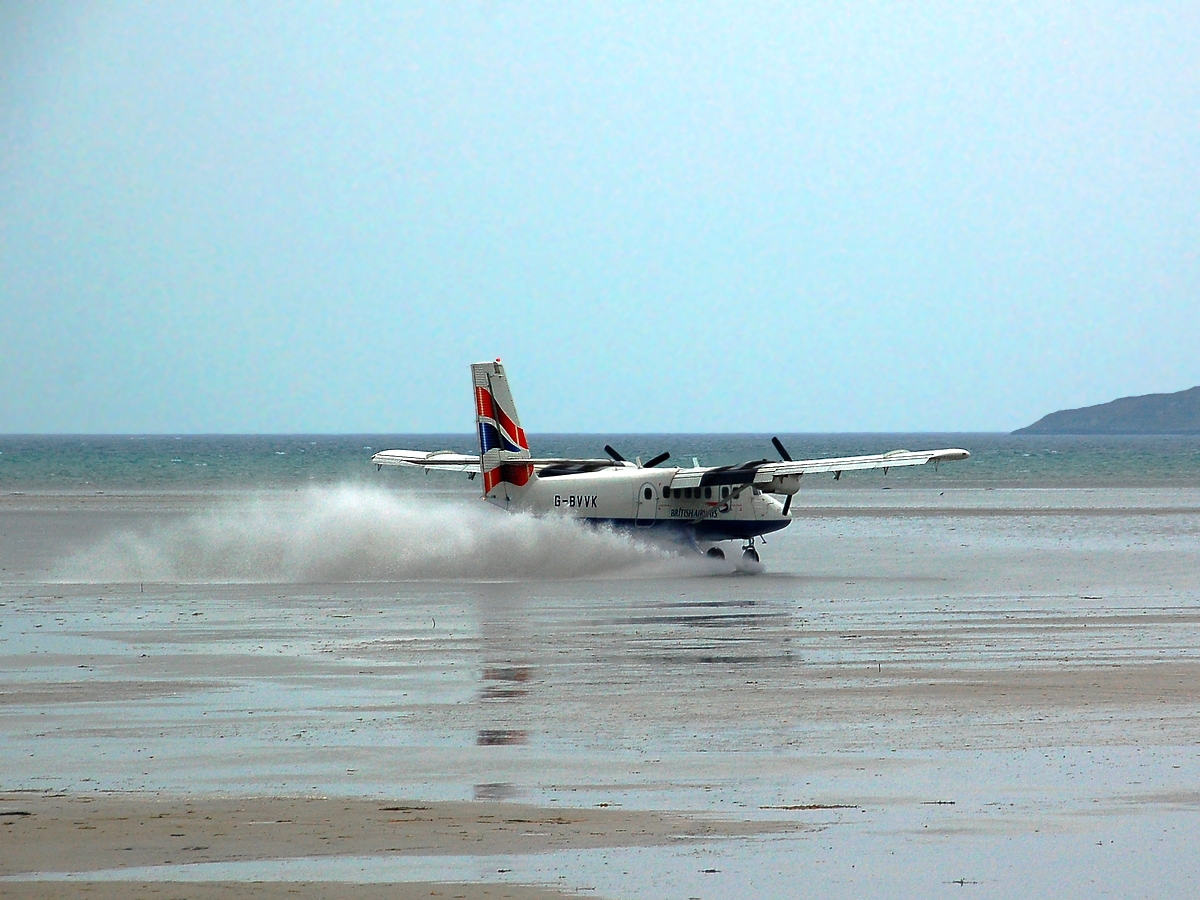
Barclay became synonymous with the Air Ambulance services for the Western Isles, carrying out almost 1300 life-saving missions by day and night in often atrocious weather conditions, leaving an impressive legacy that lives on with the modern-day Scottish Ambulance Service flights, now operated out of Aberdeen, Inverness and Glasgow Airports.
He went on to become the base manager at Renfrew and continued flying with the
state-owned British European Airways until his retirement in April 1965; a much respected figure and something of a legend in Scottish Aviation.
A Scottish Airways sales brochure from 1939 describes him as being “small, brown-faced, clear-eyed,” and “wrestling all the time with the dirty weather of the western seaboard.” It is clear that he was a respected figure within the company and his role and experience is cited frequently. The same sales brochure goes on to say that “Captain
David Barclay has been so long on the job that he knows every conceivable landing
place from the Mull of Kintyre to the Butt of Lewis.”
It also describes some of the difficulties faced by the Air Ambulance pilots
operating on the west coast of Scotland, carrying out flights that today are much more likely to be achieved using state of the art Search and Rescue helicopters, due to the difficult nature of some of the landing grounds. “Sometimes the pilot has to use a mere strip of wet beach, a runway indicated by the doctor himself, or even to discover a small field that will serve in the emergency.”
Although the base airfield at Renfrew could provide radio bearings to the Wireless
Operator on board the aircraft, a technique which Barclay also pioneered on the west coast, finding these remote landing grounds in challenging weather and often at night would have been a very demanding task indeed and it is testament to the skills of Barclay and the other Air Ambulance pilots that the service held such a good safety record throughout the period.
It is said that Barclay never tired of the vistas coming in to Tiree and Islay over
the mountains, always seeing something different or new, even after all his years of airline flying, almost without exception, over Scotland’s coasts and mountains. Many other pilots left after a few years for the larger, globe spanning airlines that were emerging following WWII, but Barclay stayed close to the flying he loved, intimately connected with the landscape he came to know so well and to the people he served in the many flights of his long career.
In ‘Wings Over The Glens’ by Peter V. Clegg we get a sense of the draw that flying in
this part of the world held for Barclay: “Heading westwards in the morning sun with the sun illuminating all the ground in front, or eastwards on the way back into the sun, and the shadowy side of the mountains; each flight was like a pilgrimage for David. In the mornings, the sea around the Uists could be turquoise green and the sands at Barra like
shining coral; in the evening the inlets and islands near the mainland could be pools of deep purple in a blazing red and orange sky.”

By the time he retired in 1965 he had flown an amazing total of 17, 349 hours and
40 minutes in his civil career alone. In 1944 he was appointed an M.B.E and during his time flying the many Air Ambulance missions of the British European Airways years, was made a member of the Order of St. John of Jerusalem. Many of the landing sites that he surveyed and established across the region are still in use and his ground breaking work paved the way for the years to come.
 The Auster Diaries