
Fun Flying on a Budget
Copyright ‘The Auster Diaries’ (www.theausterdiaries.com)
(As appeared in the February 2013 issue of Light Aviation)

The increasing costs of aircraft ownership on a Certificate of Airworthiness combined with ever rising fuel costs, is turning many pilots in the UK away from Group A flying. Indeed, simply maintaining a traditional PPL licence in the UK is a costly business. Unsurprisingly, the microlight and Light Sport market is growing and membership of the LAA is also on the rise, as pilots look for more affordable ways to keep flying while the uncertain clouds of EASA loom on the horizon.
I am no exception to this, but spending years building an aeroplane or flying microlights holds less attraction for me than traditional Group A aeroplanes. I am drawn especially to vintage aircraft, which have a bit of a reputation for being troublesome and costly to operate, but this is not necessarily the case. Looking to the vintage market is a viable way to gain access to some great flying in some interesting types, whilst also keeping costs down. A share in a Luscombe Silvair, Piper Cub or Jodel on a Permit is a great way to fly without spending a small fortune. One vintage aircraft that I am particularly fond of and which has been added to the LAA list in recent years is the venerable old Auster.
I am based in the North East of Scotland and group shares are hard to come by. Luckily, there is a long running Auster group in the area that has been providing a steady stream of pilots with fun, affordable flying for years and I joined the syndicate in June 2010. The aircraft is based at a farm strip, nestled inconspicuously about 7 miles north of Aberdeen airport in the rolling green fields and hills of the countryside. It is just a 10-minute drive from my house, so a share in this Auster was ideal. G-AIJT, or ‘JT’, as she is known, is a modified J4 and seemed almost too good to be true at just fifty pounds a month and forty-five pounds per flying hour, inclusive of fuel. At rates like these, exploring Scotland’s islands, mountains and coastlines by air without breaking the bank is a very real prospect and in the time that I have been a member of the group, I’ve been able to do just that and more besides.
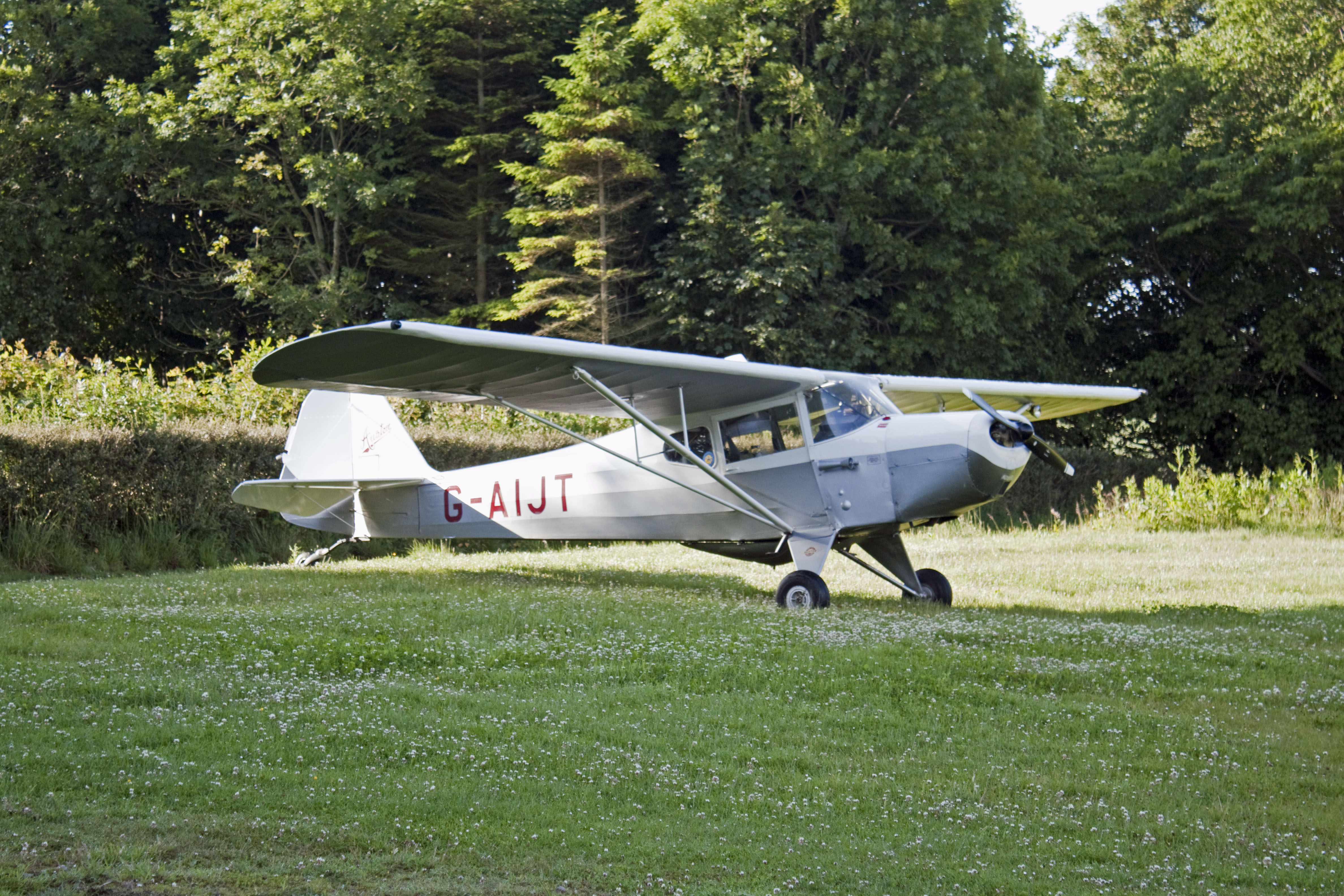
Austers come in many guises and have their origins in the American Taylorcraft Aircraft Corporation, who supplied the Taylorcraft ‘Auster’ observation plane for the UK and Commonwealth armed forces throughout World War II. The UK branch of the company built them under licence in Leicester. After the war, the UK Taylorcraft Company became the ‘Auster Aircraft Company’ who continued to manufacture aircraft derived from the early Taylorcraft. The word ‘Auster’ itself is the Latin for ‘South Wind’ and that alone, seems to appeal to even the most unromantic of pilots.
The models used during World War II had, for the time, excellent short field take-off and landing capabilities. This was perfect for getting in and out of unprepared landing strips. After the War, the newly produced Auster variants were used as basic training and touring aircraft. They were a common sight at most flying clubs around the UK and in some of their guises, made handsome private aircraft. The lovely Auster Autocrat is one such example.

Auster Autocrat
Our particular Auster, however, has a long and chequered history and is what you might describe as well used, rather than much loved. It is on its second pair of wings and third engine: an O – 200 Rolls Royce Continental driving a fixed pitch propeller. Despite being more economical and reliable than the original Blackburn Cirrus Minor engine, the Continental is sadly lacking in what is commonly referred to as ‘grunt’, having only 100 hp to drag 1650 lbs of reluctant aeroplane into the air. JT is consequently underpowered and every departure from the strip is a mini-adventure that reminds me of some fat old seagull trying to get airborne, overloaded with fish or discarded junk food!
Although take-off performance is poor, once airborne, there seems no finer way to take in the beauty of the countryside than by drifting happily along with the clouds in this old and shabby aeroplane. A slow cruise affords plenty of time to take in the view and in the air the Auster feels stable and solid. These attributes, together with the high wing, means that it’s an aeroplane that you can really take the sights in with.
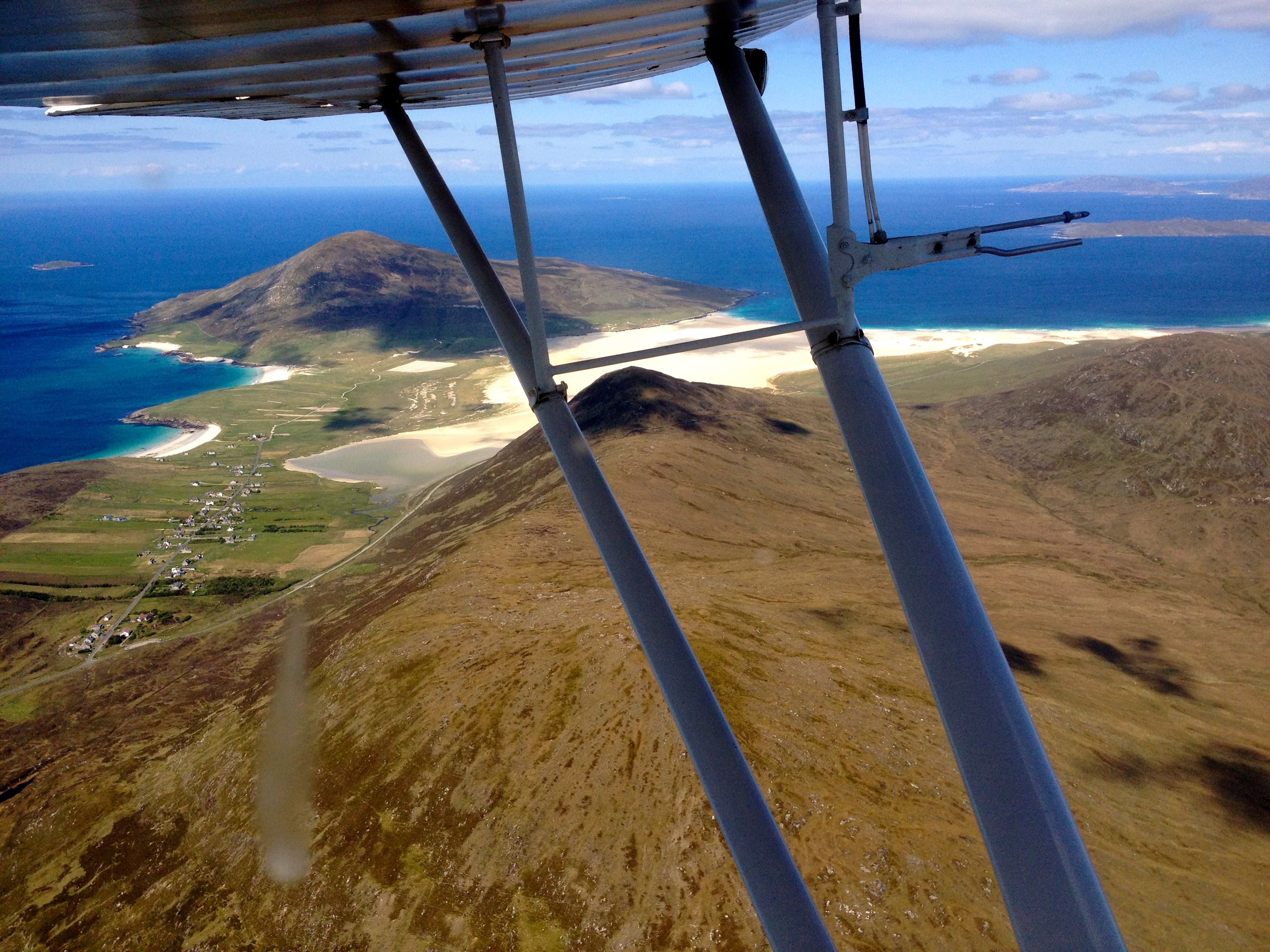
One of the great benefits of the Auster is that she can stay airborne for around 5 hours, carrying two adults and some overnight gear and burning just 20 to 25 litres an hour (note that fuel consumption will vary depending on Mark and many Austers are fitted with Gipsy Major engines). That’s more than can be said of a lot of kit-built or microlight aircraft, which would struggle to offer that sort of payload within their weight restrictions.
The cockpit, however, is a different story. It becomes quite cramped on long journeys with two on-board and with the exception of a few retrofitted modern items is straight out of 1946. The instrument panel seems very antiquated and still has the original clock. The old fashioned ship’s, or ‘P’ type compass, is fitted to the floor between the two seats and is awkward to see and use. All the switches and circuit breakers are made of Bakelite and must be handled with care as the material is very brittle. Just getting into the machine, which predates modern ergonomic design principals, without injury or strain, let alone any semblance of grace or decorum, is an act worthy of applause upon completion.

Each side of the cockpit has a long control column that comes from a bell crank arrangement from under the instrument cowl, just aft of the firewall. There is a central throttle lever and mixture control with a carb’ and cabin heat selector. Rudder pedals are fitted to each side, also, with heel-operated brakes on the pilot side only. Heel brakes are justly unpopular; they are awkward to use and take a while to get used to as they cannot be used in unison with the rudder. The pilot must take pressure away from the rudder pedal on to the brake in order to steer during taxiing. They’re not as bad as the set up on some other older types, however and heel brakes are better than no brakes!
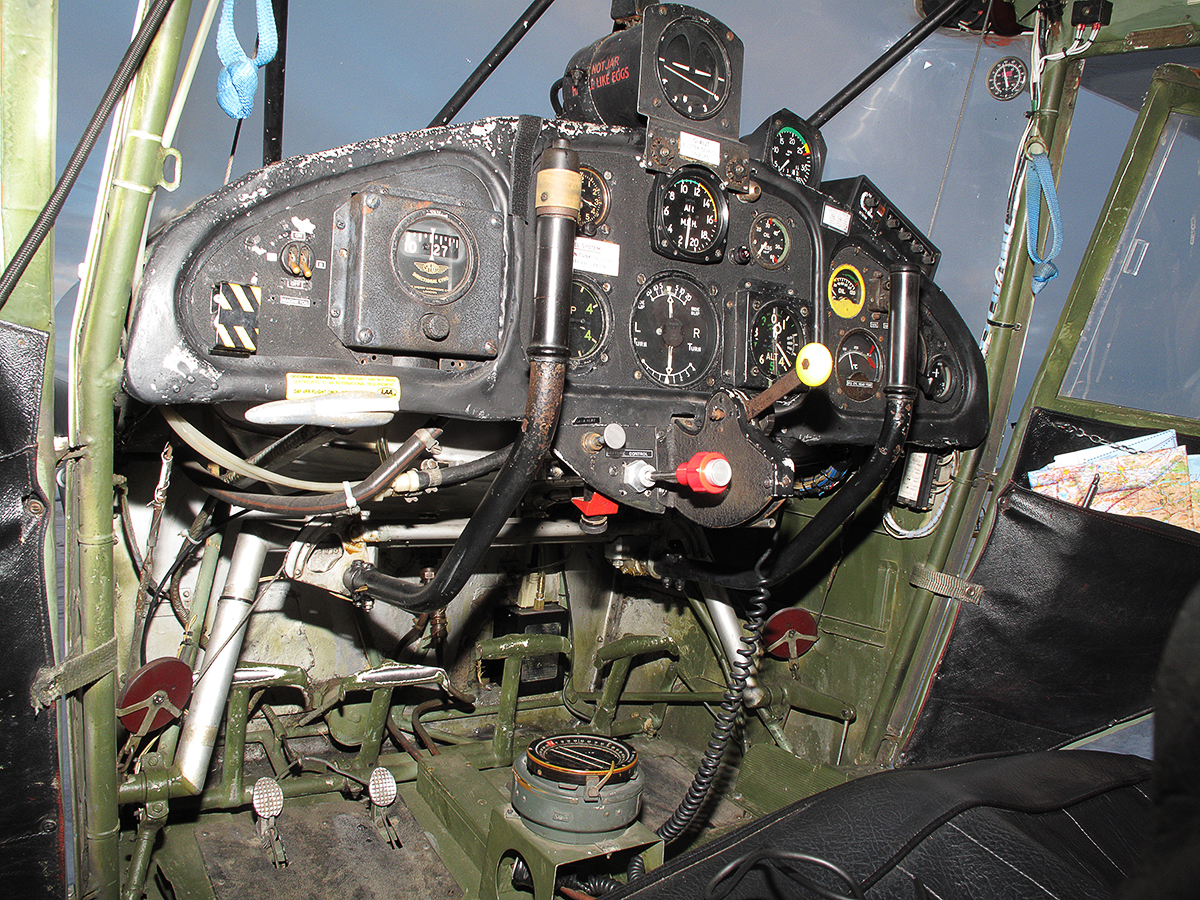
Cockpit Ergonomics 1940’s style. Photograph Courtesy of Wallace Shackleton – click on the photo to see more by Wallace.
Elevator trim is adjusted using a small trim lever on the upper left hand side of the roof panel, which never seems to stay in the position you want it in. For the cruise, we keep ours in place with a small bungee chord, otherwise it gradually applies nose up trim. Visibility to the side and often above, is good, with a clear centre wing section on many variants, though the view ahead is always fairly poor, as with most tail-wheel aircraft.
To fly, the Auster certainly doesn’t have the performance or ease of handling of modern aircraft and it takes a little while to get used to, demanding a little more skill from the pilot, perhaps, than most modern machines. The control harmony is typical of the era, with a powerful rudder, heavy elevator and sluggish ailerons (moving the stick rapidly left and right has no effect whatsoever, such is the slack in the cable operated control runs), which produce huge amounts of adverse yaw.
On take-off and landing, Austers have a tendency to bounce and if not careful, a Pilot Induced Oscillation can easily develop. Upon landing, it’s important to tuck the stick right back in to the lap to prevent this. In a crosswind, especially on the ground run, the pilot must be vigilant to hold a wing into the wind to prevent unwanted drift and roll. The low wing loading makes the aircraft sensitive to any gusts and even in a relatively benign 10-knot crosswind; almost full aileron deflection is required to prevent a wing from lifting.
Having no flaps (on this particular model) makes for very flat approaches. This is compounded by a slow approach speed of around 50 mph, which further reduces the already poor view ahead. These very flat, slow approaches also take a while to adjust to when converting to type. Coming in even just a little steep or fast to improve the view will only result in endless floating that eats up runway like there’s no tomorrow. To begin with, it’s fair to say that the Auster does seem to be a bit of an ungainly handful.
After a few hours however, you get used to the terrible performance, the sluggish feel of the controls and the way some Austers just won’t climb if you don’t hold the rudder perfectly in balance! What you also discover is that this cumbersome old machine can be flown very safely, very slowly (the stall speed is just 38 mph!) and plucked from the ground on short airstrips at just above the stall speed. In this way, the pilot can hold the aircraft just a few feet above the surface to accelerate in ground effect before climbing safely away, thereby shortening the Take-off distance required.
An Auster is certainly not the sort of machine that is going to impress. Neither is it going to get you anywhere particularly quickly with a cruise speed of a little over 80 mph, but, it’s a plane of old; a real stick and rudder machine with a proud lineage and it’s always fun to fly. Ironically, it’s the very lack of performance that makes it so much fun and coaxing old JT in and out of various grass airfields has been more satisfying than I ever imagined it could be.
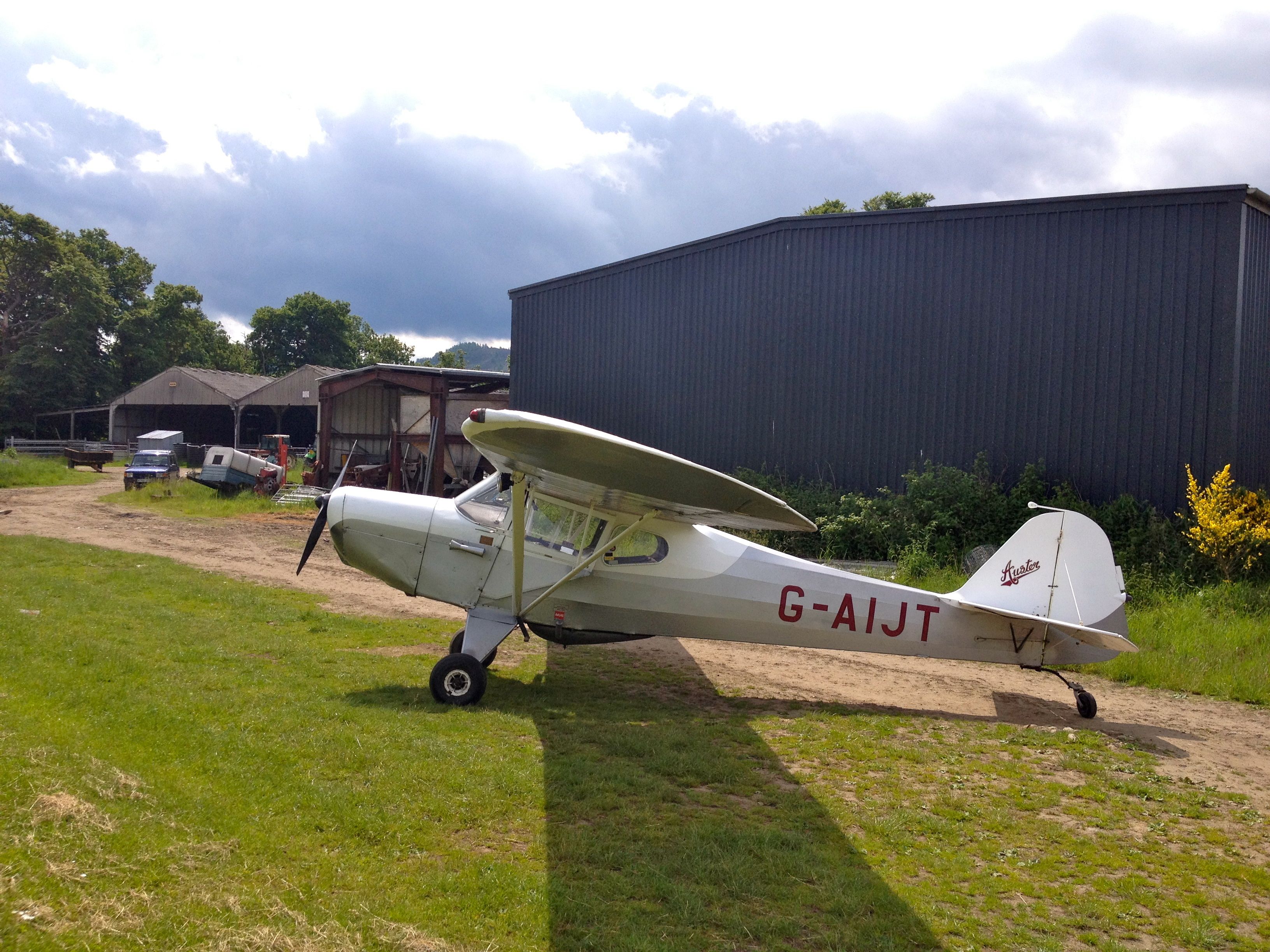
In the wider area around Aberdeen, there are a surprising number of small and virtually unknown private grass airstrips that are an absolute antidote to the stress of work and life. Most of them are simply mown strips in fields, carved out by an enthusiastic farmer with a love for aviation. They don’t appear on the charts, there is no terminal, no handling agents or security fences – just a field hidden away in the beautiful folds of the countryside. A modern pilot can, for a brief hour or two, fly as they did in the early years – slip down quietly into a field at their own risk in complete freedom and with the blessing of the landowner. It is quite simply, bliss: no radios, no high visibility vests and no landing charges! To land in a field on a sunny day with nothing but the sound of the birds after you shut down the engine, is an experience, sadly, that many modern pilots miss out on. Having a share in an aeroplane like an Auster brings all these things with it, because it’s in these sorts of places that the Auster and other vintage aeroplanes are most at home.

Of course, it’s not all been happy days and farm strips. Since joining the group in June 2010, we’ve been plagued with fuel leaks from the valves between the two tanks, generator problems (it has a very old fashioned Generator and Regulator set up) and a bill for over £5000 during its permit renewal early in 2011 when a number of outstanding issues were fettled. The latest issue is a blown exhaust gasket and a need to replace an exhaust shroud that has to be specially built from scratch, since they are not made anymore and there are no plans available!
All this is part and parcel of operating an old type and with the charm of flying an old aeroplane comes a host of maintenance difficulties that sometimes try your patience. However, although the problems have been unwelcome, even the major cost at the last annual was easily dealt with by utilising accrued funds within the group account and splitting the remainder six ways. In a well-run syndicate, the occasional obstacles are never enough to keep you out the air for very long and on the whole, the fun of flying the machine has outweighed the hassle of keeping it airworthy.
One of the great highlights of the 2011 summer flying season was taking JT down to North Weald for the British Classics Fly-in organised by Air Britain. This event celebrated 65 years of the Auster and Chipmunk, as well as 50 years of the Beagle Terrier and Rollinson Condor. JT was manufactured in 1946, so this really was her 65th birthday celebration and despite being hampered with generator problems in the weeks leading up to the event we managed to have her ready in time.
Myself and another syndicate member had booked the machine for the weekend of the Fly-in, but we never really expected the trip to go ahead. Scotland is not exactly famed for its fair weather, but to find that the forecast had the whole country in sunshine and light winds for the entire weekend was unbelievable – we even had a tail wind both ways! Those sorts of odds come together perhaps once a decade and so off we went.
What a trip it was, too: 1002 nm over the weekend and 12 hours and 40 minutes flying. It took a while for our backsides to recover from spending that amount of time on the Auster’s uncomfortable seats and I think I did my back permanent damage, but the chance to fly down the length of Britain was something I wouldn’t have missed for anything. We flew along wide stretches of glittering coastline and over famous landmarks like the Fourth Road Bridge, the viaduct at Berwick on Tweed, Bamburgh castle and the Holy Isle. Being greeted on arrival at Weald by the sight of a colourful line up of lovingly maintained Austers was the icing on an already very tasty cake. We also made some great new friends in the members of the International Auster Club, won two trophies (one for the longest flight and one for the ‘Spirit of the Fly-In’ award – they must have said – ‘How far? In that thing! ‘) and found a renewed love for our shabby old Auster. JT, laden with fuel and coping with the hot weather over that weekend, hauled us safely all the way without missing a beat from its hard working little Continental engine.
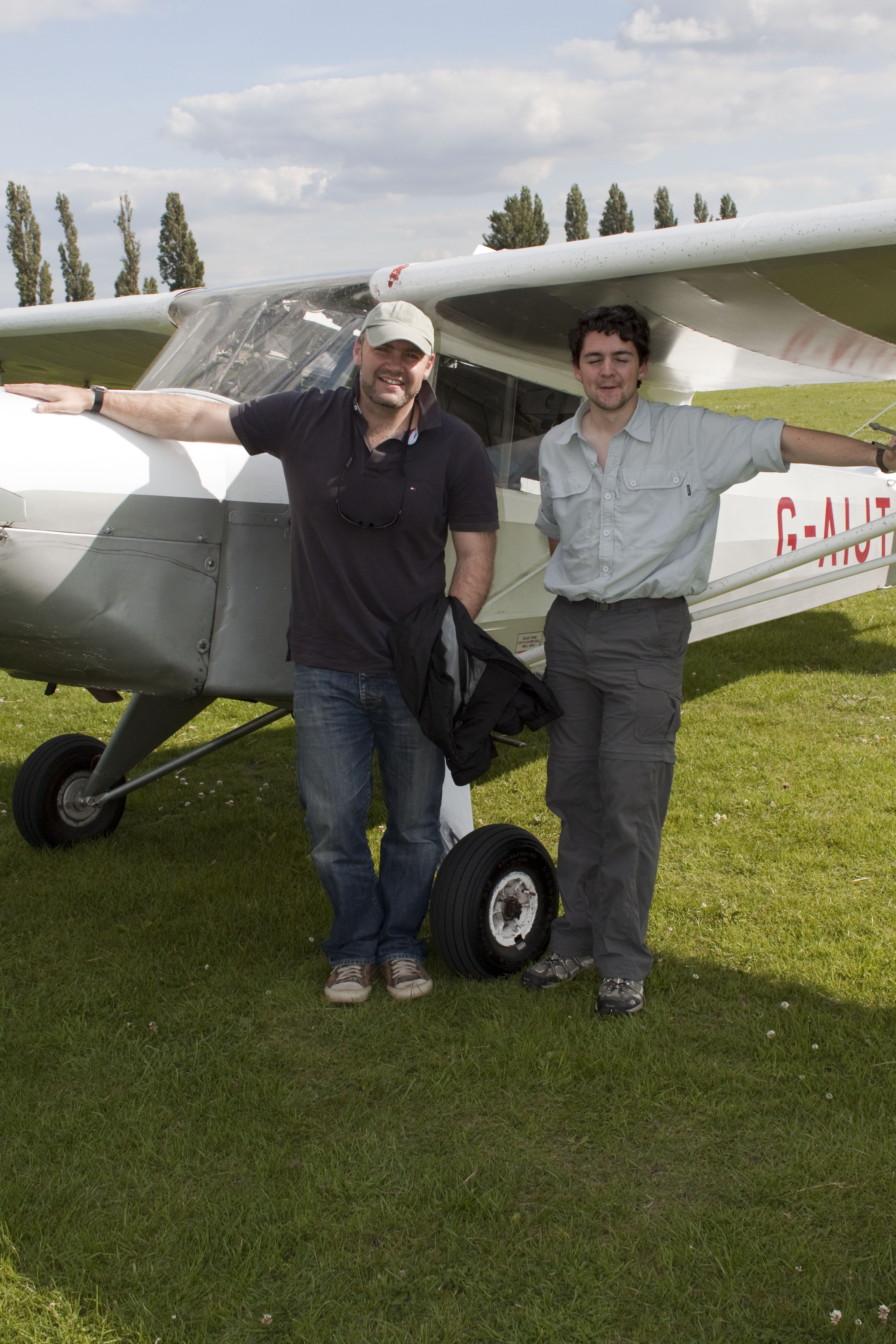
Happy pilots! On arrival at Weald
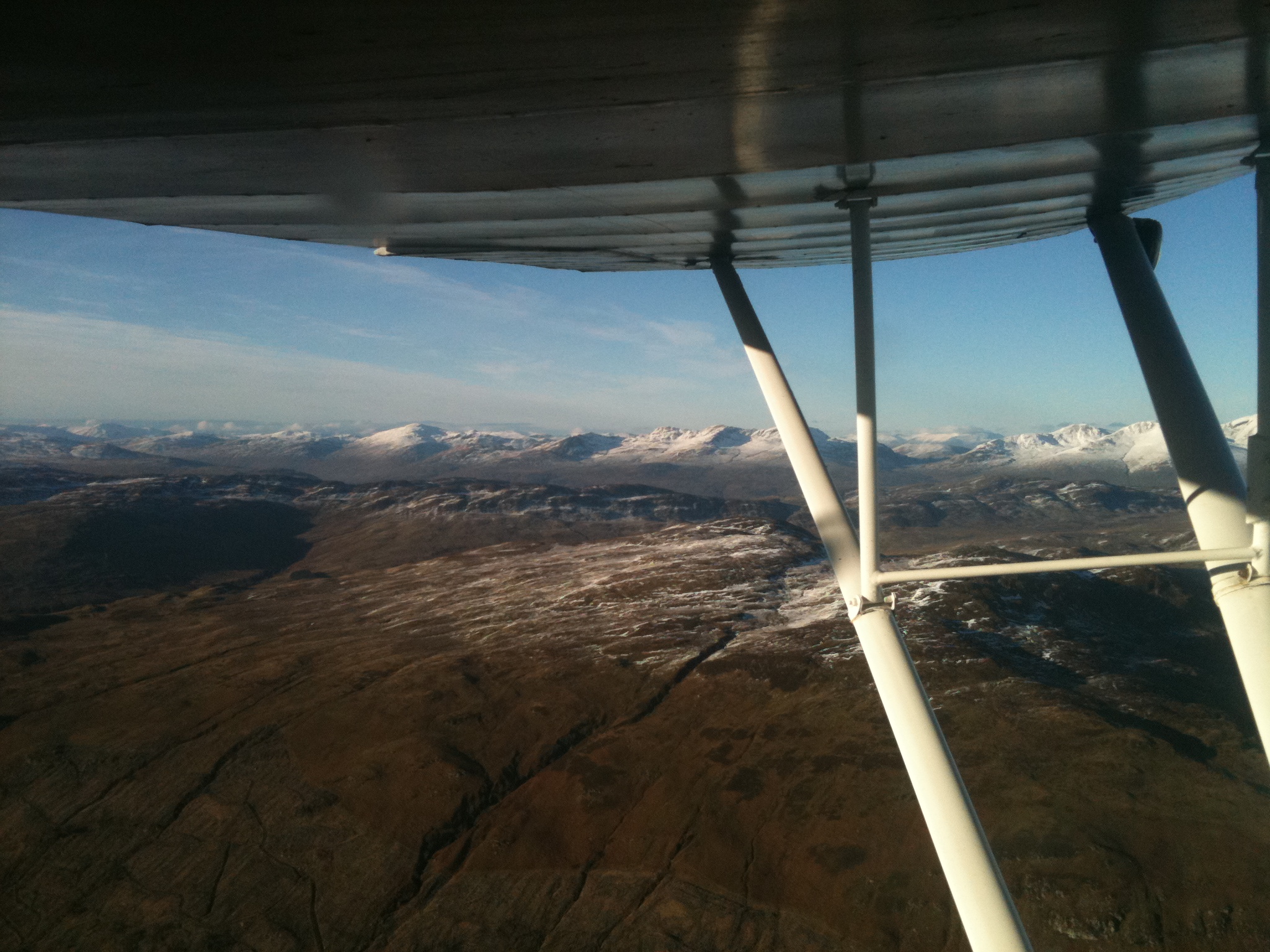
The Auster has given me many memorable flights besides that Weald trip. I’ve been able to fly through the mountains over to the west coast of Scotland, with snow covered peaks drifting past my wings and have looked out across the mist veiled waters of Loch Awe in evening light. I’ve flown along empty beaches and over the golden crops of summer and I’ve learned that flying an old aeroplane offers just as much access to the skies as any modern machine.

I’ve also found that old aeroplanes can improve your handling skills and make you a better pilot. Vintage aircraft are very good teachers because flying one forces you to fly accurately and efficiently. This is what they demand if you’re going to get out of a short strip, or make a nice landing on tarmac, or even make a reasonable job of turning. They can offer bucket-loads of fun at bargain basement prices and being a member of the Auster syndicate has not only kept my handling skills up, it has introduced me to a wider community of happy fliers out-with the busy tarmac runways and airfields, who fly in the simple spirit of what recreational flying is all about.
Vintage flying can be frustrating at times, but when it all comes together in a well run group, it will put a smile on your face that lasts and perhaps more to the point, hasn’t cost you a small fortune. In the first twelve months of being in the Auster syndicate, I flew just over 30 hours, which worked out at £85.00 an hour. That mix of maximum fun for minimal cost is very hard to find and I’m not sure that I could better it in other areas of Light Aviation.
So if you’re looking for fun flying on a budget, why not consider a share in a vintage aeroplane like the Auster? You will be helping to keep a piece of flying history alive and you will find new delight in the rewards that vintage flying can offer. There is the satisfaction of a well-executed three-point landing, or coaxing an underpowered flying machine into the air from some hidden farm strip, with nothing but the breeze and the birds for an audience. You will soon discover that these kinds of flying experiences are worth a whole lot more than the price you are paying for them and for my money, that kind of value takes some beating.

 The Auster Diaries
Pingback: New article added | The Auster Diaries
Hello there,
I’m delighted to read about your Auster and flying over all that beautiful landscape. Inspiring! I’m so glad you’re flying this wonderful aircraft in open skies!
I noticed that in the picture of the cockpit you have what looks like a P8 compass on a square sided stand. Was that original Auster equipment? I ask because I have just the same sort of stand and I have no idea what it came from. It is stamped RCAF (just to add confusion) on the corrector, which swings down on a hinged flap. Any help on its provenance would be most gratefully accepted!
All best wishes,
Allan
Allan Hunter
Hi Allan – thanks for getting in touch – as far as I know this is original fit, but can’t give you any info beyond that – there’s also an interesting 8 day clock fitted, the type found on a lot of RAF aircraft of the period, but JT is a civvy variant built for training and touring and has no military provenance – she’s been through many hands and over the years all sorts of kit may have been picked up and fitted retrospectively – sorry I can’t be of more help. It certainly adds to the charm of flying her though – something I haven’t done for about 6 years… She is still flying though – out of the same strip and now fitted with a variable pitch prop! I may have to go and reacquaint myself with her again.