
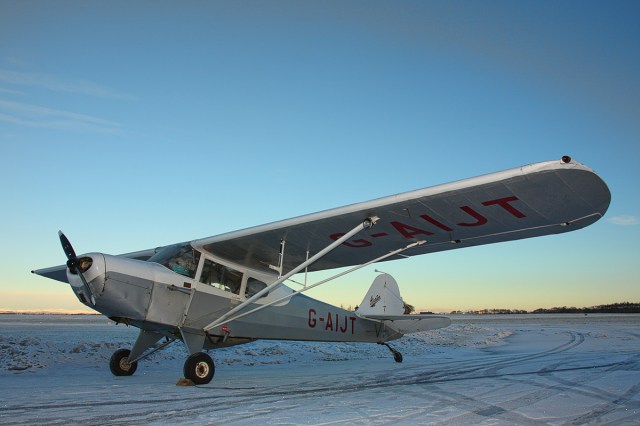
JT at Scone in the snow – Photograph Courtesy Of Wallace Shackleton – click on the photo to see more pictures by Wallace.
JT is operated by a syndicate that has had many members over the years. The current membership stands at four pilots, who fly JT to varying degrees mostly around Scotland, although two of the longer standing members did take her all the way to, and around, France and back! JT is, therefore, no ‘Concours D’Elegance’ prize contender, but neither is she a hangar Queen and most importantly, she is still doing now what she was built to do back in 1946; something, I think, those who built her would be proud of. Here’s a little history:
The following is taken from the Pilot Notes for ‘JT’.
The Auster MK 5 series J/4 registration G-AIJT, constructors number 2075 was built by the Auster Aircraft Company. It first flew with a Blackburn Cirrus Minor Series 1 engine on 20th December 1946.
The aeroplane was grounded from September 1949 to March 1954, when after C of A renewal it was flown regularly until February 1955. The C of A was renewed and in March 1955 it was taken over by the RCAF and used by the Canuck Flying Club in France until September 1959. By this time the total time on the aeroplane was 556 hours. The C of A was renewed in August 1960 and it was flown in Norfolk regularly as a club aircraft. The original engine was replaced in September 1962 at 797 hours.
During this period it was maintained under the Royal Aero Club Maintenance Schedule R. Ae. C. 3 (Issue 2). A Murphy TR41A radio was fitted at Biggin Hill in April 1966 and the aeroplane sold to the Merlin Flying Club at Hucknall in January 1967 at 1079 airframe hours.
The next C of A took 11 months, from February 1967 until January 1968 and involved a complete recover of the entire structure. However, by August 1968 the aeroplane was withdrawn from service at 1246 airframe hours due to low engine oil pressure and metal in the filters. 12 to 14 psi was recorded in climb at 2150 rpm.
The conversion to 5/J4-100, with an 0-200A Rolls Royce Continental engine was complete by March 1970. During the enforced lay-up the mainplanes were removed and fitted to G-AIPH. The mainplanes ex-G-AIPH were stripped, overhauled, recovered and fitted to G-AIJT.
JT flew intensively as a club aeroplane reaching 2085 airframe hours by December 1971 when it was overturned whilst taxying in gusty conditions. Repair work was combined with the two yearly inspection for renewal of the C of A and was completed in May 1972.
The next C of A, at 2968 airframe hours in April 1974 took four months, the first engine was replaced in May 1975 at 3338 airframe hours. At 3860 airframe hours the Murphy VHF was removed and a Narco Com 11A fitted, the C of A in August 1976 ay 3907 airframe hours took 4 months.
The aeroplane flew regularly with the Merline Flying Club until being sold to the Aberdeen Flying Group in March 1978 at 4206 airframe hours.
In December 1978 at 4299 airframe hours the aeroplane underwent a lengthy C of A renewal which was not completed until March 1980 due to poor organisation by group members. In July 1981 ownership passed to the Aberdeen Auster Flying Group.
Twelve months later, in July 1982 a major failure occurred whilst starting the engine. Having replaced the engine with a completely overhauled unit the aeroplane was put through its C of A in March to July 1983. After an active year the starter pinion gear disintegrated in the new engine resulting in removal, complete strip down and rebuild of the engine during October 1984.
The aeroplane was dismantled in April 1985 when the fuselage, rudder, tailplanes, elevators and undercarriage were shipped down and re-covered. General condition was good, a minor cracked weld in the sternpost was repaired. JT was flown for 40 hours in September/October 1985 before being hangared at Perth for the winter.
On its return to Aboyne in April 1986 it was dismantled and mainplanes and ailerons recovered in Ceconite 102 with butyrate dope. With a certificate of Fitness for flight issued on 13 September it was flown to Glenrothes for C of A renewal by J.E. Heywood Ltd. This was completed and the aeroplane test flown and released to service on 8th October 1986.
It continued to fly extensively as an active group aircraft in Scotland from this point, almost un-interrupted until July 2004, when it suffered damage to its port undercarriage, right wing and prop, following a forced landing due to engine failure. The engine failure was related to Carburettor icing resulting from a worn carb’ heat detent at the butterfly valve spindle.
The undercarriage leg was replaced, the right wing repaired and re-sprayed (the whole airframe had been re-painted in approx 2001) and the engine overhauled. A new McAuley metal prop was also fitted. The aircraft was transferred from its Private Category CofA to an LAA Permit to Fly in 2009.
It now resides mostly at a little known grass strip north of Aberdeen where it continues to provide service and pleasure to those that are fortunate enough to fly her.
 The Auster Diaries
I was involved with the conversion to O-200 at Hucknall and made some of the components including mixture knob and engine baffles.I did my second solo on this aeroplane befure its conversion(my first solo being on G-AIPH).
Happy days.
Stuart Jones.
Good to hear from you Stuart! It’s always nice to get a chance to make contact with people who have a history with the machine – your mixture knob is alive and well and still doing a good job! 🙂 Get in touch if you’re ever in the NE of Scotland and we can go for a flight.
Hi, I just found your website and was very pleased as I am restoring G-AIJS (JTs older brother !)and have taken the J4 to heart as well, so its great to see that one of the few airworthy ones is keeping busy. I enjoyed the article (well done for the flight, fancy a visit to Moret Episy south of Paris in May?) as well and it was a shame I missed North Weald, but living in France nr Paris I have to choose the fly ins in advance and this year I went to the AGM at Old Warden. I also started a website but havent had time to update it recently, and I have done an article for the next mag on French Austers, and will do another on the restoration of JS in the future. If you want more info on IJS or J4s please feel free to drop me an email.
Cheers
Roger
Great to hear from you Roger! How far into the restoration are you? A trip to France sounds like fun! Give me the dates and I’ll see if I can make it. Might take a cushion this time, though!
I was delighted to discover this website and the fact that JT is still flying through he recent article in Pilot. I flew JT in 1970 and ’71 from Hucknall as a memeber of the Rolls Royce flying club. Many happy hours at 48shillings an hour wet! I remember flying her on a tour of the Southwest down to Perranporth. No heater or radio. Permission to land by very pistol fromthe tower, a different age. On the way back we encountered an F4 Phantom which passed below us in the opposite direction in flash as we pottered along at 80kt. The a/c had recently had the Continental engine fitted but had not been re-trimmed which led to interesting yaw characteristics depending on which way you turned! I assume that was fixed a long time ago. Do look after the old girl, she provided some of my formative flying experiences!
Tony
Tony – thanks so much for getting in touch. I love hearing from other Auster pilots and especially those who flew JT. Wow – 48 shillings an hour! She’s still pretty affordable and yaw control, well, still interesting so either that’s just me or they never did sort it! 🙂 Once again – very good of you to get in touch and a pleasure to read your experiences with the old thing.
All the best and happy landings!
The engine prior to the Continental rotated in the opposite direction so the torque effects were reversed with the new engine.A modest investment in getting her re-trimmed might produce a much sweeter handling a/c. I remember it required full rudder to compensate yaw turning in one direction and absolutely none in the other. Is that still the cae? I will see if I have got soem old photos for your archive.
Tony
Thankfully no! Must have been re trimmed years ago and glad it was, she can be enough of a handful as it is at times 😄 Very grateful for any pictures you might have and if you don’t mind, Ill post your first message up in the Memory Lane section?